
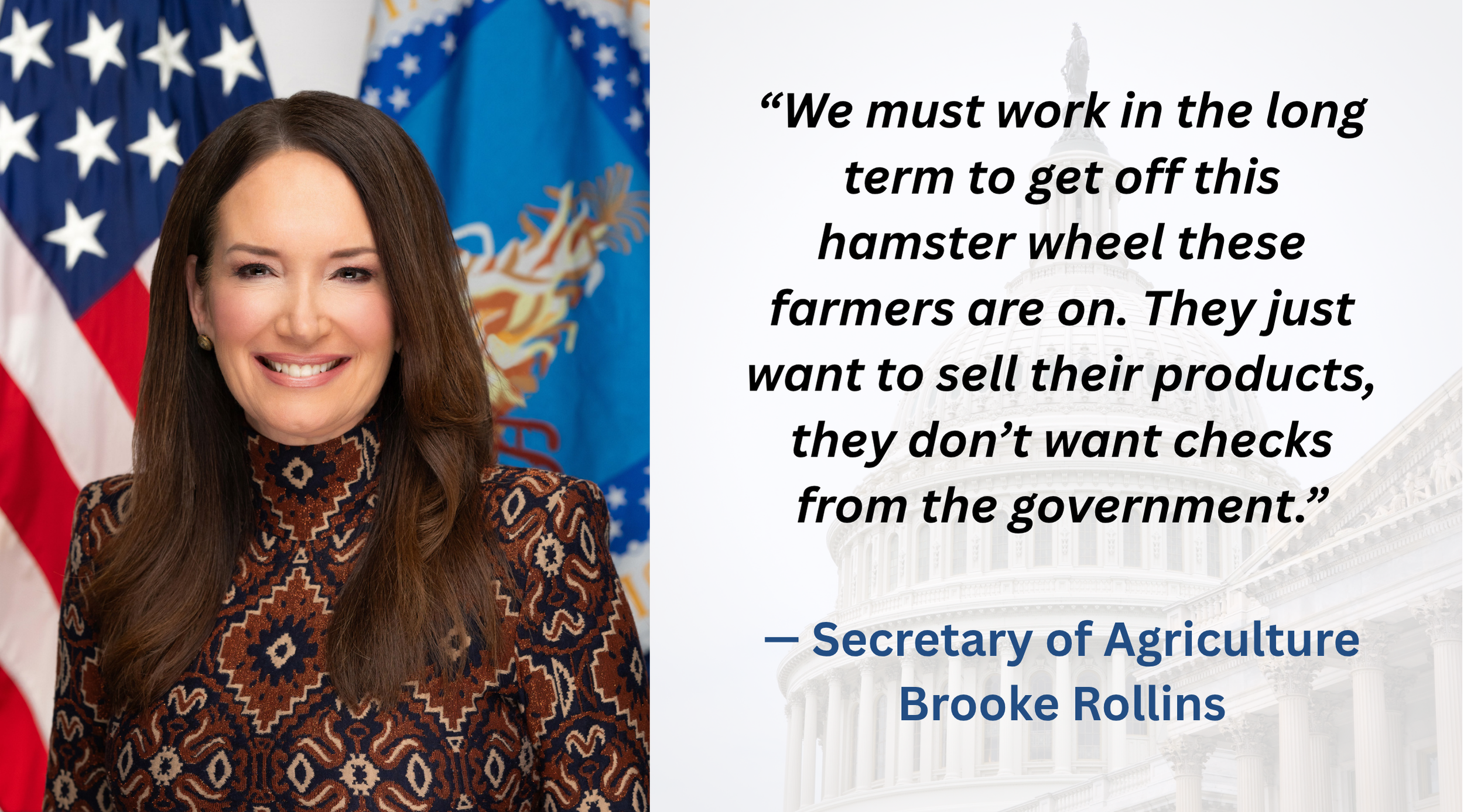
Secretary of Agriculture Brooke Rollins says the USDA will be announcing an aid program for row-crop farmers but cannot do it until the government shutdown ends.
Rollins told Fox News in an interview Thursday there is also $4 billion in aid that should be going to U.S. farmers at the current time but can’t be distributed due to the situation in Washington, which shows no signs of abating this week.
Rollins revealed the government used tariff revenue to fund WIC food aid program after the shutdown endangered the program for vulnerable women and children.
Rollins said she updated President Trump and cabinet members Thursday on the farm economy and acknowledged the rough shape the farm economy is in, especially for those who raise corn, soybeans, sorghum, cotton and other row crops.
“We must work in the long term to get off this hamster wheel these farmers are on,” Rollins said in the interview. “They just want to sell their products, they don’t want checks from the government.”
Due to tariffs laid down by the Trump administration, China has not ordered any soybeans from the U.S. this year, which is a loss of billions of dollars in trade revenue for U.S. agriculture.
Another blow occurred Friday when China threatened restrictive tariffs on rare earth materials across the globe, prompting Trump to cancel an end-of-the-month meeting he had scheduled with China President Xi Zinping.
“Trade wars are harmful to everyone, and these latest developments are deeply disappointing at a moment when soybean farmers are facing an ever-growing financial crisis,” said American Soybean Assn. President Caleb Ragland. “ASA hopes that talks can be put back on track to restore markets and trade relationships.”
A couple of weeks ago, as U.S. soybean prices continued to fall and harvest was under way, the U.S. government said it was extending $20 billion in economic support to Argentina while Argentina dropped its soybean export taxes to sell 20 shiploads of Argentine soybeans to China over a 2-day span.
Rollins said China isn’t living up to 2019 trade deal, where the country had promised to buy soybeans from the U.S. as a goodwill gesture. The deal was never finalized and China has since increased its reliance on Brazil for soybean supplies.
According to ASA, over the last 5 soybean marketing years China has imported an average of 61% of the world’s traded soybean supplies, more than the rest of the world combined.
Historically, the U.S. has been a primary soybean supplier to China. In the 7 years leading up to the 2018 trade war, an average of 28% of U.S. soybean production was exported to China, with a peak of 31% recorded in marketing year 2020/21 following the Phase One Trade Agreement.
During the 7 years preceding the trade war, U.S. soybean exports to China accounted for an average of 60% of total U.S. soybean exports.
In response to tariffs the U.S. imposed on Chinese goods during the 2018 trade war, China imposed a 25% retaliatory tariff, which effectively priced U.S. out of the Chinese market. This was on top of the 3% Most Favored Nation (MFN) tariff, and a sliding Value Added Tax (VAT) on U.S. soybeans.
The USDA estimates U.S. soybean farmers experienced $9.4 billion in annualized losses during the 2018 trade war, accounting for a staggering 71% of the $27 billion total loss in agricultural exports suffered by U.S. farmers during that time, the ASA says.