Trying to create more with less is what drove strip-tiller Zack Smith to experiment with the “weird stuff” on his farm in Lake Mills, Iowa. Some of those ideas include strip-till when it was a novel practice in the early 2010s, intercropping and what’s gained him attention most recently, an autonomous livestock barn that moves down the rows between strip-cropped corn.
“The thing that has always driven me is how do I create more yield and revenue without spending more money?” Smith says. “Are there ways that we can think creatively about that?”
Smith spent the first 18 years of his career in ag retail as a certified crop adviser and sales agronomist. In 2010, he began crop sharing with his dad. Smith’s father initially resisted transitioning the farm to strip-till — until he saw strip-till’s yields in the 2012 drought year.
“He gave me 15 acres to strip-till, and we had a 30-foot side-by-side trial of my corn on corn vs. his,” Smith says. “We did the same dry fertility and anhydrous in the strips instead of moldboard plowing and anhydrous in the spring. When we weighed it up side-by-side, the strip-till was 27 bushels per acre higher than the conventional tillage.”
Smith took on a portion of his dad’s acres in 2013 when his dad retired. The opportunity to farm full time arose unexpectedly in 2022 when one of Smith’s customers asked if Smith wanted to take over his operation. Today, Smith strip-tills 1,200 acres of corn and soybeans. He says only a small portion of his acres are dedicated to experiments, but his entire operation is 100% fall strip-till and 100% cover cropped.
“All of my nutrients are row indexed,” Smith says. “The dry is in the strip in the fall, and then all my nitrogen is applied in season. A third is with the planter off the back, and then I come back with a modified Y-drop on a toolbar to put on the rest of it.”
Over the last two soil sampling cycles, the organic matter increased about 9/10 of a percent across the entire farm, and actual production history (APH) increased about 15%.
“I would rather quit farming than go away from the strip-till system,” Smith says. “Have we got it all figured out? No. Is it always easy? No, but the good of the system outweighs the bad.”
Finding a Missing Link
Smith credits Sheldon Stevermer, an ag engineer who farms in Easton, Minn., with introducing him to strip-till and encouraging him to explore ideas that challenge conventional farming practices. Strip intercropping was Smith’s first experiment. In 2012, he planted alternating 30-foot strips of corn and soybeans to try to boost yield on the outside edges. The outside rows were planted at a population of 48,000, while the middles were lower.
“The ear weights were 370-380 bushels per acre on these outside rows,” Smith says. “The overall average that year was 250 bushels per acre in the strip intercropped rows, compared to 190 bushels for most of our corn that year from the drought.”
Stevermer and Smith tried variations on strip intercropping in the years that followed and got mixed results with their experiments. Eventually, they decided to focus on optimizing their strip-till setups — until the COVID-19 pandemic presented an opportunity to innovate in 2020.
“I would rather quit farming than go away from the strip-till system…”
“Locally, corn was $2.75 per bushel. Beans were $7.50 or $7.60 per bushel at that point,” Smith says. “It was tough. Even with all the efficiencies and advantages of strip-till, you’re not going to make money on $2.75 corn, so we started trying to brainstorm how to raise revenue without spending more money on the farm.”
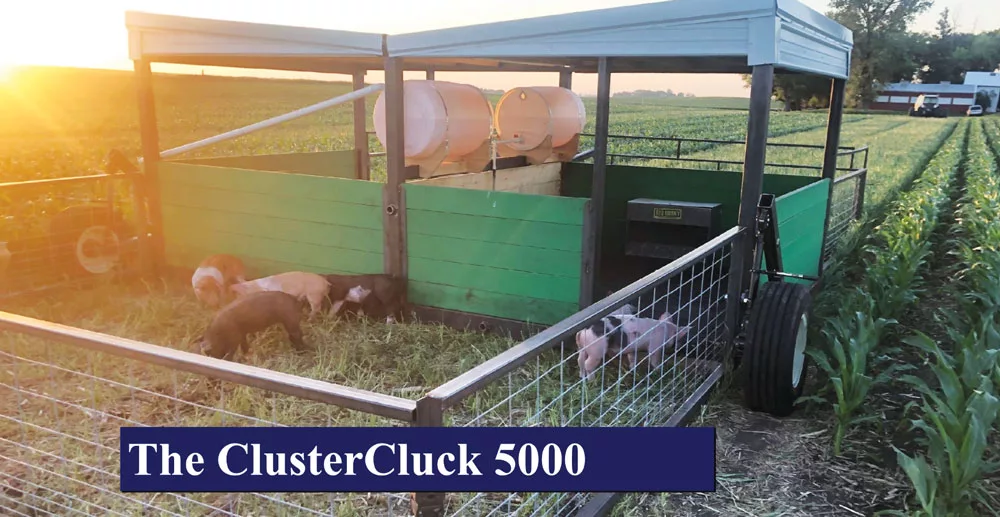
That led Stevermer, Smith and Lance Peterson, a farmer from Rush City, Minn., back to the concept of strip intercropping. Peterson suggested putting livestock between the rows of corn instead of another crop. Smith was doubtful at first, but the idea quickly evolved into the prototype of the Stock Cropper, a mobile grazing barn that guides a diversity of livestock between wide strips of corn.
The first iteration of the Stock Cropper launched June 14, 2020, with sheep and goats in the front of the barn, hogs behind it and two chicken tractors trailing it. The “four-ring animal circus” had an electric winch acting as an anchor, and Smith would move the contraption two or three times per day to keep the animals in fresh pasture.
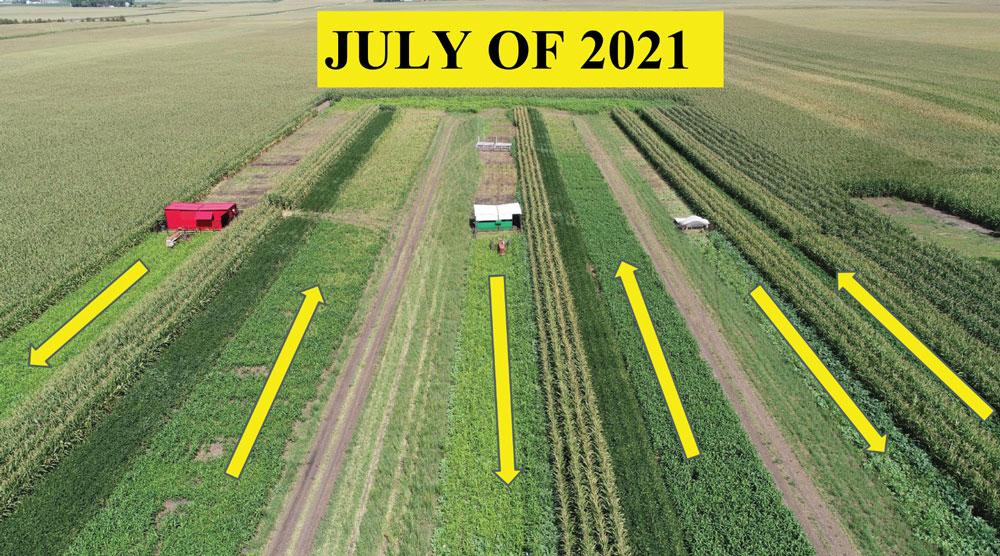
LIVESTOCK RACETRACK. This aerial photo from Smith’s Lake Mills, Iowa, farm illustrates the racetrack pattern designed for the autonomous Stock Cropper barns. “The racetrack is designed so that the barn will make two cycles in a year and graze the same acre twice,” Smith says. Zack Smith
“It’s the reintroduction of livestock and crops working together in a dynamic arrangement that can be rotated with the strips,” Smith says. “Next year, we’ll strip-till that, plant corn into those strips and have the benefit of this perfect closed-loop rotation where we go back and forth with animals feeding plants, plants feeding animals.”
In the first year, the animals grazed a six-way annual pasture mix that was mostly oats planted between rows of strip-tilled corn on corn. The oats proved to be too dominant in the mix, and Smith mowed them off and fed hay until the Stock Cropper had moved to a summer cover crop mix.
The first year taught Smith a lot about timing the Stock Cropper’s movement. In 2021, he created an expanded plot that had three Stock Cropper systems. One had four rows of corn separated by 10 feet of pasture with a 10-foot-wide barn traveling down the pasture rows. The same setup was replicated with 20 feet of pasture and a 20-foot-wide barn and 30 feet of pasture with a 30-foot barn. Smith also designed a “racetrack” pattern that allowed the barns to cover the same area twice in one growing season. By October, the animals are finished and ready for market.
“Integrating animals isn’t just taking the manure and spreading it,” Smith says. “It’s getting their hooves and beaks on the ground and getting their saliva interacting with and feeding the soil. That’s what we were excited about. We stumbled onto the missing link of a system growing in conjunction with a crop like corn.”
Smith formed a relationship with Dawn Equipment in 2021, and the company helped him make the barns autonomous. Solar panels on the top of the barn power GPS pucks, the cell modem and an on-board computer, giving Smith the ability to program a path for the barn to move through the cornfield.
“It’s livestock & crops working together in a dynamic arrangement…”
Soon after, Jason Webster, farm manager and lead agronomist at Precision Planting’s PTI farm in Pontiac, Ill., heard about the project and asked to demo the barn for a strip cropping trial at the PTI farm. Smith liked the idea of validating the project with Precision Planting and set up an autonomous barn with sheep, poultry and hogs in the rows between corn.
In 2024, the PTI team planted corn where the livestock had been, and the corn produced an all-time PTI farm yield record of 434.9 bushels per acre, beating the previous record by 32 bushels. Smith says the corn in the strip cropped plot was 58 bushels better than any other 30-inch row corn plots on the farm, even those that were irrigated and treated with other high-management inputs and techniques.
“Think about all the money that gets spent and what really drives yield,” Smith says. “Crop arrangement is free. It’s just changing what a field can look like and letting the plants express and interact with the livestock. It’s an incredible result.”
Scaling Stock Cropping
While the yield itself is impressive, farmers often ask if the Stock Cropper pencils out. Smith says his 20-foot barn operated on 0.82 of an acre, which is grazed twice. The barn raised 10 hogs, eight lambs or goats, and 300 chickens with two turns of chickens in the barn throughout the summer. Using USDA averages, Smith says he’s producing about $15,000 of protein per acre. The animals were marketed as pasture raised and sold locally, and Smith did most of his own butchering to keep costs low.
The corn planted in the grazed rows had about a 60 bushel-per-acre advantage over the neighboring conventional strip-tilled corn and produced 305 bushels per acre. The strip-cropped corn also used 75% fewer nutrients, thanks to what Smith estimates is a 10-fold increase in biodiversity with the cover crop mix and livestock. In 2023, the additional yield and income from the livestock resulted in $2,200 per acre in net profit.
Strip-Tilling Outside the Lines
Zack Smith goes more in-depth on the evolution of the Stock Cropper and his plans for future experiments in his presentation from the 2025 National Strip-Tillage Conference. Click here to watch a replay.
Smith did the math for 160 acres under the stock cropping system in the racetrack design to estimate what scaling the system might look like. He estimates 60-65 barns could operate on 160 acres, but they’d need to be autonomous or the labor demand would be too high to manually move that many barns. The barns still would require two or three people to do chores and check on the health of the animals, but the onboard feeding and watering system could last for three to four days to reduce labor demands. With those considerations, he thinks it would take one person for every 50 acres to manage the barns and other farm operations.
“The goal when we started was to come up with a system that might allow people to not have to farm 10,000 acres to make a profit and to get by with less,” Smith says. “We’ve proven that a truly regenerative production system can be scalable, but a lot of other things beyond our control need to happen in the background to make it work. The only way that you can get this profit is if you can get the animals processed, marketed and in the hands of consumers willing to pay for it.”