Thirty-year-old Wade Yingling and his father, Bruce, run a corn-soybean rotation on several different, highly erodible soil types across 2,300 acres in Mt. Sterling, Ill.
Looking to save their soil and get more bang for the buck with inputs, Wade convinced Bruce to give strip-till a shot 5 years ago.
“We were primarily vertical tillage before then,” Yingling says. “About 7 years ago we bought an anhydrous bar, and it seemed to work well for our corn. Then we took it a step further and tried fall strip-till on a few hundred acres.
“We were indecisive about it at first, but after seeing how well it worked, Dad wanted to strip-till even more than I originally did.”
Yingling says they essentially went “all in” on strip-till after seeing with their own eyes that it was a good fit for their operation.
Freshening Up
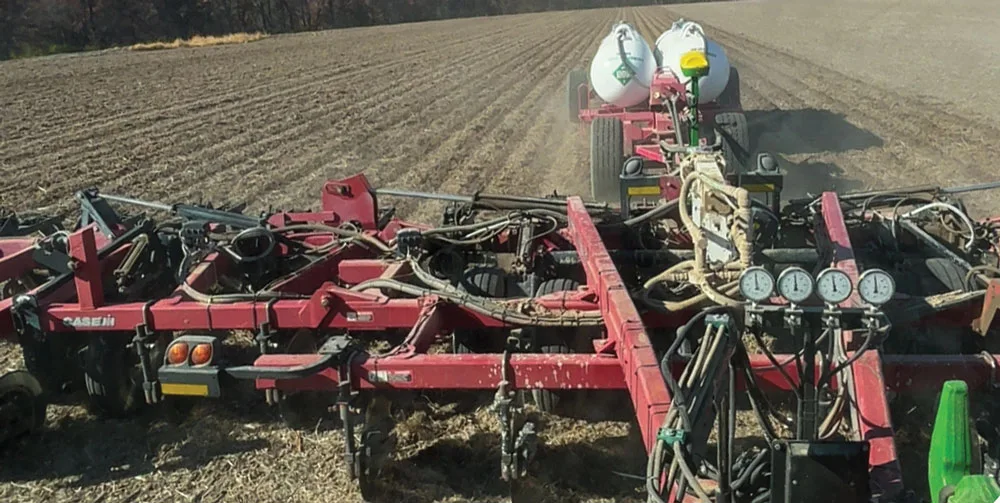
They bought a 16-row Case IH strip-till bar with a shank setup to make strips 7 inches deep and apply anhydrous ammonia in the fall.
In the spring, Yingling makes a second pass with a Yetter Strip Freshener Cab Control (CC) coulter unit that dribbles fertilizer 2-by-2 on each side of the strip. The rolling baskets on the strip freshener mix the fertilizer into the soil and cover it up.
The Yinglings custom-built their strip freshener unit with a liquid fertilizer system and mounted it on a John Deere 1770NT planter bar.
“With the strip freshener, we basically just smooth up the strips about 1.5-2 inches deep and apply some UAN-28, ATS and micronutrients ahead of the planter,” Yingling says. “We’ve dialed in our rates through trial and error since we started running this system 3 years ago.
“We’ve been applying about 15 gallons of UAN-28 and ATS and we’ve been playing around with humics and micronutrients as well. We shoot for about 30 pounds of nitrogen and 18 pounds of sulfur.”
-unit.jpg)
SPRING STRIP-TILL. Yingling runs a Yetter Strip Freshener Cab Control (CC) unit in the spring to “smooth up” the strips 1.5-2 inches deep while applying fertilizer ahead of planting. Wade Yingling
Yingling can plant the same day he runs the strip freshener sometimes, but he usually waits a day or two before firing up his 16-row Kinze 3600 corn planter, equipped with Precision Planting technology and row cleaners.
“We have a lot of soil that doesn’t dry out very well, so the freshener helps us get everything on an ‘even playing field.’ Just trying to get everything to dry out evenly was a big challenge for us before we started strip-tilling.”
Yingling says the switch to strip-till came with a relatively easy learning curve, which he attributes to their usage of implement guidance. Yingling also credits the “simple setup” of the strip freshener for making the transition a smooth one.
“The biggest thing is just having good guidance to where you can repeat your passes easily,” Yingling says. “And with the strip freshener, you can change on the fly and adjust to different soil types and ground conditions.”
Covering the Soil
The Yinglings are big proponents of cover crops. On most fields going from strip-tilled corn to no-tilled soybeans, they seed cereal rye with a Salford Valmar seeder attached to a Kuhn Krause Accelerator vertical tillage unit.
“We chop residue with vertical tillage while blowing on cereal rye at a rate of about 35-40 pounds per acre all in one pass in the fall,” Yingling says.
“We have some highly erodible ground, so the cover crops help a lot with that. They’ve also helped with weed control. And it just seems like, overall, our soil absorbs those heavy rains better with the rye.”
Yingling often plants soybeans green into living cereal rye, sometimes as tall as a foot, and then terminates the rye within 1-2 weeks.
Continuous Corn Conquest
While most of the Yinglings’ acres are under a simple 50-50 corn-soybean rotation, they grow continuous corn on about 300 acres, which presents a different set of challenges.
“The biggest challenge is sizing residue and making sure it breaks down through the fall,” Yingling says. “We run the Accelerator through it in the fall before running the strip-till anhydrous bar. We also have Yetter Stalk Devastators on our corn head, which helps big time with residue management.
“The last two years, we’ve done spring strip-till on some of those corn-on-corn acres, and then coming back with the freshener makes it a breeze. But as long as we can get through it with the shank machine in the fall, we haven’t had too many troubles with strip-till corn-on-corn.
“We have a lot of soil that doesn’t dry out very well, so the strip freshener helps us get everything on an even playing field…”
“If it gets a little damp or the sun goes down, it can get a little tricky at times, but it’s not too big of a deal,” he adds.
The Yinglings have seen multiple benefits since implementing their fall strip-till/spring strip freshener system, especially on some of their most challenging soils.
“We had the best corn we’ve ever raised on our marginal ground last year,” Yingling says. “It probably wasn’t all because of strip-till but being able to band nutrients and be more efficient with nutrient uptake was a big deal, even more so on our lighter soils that aren’t as fertile or don’t have great water holding capacity. The less we work our soil, the more tilth it has, and it doesn’t get nearly as hard or crust over.”
Advice for Beginners
Still relatively new to strip-till, one of Yingling’s biggest lessons learned so far is the importance of marrying the planter to the strip-till bar.
“The planter guys should run the strip-till bar and vice versa,” Yingling says. “That way you know each guy is on the same page when it comes to planting because that definitely leads to less headaches and confusion.”
Yingling has also learned to exercise caution on steep hills.
“Even though it’s strip-till, you can still end up with erosion in some areas if you’re not careful,” he says. “Patience is the other big key. You can’t just jump in with a field cultivator early and try to work the ground or get the air out. Strip-till definitely takes a little more of a thought process and requires more planning.”
Other farmers in Yingling’s area have caught on to the benefits of strip-till, he’s noticed, and strip-till acreage appears to be on the rise in the state.
“There are a few strip-tillers right in my area, but if you go 15-20 miles away, I’d estimate 50-60% of the acres are under strip-till,” Yingling says. “Strip-till seems like it’s becoming a more popular practice over the last couple years in Illinois.”