
A problem as complex as herbicide-resistant weeds requires a systems approach to solve, says Daniel H. Smith, nutrient and pest management program manager for the Univ. of Wisconsin-Madison.
Strip-tilled fields are susceptible to small-seeded weeds like waterhemp, grasses and ragweed in the tilled root zone and marestail, horseweed, shepherd’s purse and dandelions in the undisturbed soil between the strips. Add in herbicide resistance, and weed control becomes even more complicated. However, Smith says cover crops are a promising solution to all these problems.
“Cover crops historically have shown to be resilient to fighting waterhemp,” Smith says, “so we set out to do a study where we had fall and spring tillage, no-till and various termination treatments of cereal rye in corn and soybeans.”
This was the beginning of a years-long, ongoing research project to assess the weed suppression capabilities of cereal rye for farmers in the upper Midwest. The first study started in fall 2018 when Smith and his team seeded cereal rye on several farms in Rock, Walworth and Jefferson counties in southern Wisconsin. They planted the rye at a rate of 1 bushel per acre after harvesting the cash crop — in early October for a soybean plot going to corn and around Nov. 1 for the corn plot going to soybeans.
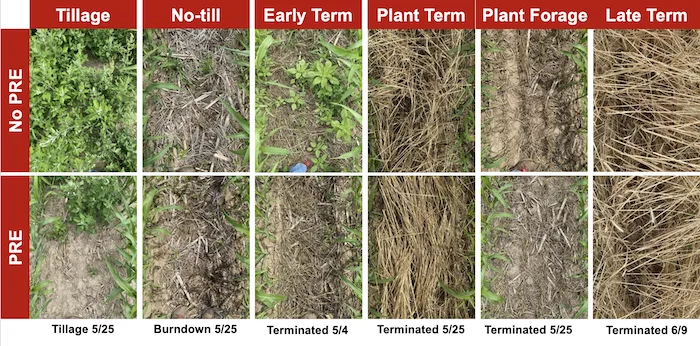
No pre-emergence herbicides were applied to the plots, “not a recommendation we’d make,” Smith says, while acknowledging that the pre-pass can cost $30-40 per acre. In all systems, the cereal rye terminated at planting showed great weed suppression without any yield drag on the corn.
“There was a tremendous difference in the amount of biomass,” Smith says. “This is a systems-based approach to weed control.”
Right Place, Right Time
Due to the climate and shorter growing season, Smith says cover crop establishment windows are tough in the upper Midwest. Having less time to establish covers makes it critical to identify goals for the cover crop before planting.
“If we’re going after weed suppression and erosion control, small grains do quite well,” Smith says. “They help crush herbicide-resistant weeds with a nice biomass and mulch layer.”
Smith says winter cereal rye lends well to this goal due to its ability to overwinter and produce a large amount of biomass. It begins growing at 40 degrees F, giving it about 10 extra degrees when it can grow compared to corn. That equates to about a month of extra growth in most settings, according to Smith.
“Think about maximizing early spring biomass,” Smith says. “Planting dates are inherently important for yield, and you’re going to want to find that middle point of maximizing yield and weed control for the best results possible.”
“Cover crops are a systems-based approach to weed control…”
Based on research from Rodrigo Werle, weed scientist at UW-Madison, Smith recommends aiming for 4,600 pounds of cereal rye biomass per acre on the field — about knee to waist high. He says it will be hard to achieve with corn, but it’s possible with soybeans.
“Spring termination is really important when we’re thinking about the system,” Smith says. “We could plant soybeans into the rye, let the rye grow a little longer and terminate it later. Maximizing the amount of biomass reduces the waterhemp population by 50% and controls most weeds in soybeans.”
In order for glyphosate to translocate, Smith says nighttime temperatures have to be above 50 degrees F and daytime temperatures need to reach 60 degrees F or higher for 3 days before and after application. While some farmers are concerned about covers impeding the pre-emergence herbicide pass, Smith says his research shows that the herbicide will still make it through the cover crop biomass to the soil surface.
“Where we had a pre, even with poor coverage, we only had 1-3 waterhemp plants in a 3-by-3-foot area, compared to 9 plants without the pre,” Smith says. “Even though we’re tying up a little of that herbicide initially, it’s eventually making it down to the soil surface through rainfall or naturally.”
Smith says his strip studies have shown that even half the rate of glyphosate will kill rye when it’s actively growing, regardless of the height of the rye.
Weed Suppression
Plots at UW-Madison’s research farms in Arlington and Lancaster, Wis., compared weed control approaches in conventional tillage, no-till, no-till with early terminated cereal rye, no-till with cereal rye terminated at plant, no-till with cereal rye harvested for forage and no-till with late-terminated cereal rye. The plots rotated annually between corn and soybeans.
Smith says the herbicide program is similar for both crops. Control plots didn’t receive a pre-emergence pass. Since 2023, the tilled, no-tilled and cover-cropped plots used in the study received a burndown of Roundup PowerMAX 3. For the pre-emergence pass at planting, Resicore XL was applied to corn plots and Zidua PRO was applied to soybean plots. The corn also received a split nitrogen (N) application of 40 pounds at planting and 120 pounds of urea broadcasted at sidedress.
“That’s not the best tool for sidedress, but we’re in a smaller plot setting and don’t have all the options that we would have on a farm scale,” Smith says.
Researchers seeded Aroostook rye at a rate of 1 bushel per acre. Smith says Aroostook matures earlier than most other rye varieties, which helps hit the target rye planting date in October after combining the cash crops. The rye was terminated using Roundup PowerMAX 3. Early termination happened 10-15 days before planting, and late-terminated plots received the glyphosate pass 10-15 days after planting.
“Think about maximizing early spring biomass…”
Finally, a post-emergence herbicide was applied to all plots when approximately 50% of weed density reached 10 centimeters. Corn plots received Status and Roundup PowerMAX 3, and soybean plots received Enlist One and Roundup PowerMAX 3.
Smith says there was a dramatic drop in weed population in both corn and soybeans as the amount of cereal rye biomass increased in plots without a pre-emergence pass. The tilled plots were full of weeds by the time Smith would typically apply a late post-emergence treatment. Meanwhile, the rye biomass kept the plots that were planted green, harvested for forage and terminated late weed free.
“We had a lot of biomass in the plant green system,” Smith says. “When we lifted all the biomass in the forage harvest plot, it was still weed free. We had opportunities for the early summer annuals to germinate, and we had less overwintering winter annuals. We don’t recommend the late-terminated cover crop because it’s just too much biomass unless you’re an advanced cover cropper.”
In the plots that received a pre-emergence herbicide application, Smith says there was no statistical difference in the number of weeds.
“Even if you’re strip-tilling and cover cropping, that pre is still really important to have in the system of weed control,” Smith says. “Then we can think about reducing your post-emergence application because we’ve already had good weed control.”
Yield Impact
According to Smith’s data, there were no differences in corn and soybean yields when a pre-emergence herbicide was applied. He says pre-emergence herbicides are critical for weed control and thus crop yield.
“Soybeans do not care about the cover crop unless it’s dry early on,” Smith says. “We only saw a yield decrease one time, and that was when it was very dry in 2023. Soybeans do really well within the rye biomass system.”
Corn is much more difficult to grow with rye residue, according to Smith. If the weather gets dry later in the season, cover-cropped corn plots do a little better because the residue holds soil moisture in place, but Smith says in general, corn planted into heavy residue can be a “trainwreck.” He recommends terminating cereal rye at planting if the rye is less than 15 inches tall or before planting if the rye is growing quickly and corn planting may be delayed.
“The corn is affected by competition for early season moisture, light and nutrients,” Smith says. “If we had an irrigator or more nutrients applied at different timings, that would help, but it’s still inherently difficult to overcome that biomass, especially if it’s very dry in the early season.”
That’s where thinking about weed control as a system becomes crucial for decision making.
“It starts with a plan,” Smith says. “Whether you’re going to crush herbicide resistance with cover crops or a mix of herbicides, write down your plan and have some contingencies figured into your budget.”