TAKEAWAYS
- Learn to read soil tests to understand the yield-limiting factors on your farm. Use GPS points to link soil tests to yield results.
- Make sure your soil is in balance. Don’t spend money on inputs that won’t make you money.
- Understand your soil’s cation exchange capacity. Heavy soils, which have a cation exchange capacity of 20 or above, can be loosened with calcium. Sandy soils that have a cation exchange capacity of 10 or less can be tightened with magnesium.
As the average prices of fertilizer and diesel remain elevated for the 2026 harvest season, many farmers are looking for ways to cut costs. An easy target with the current farm economics is reducing nutrient applications, but Brian Hefty, strip-tiller and longtime host of the Ag PhD agronomy show, says strategic fertilizer applications can increase yields without changing the overall fertilizer bill.
“We as farmers often like to complain about wanting more yield, lower costs and more profits,” Hefty says. “What are you doing about it?”
His answer is frequent soil testing and understanding soil test results.
“Farmers don’t know how to read the soil test,” Hefty says. “It’s a rampant issue in our industry. We have to decide where we are putting the fertilizer and where we are not. The answer is right here. The No. 1 thing you can do on your farm is to learn about this.”
Linking Soil Tests to Yields
Hefty farms 4,000 acres north of Sioux Falls, S.D., most of which are strip-tilled. The deep fertilizer placement allows the plants’ roots to take up more applied, non-mobile nutrients like phosphorus (P), zinc, copper, and potassium (K). Hefty also likes that there’s no compaction at the bottom of the strip, and his strips average 7 degrees F warmer than no-tilled fields in early spring.
All crops and all fields are seeded at variable rates, and Hefty uses strip-till and banding to feed the plants. He’ll also broadcast apply nutrients to raise soil nutrient levels into his ideal range.
“We own most of the ground that we farm, and we try to build up the soil for the long term,” Hefty says. “We don’t have a lot of rented ground anymore, but I always tell people who are renting a lot of ground, if you want to get more fertilizer into the plant in year one, strip-till is an amazing way to go.”
The foundation of Hefty’s fertilizer program is soil tests conducted across his farm. Hefty and his brother, Darren, started doing 1-acre grids in 2016 for research purposes. After 10 years of grids on approximately 3,000 acres per year, Hefty has 30,000 data points matching fertility to yield.
“If I add up all the land grant universities in the U.S., I don’t think they have that many data points,” Hefty says, “and that’s on my own farm. Nothing against universities — I’m simply saying, you can generate this data yourself.”
In 2025, his dryland corn averaged 245 bushels per acre, but he notes that it’s exactly that — an average.
“I got spots that are 300-plus bushels per acre,” Hefty says. “Unfortunately, I also have some spots that are 200 and less. If I fertilize that field the same way across the board, I’m shorting the good ground, and I’m putting too much on the other ground.”
That translates to a loss in profit on both the lowest-yielding and highest-yielding acres.
“That’s what I want you to think about from now on for the rest of your life,” Hefty says. “Think about how you are investing your fertilizer dollars on every acre you’ve got. It starts with reading the soil test.”
Reading Soil Tests
The most important factor to consider when planning nutrient applications is the soil organic matter, according to Hefty. He says through mineralization, each 1% of organic matter in the soil releases approximately 20-30 pounds of N, 4-7 pounds of P and 2-3 pounds of sulfur annually.
“If I had 5% organic matter soil, I’m going to get 100-150 free pounds of N every year,” Hefty says. “Nutrient release is going to be greater in well-drained soils that are warmer and have lots of microbial life. On my farm, I’m getting more than 30 pounds of N every year for every 1% of soil organic matter. It saves me tons of money.”
Strip-tillers can calculate their soil’s N-holding capacity using the cation exchange capacity on their soil test. The cation exchange capacity indicates the amount of clay and organic matter in the soil. Hefty considers 20 or above to be heavy soil and 10 or less to be light soil.
“Take your cation exchange capacity number and times it by 10,” Hefty says. “That will tell you roughly how much N your soil can hold at any one time.”
The only factor that strip-tillers can change in the soil’s cation exchange capacity is organic matter. For every 1% increase in organic matter, the average soil can hold approximately 4% more water.
“I have to look at how much N my soil can hold because if I’m putting too much on, what’s going to happen when I get a big rain?” Hefty asks. “Odds are pretty good that I’m going to lose it. The last thing we want is losing that expensive material.”
Taking a N Credit
Knowing how much N needs to be applied starts with knowing how much N is actually in the soil.
“I hear some soil labs and universities talking about taking a N credit,” Hefty says. “You raised soybeans last year, so you have a N credit. That’s not true. I’m not saying you don’t have N left. I’m simply saying you don’t know how much.”
Having an accurate number for the amount of N left in the soil can save thousands of dollars per year in applied nutrients. In fall 2021, N cost $1 per unit — the highest price ever, according to Hefty. He soil tested his fields after soybeans and found a range of N levels, from 34 pounds to 136 pounds of N.
“Because I soil tested, I cut my N by 100 pounds,” Hefty says. “That saved me $100 per acre. On one 330-acre field, I saved $33,000 because I soil tested.”
In 2026, Hefty had 3,000 acres of corn and aimed to raise 250 bushels per acre. If he assumed that he needed to put on 200 pounds of N per acre, it would cost him approximately $450,000.
“That’s almost half a million dollars,” Hefty says. “And we’re going to guess, seriously. I don’t get it.”
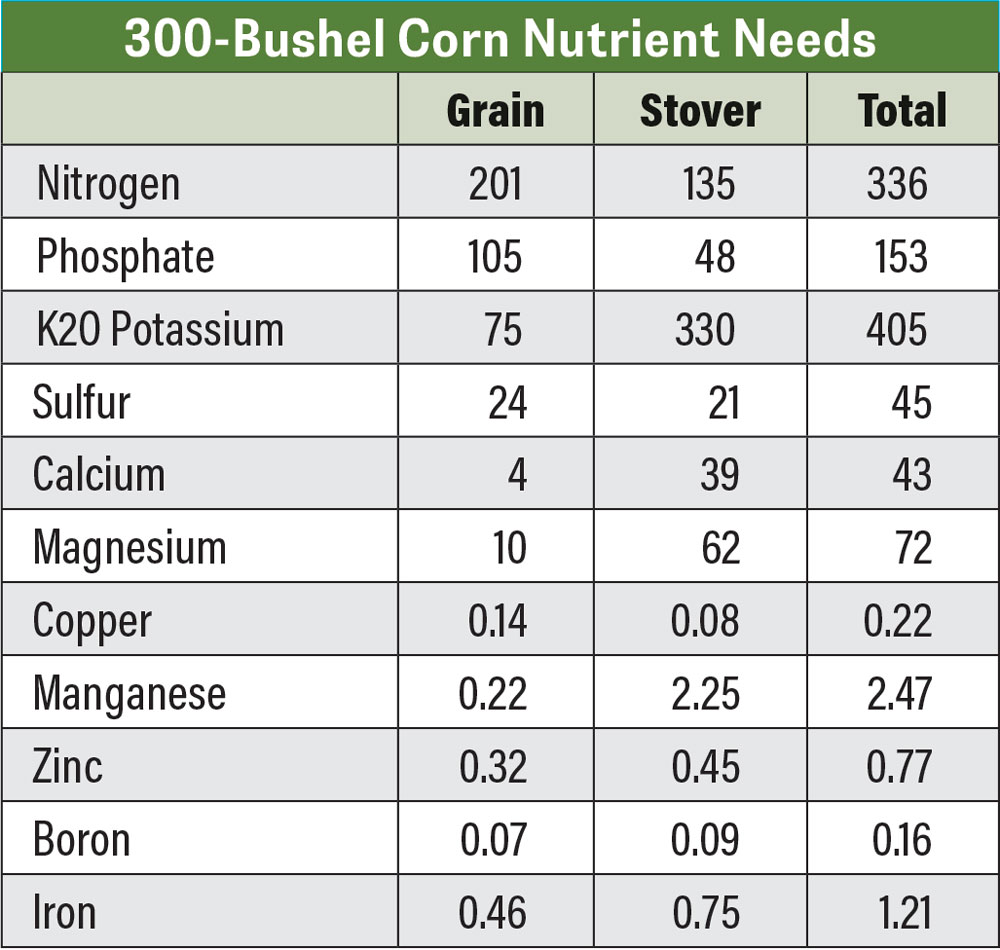
Figure 1. This table shows the amount of nutrients needed to produce 300-bushel corn. Hefty says the nutrients are in ratio to each other and points out that it takes much more potassium (K) than nitrogen (N) to raise a great corn crop. “K is the No. 1 yield-limiting factor that we see in the U.S. today,” Hefty says. “I look at soil tests from all over the country. 90% are short on K, and that ends up hurting a lot.”
Hefty says corn needs 1.12 pounds of N per bushel, no matter the yield goal (Figure 1). To determine how much N is required for the corn, multiply the bushels per acre by 1.12. Add carryover N, organic matter mineralization of 20-30 pounds and applied N in all forms. Then subtract N tie-up in high-carbon residue and N loss from leaching, denitrification and volatilization to find out if the corn will have enough N.
At sidedress, Hefty tests at 0-12 inches and 12-24 inches. He assumes the corn will take up almost all of the N at 0-12 inches and a portion of the N at 12-24 inches.
“Do some testing on your farm,” Hefty says. “It’s really going to help you.”
Raising Nutrient Levels
Results from Mehlich 3 soil tests are the starting point for Hefty’s assessment of the nutrients in his soil. He prefers to use Mehlich 3 tests because they’re inexpensive, work in any soil pH and he finds them to be very accurate.
The most common question that Hefty hears from other farmers is how much monoammonium phosphate (MAP) and diammonium phosphate (DAP) to apply to raise the soil’s parts per million of P (Figure 2). The cost of P has gone up dramatically in recent years, and it’s not cost effective to only apply DAP or MAP to raise P levels in the soil.

Figure 2. The chart above shows approximately how many pounds of diammonium phosphate (DAP) and monoammonium phosphate (MAP) are needed to raise soil parts per million (ppm) on a Mehlich 3 soil test. Applying hundreds of pounds of DAP or MAP is not a cost-effective solution to raise soil ppm. Instead, Hefty says the soil’s macro and micronutrients have to be in balance.
Instead, Hefty says the soil has to be in balance. If P isn’t the yield-limiting factor or other nutrients aren’t in balance, increasing P may not boost yields.
“I don’t want you to spend money that doesn’t make you money,” Hefty says. “I see people all the time putting more P on the ground, and I ask why they’re doing it. ‘Well, the fertilizer dealer said I needed it.’ Did you need it, or did they need to sell it?”
Micronutrient Ratios
To get the complete picture of the effect of nutrients on yields, Hefty encourages farmers to use GPS points to soil test. This will link the soil tests to yields, spray records and seed varieties. Hefty started soil testing by GPS points in 2019, and after a painstaking process of manually linking the soil test points to yields, the soil tests showed a surprising result.
“All our good yields, 240-plus bushels, were where the magnesium to K ratio was 2:1 or less,” Hefty says. “There are, in my opinion, no two elements that fight each other more to get into your plants than K and magnesium.”
The ideal soil magnesium to K ratio is usually between 1:1 and 2:1, according to Hefty. In the Dakotas and Minnesota, farmers often have ratios closer to 6:1. Hefty says that’s why K deficiency is usually the top yield-limiting factor in his region, especially in soybeans, even if the soil has more than 200 parts per million of K.
“I hate to tell you this, but K is too cheap today,” Hefty says. “If I put it where it belongs, I make tons of money putting K on.”
The ratio of K to other micronutrients is also important, and that’s where conducting a base saturation test is critical. Hefty recommends K in the 4-8% range, sodium at less than 1%, a soil pH in the 6s and a single-digit hydrogen level, 65-80% calcium and variable magnesium levels, depending on the soil type.
“If I have heavy soil, I want a little less magnesium,” Hefty says. “I can loosen a heavy soil with calcium. I can tighten a sandy soil with magnesium. When we have a cation exchange capacity of less than 10, I want to push the magnesium a little bit to tighten up the soil. It can hold more water and nutrients, and I’m getting a little higher yield.”
Strip-tillers also need to be mindful of the fertility balance in the soil when trying to raise P levels. Hefty says adding more P may not boost yields if P isn’t the yield-limiting factor or if other nutrients aren’t in balance. When reading a Melich 3 soil test, look for a P to zinc ratio of 7:1 to 10:1 and a P to copper ratio of approximately 30:1.
“If I had to raise my zinc soil test level by 5 parts per million, it only costs about $23,” Hefty says. “When I raise it, zinc doesn’t move in the soil or leach away. Zinc, copper and P are stuck where you place them, so long as you don’t have soil erosion.”
Copper is often considered the disease nutrient, and low copper levels could be behind disease issues, seed coat resiliency and plant flexibility. Hefty says a copper deficiency is often the reason behind green snap and soybean seed coats falling off during harvest.
“In a lot of cases, we only need the copper levels in the soil to be 3-5 parts per million,” Hefty says. “Let’s say the soil is 2 parts per million low. Yeah, it’s $34 per acre, but now I’ve fixed my problem for the next 10 years. Sure, we can complain about the price of P and N, but the big thing is we have to understand where to place these things, read the soil test, and then we can wisely invest our fertilizer dollars.”