
TAKEAWAYS
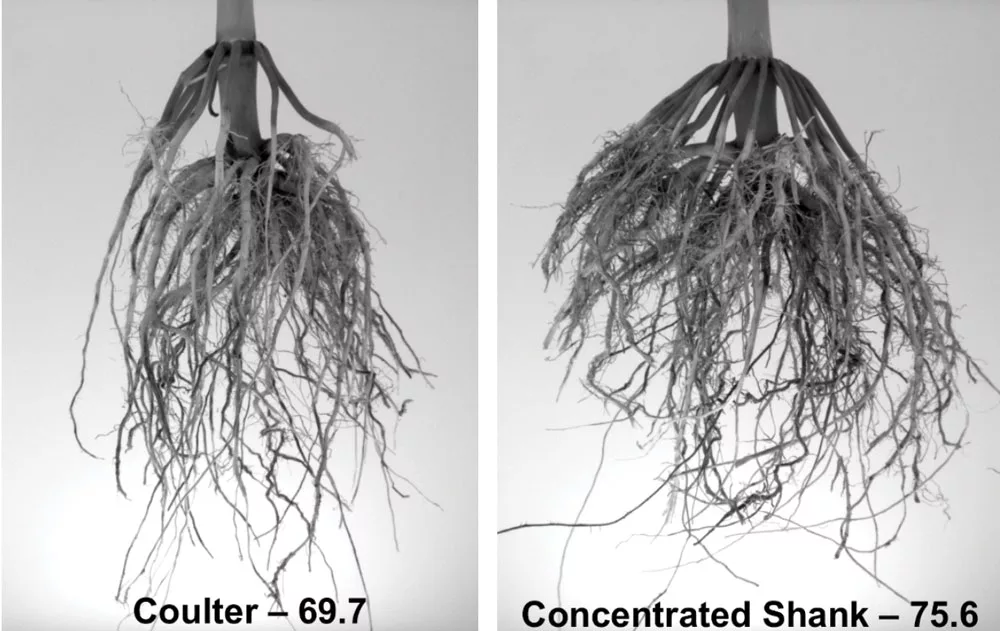
- Rooting structure varies within strip-till.
- Fertilizer placement seems to affect above-ground growth.
- Fertility and placement affects root development.
Making intentional decisions about when to strip-till, whether to use a coulter or shank to make strips, and hybrid selection can result in yield differences upward of 10 bushels per acre, according to Jared Fender, senior research specialist at the Univ. of Illinois Crop Physiology Lab.
The university’s 2024 fertility trial compared corn yields from strip-till with a coulter, shank stratified strip-till, shank concentrated strip-till, conventional tillage with broadcast fertilizer and no-till with broadcast fertilizer. The stratified shank application placed the fertilizer at all depths of the furrow, while the concentrated shank application placed it at the bottom.
Fender chose Bayer’s Channel 215-70 as the corn hybrid because it has a good fertility response and an overall root structure that he didn’t think would favor one placement over another. The plots received 75 pounds per acre of phosphorus (P) in the form of P2O5 from Mosaic MicroEssentials fertilizer (MESZ), 60 pounds per acre of potassium (K) in the form of K2O from potash and 175 units of nitrogen (N) from spring-applied UAN32.
“Because we have different tillage types and fertilizer placements, we had to spray the 32% over the top,” Fender says. “It was about a 200/100 typical rate for Champaign, Ill., farmers.”
“We had a 4-times increase in our P level just by strip-tilling in the spring…”
The fall fertilizer application went out around November 13, 2023, during a dry window after harvest. Fender says the winter was one of the mildest the Champaign area has ever had for research trials. Temperatures stayed above freezing until mid-January 2024.
“Our microbes were alive all the way until January because we did not drop below 30 degrees F,” Fender says. “When we did drop below 30 degrees, we dropped fast, all the way down to negative. But then about 5 days later, we went right back up and never froze again, so our soils were active for very long periods of time after that fall application.”
A wet spring followed the mild winter, and Fender and his team weren’t able to make spring fertilizer applications until mid-May, which was later than they had hoped. Corn planting followed about a week later.
Root Measurements
To assess the impact of the different tillage types and fertilizer placements, Fender and his team took soil samples at tassel time in zones from 0-4 inches, 4-8 inches and 8-12 inches. The fall broadcast samples at 0-4 inches had a higher K test compared to spring because soils were active in the mild weather. In the middle zone, the coulter, shank and concentrated shank placed fertility down into the profile.
“We’re starting to get those nutrients in the 4–8-inch zone,” Fender says. “Our stratified shank, the one that layers fertility completely down through the profile to the tillage depth, increases K in the springtime.”
The concentrated shank, which ran at 9 inches deep, showed the most change in the 8–12-inch zone because it placed 100% of the fertility there.
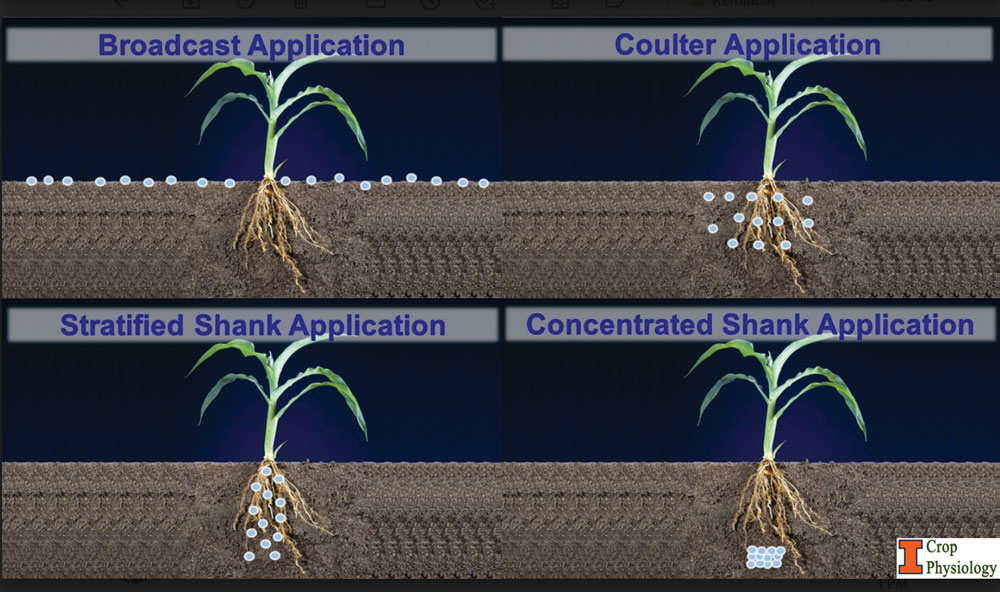
DIFFERENT APPLICATIONS. Fender and his team assessed the impact of fertilizer placement on strip-till using four application methods. The coulter application was about a 6-inch-by-6-inch placement of fertilizer. The concentrated shank applied all the fertilizer at the bottom of the furrow. The stratified shank application dropped the fertility down behind the knife, and layers formed as the soil filled in the shank trench. Jared Fender
“We had a 4-times increase in our P level just by doing it in the spring,” Fender says. “Our coulter also started pushing some of that K down through the soil profile. We’re starting to get some nutrient movement just by releasing it with water.”
The team dug corn roots — 3,216 roots to be exact — and weighed them to measure how fertility placement affected plant growth. It took about 6 days to wash them, so they’d be in good condition for 360-degree photos in a special “crop box” photobooth. Fender says the box captures pixel accumulation, which is converted into relative surface area.
“We can gauge how big the root is and get an asymmetry measurement, root angle, stalk diameter and root ball depth,” Fender says. “We don’t have to measure each individual root with a ruler. We can figure out how deep they grew based upon pixels.”
“Tillage timing affects your performance of strip-till…”
The photos and measurements revealed fertilizing in the spring resulted in a larger root mass compared to fall fertilization. Fender says a bigger root mass develops the closer the nutrient application is to planting. In 2024, there was a 1-gram increase in root mass between fall and spring, and tillage made roots bigger in the spring. More roots help corn plants take up more water and nutrients, plus they keep the plant anchored in place and can better withstand insect damage and disease, according to technical agronomist Jon Pruitt at Bayer.
Root angle also affects how much water and nutrients the corn plant will take up. Researchers at PennState found a steeper root angle improved N capture in corn and predicted a 10-degree change in angle would improve N uptake by 11% and plant biomass by 4% in low conditions. Fender says the root angle of the corn plants in his trial was the opposite of what he expected. They thought the concentrated shank’s smaller tillage intensity, which only ran about 2 inches wide through the soil, would cause the corn plant to grow straight down through the path of least resistance, while plants in the wider coulter tillage would spread out more.
“Our coulter had a tillage zone of about 6 inches wide, and we saw less root angle through it,” Fender says. “It’s actually growing straighter downward than our concentrated shank and our stratified shank. The shank has a lot wider root angle.”
The fall strip-till treatments also produced a wider root angle. Fender says some fertility gets tied up in the fall, forcing the corn plant to grow wide and down to find the nutrients.
Rethinking Strip-Till Assumptions with New Data
Jared Fender shared more data, photos and insights about how tillage timing affects strip-till performance at the 2025 National Strip-Tillage Conference in Iowa City. Click here to watch a replay of his presentation.
“Rooting structure will vary within strip-till,” Fender says. “Rooting structure changes throughout that switch in tillage because there are two different placements.”
Fender says many farmers think roots won’t grow down to fertility placed that deep, but the roots find the fertility every year, no matter how deep it is placed.
Yielding Results
The concentrated shank fall strips produced the highest yield in 2024 at 264 bushels per acre. Fall strip-till with a coulter and conventional tillage with fertilizer spread in the fall came in second at 263 bushels per acre. The spring-fertilized conventional tillage plot and stratified shank plot yielded 262 bushels per acre, but the spring coulter (258 bushels per acre) and concentrated shank applications (261 bushels per acre) lagged conventional tillage. The fall stratified shank, yielding 255 bushels per acre, did as well.
“The whole idea behind the three strip-till types is that we’re trying to prove that they’re equal or greater than conventional till,” Fender says. “Most of our unfertilized treatments proved that. When we added P and K into it and got tillage and fertility within the same pass, we kept yield levels relatively the same compared to conventional till.”
Fender notes how much of a yield difference can result from changing the variables when strip-tilling. The stratified shank plot with the spring fertilized application resulted in a 7-bushel gain over the fall stratified shank application.
“Tillage timing affects your performance of strip-till,” Fender says. “Fertility and placement affect your root development. We used one hybrid through the whole trial and saw different root angles and depths.”