
Brought to you by:
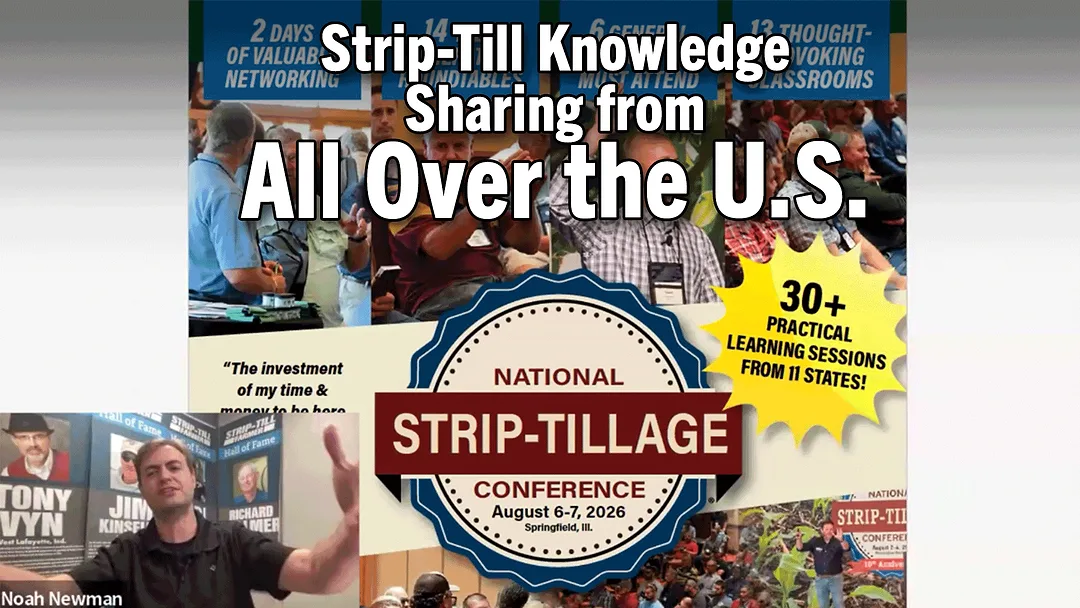
On this episode of the Strip-Till Farmer podcast, brought to you by Yetter Farm Equipment, managing editor Noah Newman previews the upcoming National Strip-Tillage Conference, taking place Aug. 6-7 in Springfield, Ill.
Hear from speakers Joe Ailts, Wes Arseneau, Clint Brauer and Robert Boyle as Newman unpacks the program and describes what to expect at the 13th annual event.
Plus, strip-tillers from Iowa, Wisconsin, Kansas and Arizona share their key takeaways and top highlights from last year’s conference.
Head to StripTillConference.com for more information on the program and to reserve your spot!




The Strip-Till Farmer podcast is brought to you by Yetter Farm Equipment.
Since 1930, Yetter Farm Equipment has been providing farmers with profitable solutions. From residue management and fertilizer placement to seedbed preparation, our equipment is designed to maximize your inputs, save you time, and deliver a strong return on investment. Explore our full line of planter attachments, precision fertilizer placement options, strip-till units, and stalk rollers at yetterco.com. Let Yetter help you prepare your equipment lineup for success today.
Full Transcript
Noah Newman:
Well, hello everybody. Noah Newman checking in here from Strip Till Farmer Headquarters with a special edition of the Strip Till Farmer Podcast. Big thanks to Yetter Farm Equipment for making this podcast series possible. And hey, we're about a week and two days away from the National Strip Tillage Conference. It's August 6th and 7th in Springfield, Illinois, our first time ever in the capital city for this 13th year event. And so I figured it'd be fun to have a podcast episode dedicated towards previewing this upcoming conference that we've been working hard to put together over the past several months. So I'm going to go ahead and share my screen here and we're going to just kind of dive into the program because I know there's a lot of questions about our conference if you've never been before. I know we have a lot of returning attendees every year, but we also have a good chunk of people who this is their first time, especially coming to Springfield, Illinois for the first time.
There's going to be a lot of people here that have never been to the conference before. So let's talk a little bit about what to expect. So consider this episode of the podcast kind of like your national strip tillage conference preview, if you will. See the cover of the program here? Two days of valuable networking, 14 idea generating round tables. Now the round table discussions, that's where you learn a lot of good practical information from other people. People will share what's worked in their operation, what hasn't, and you could really take those ideas back home with you to improve. We'll dive into some of the topics here in a little bit. Six general sessions, those are the presentations on the main stage. We'll have some dynamic speakers, some names you're probably familiar with, some maybe not, that they're going to be sharing some information to really challenge the status quo.
And then 13 thought-provoking classrooms. Now, classroom sessions are like the breakouts in the smaller rooms where you have a presenter touching on a really focused topic. So maybe it's something about cover crops or something about equipment or autonomous robots in strip till. Yes, that's right. We have a presentation like that this year. I'm going to tell you about that here in a couple minutes, but let's open up the program here. And if you want to come a day early, actually, there's still some spots available for this pre-conference workshop, which we're really excited about. Foreground by Bayer, putting together a great program out there at the Bayer Crop Science Research Farm. I think we're capping it at a hundred attendees, so there's still some spots available if you're interested in joining us out there though. That'll be Wednesday, August 2nd through 5th. And that's in New Berlin, Illinois, which is pretty close to Springfield.
I think it's like a 25 to 30 minute drive. Actually lived out in central Illinois for quite some time in my past life in the local TV world, so very familiar with Springfield and been to New Berlin quite a bit covering their football team. Does anyone know what the mascot is at New Berlin High School? The Pretzels, one of the most famous nicknames in the country, the New Berlin Pretzels. So yes, I could confidently say it's a short drive from Springfield and that workshop is going to be a lot of fun. There'll be dinner afterwards also. Barbecue, I've heard. So if you're a barbecue fan, there you go. All right, so we're going to kick things off Thursday morning with Brian Hefty, who is the longtime co-host of the popular Ag PhD radio and TV programs, the leading agronomy shows. We've been trying to get Brian to come to the conference for a long time, but have you ever heard of his hefty days that they host out there in South Dakota?
Well, the hefty days usually take place the same time as the strip-till conference, but with us being August 6th and 7th this year, well, hey, Brian's schedule opened up. And I could say that this is going to be a really meat and potatoes, as our boss Frank Lesser likes to say, style presentation. I mean, Brian's going to be diving into soil test data, nutrient levels, herbicides, and as you can see, feeding and weeding your strip-tilled crops, that's the name of the presentation. So he's going to help us learn how to pick the right fertilizers and herbicides for your strip-till operation. Sounds simple, but it's very complex and there's going to be a lot of information you'll want to be writing down your notebooks for that one. And then Dean Sponheim, heavily requested. So we have these surveys every year at the conference where we ask people, "Who would you like to see present?" And Dean's name came up quite a bit.
So I think Dean did a presentation several years ago at the strip-till conference, but I think this is the first time he's going to be taking the big stage in strip-till journey, lessons learned from the field and the mind. Dean will share some of the wins, setbacks, and hard lessons learned that only time can teach from his 30 years in strip-till. So he'll also tap into his passion for helping farmers navigate those psychological barriers of implementing change. He'll share strategies for dealing with the feelings of being overwhelmed that holds some strip-tillers back from making key improvements. So yes, there's a mental aspect of overcoming those barriers of this is how it's always done on the farm. We're making a switch to strip-till, or we're going to start using cover crops or using some new equipment. That's a challenge to make those changes, and Dean will talk about that a little bit.
All right, so here's our first block of classrooms coming up. Todd Moobery, the inventor of the strip freshener will be leading a classroom, tips and tricks to get the most out of your strip-till equipment. And then Joe Ilts, another heavily requested speaker, independent agronomist from Deer Park, Wisconsin, maximizing yield profit and soil health, an agronomist's take on having your cake and eating it too. You know what? Let's actually check in with Joe Iultz right now in Wisconsin. He's from one of his wheat fields, I believe, and he's going to tell us a little bit about what we can expect for his classroom presentation.
Joe Ailts:
Howdy everyone. My name is Joe Ieltz, independent agronomist from Northwest Wisconsin, coming to you from a wheat field that's just about to be harvested, and I wanted to express my excitement for the upcoming Strip-Till Conference presentation. We're going to discuss the intersection of agronomy and soil health where I'm going to bring a bunch of nuggets to the table that I think you're going to find pretty interesting. In fact, I'll go this far. I'm going to make a promise that if you don't leave that room without having learned at least one thing about how to implement agronomy and soil health, I'll stick around and make sure you do. So look forward to seeing you down there at the Strip-till conference here in a couple weeks. We'll see you then.
Noah Newman:
All right, there you go. Joe Alts with a big promise. And that's another thing about the Strip-Till Conference. He talked about sticking around afterwards. Yeah, you're going to have access to these speakers one-on-one time. If they don't answer a question you were hoping to get answered during one of their presentations or they said something that you're like, "Huh, that doesn't quite make sense to me." Well, guess what? Afterwards, you can go up to them, have a little conversation with them. And that's one of the great things about the conference, the networking that happens in between sessions. And elsewhere in this first classroom block, we also have another first-time speaker at the conference, Wes Arceneaux. He's a young farmer from Iroquois County, Illinois. He's going to be talking about his journey, how he's capturing strip-till success on challenging soils. And he has a good quote here.
He says, "I was conditioned to believe you couldn't strip-till unless you had good drainage." Everyone told me that. I went along with it for a long time until I learned you don't have to have the perfect soils to make strip-till work. In our experience, it works even better in the marginal stuff. So he'll dive into how strip-till and cover crops improve drainage and the chain effect both have on yields, nutrient uptake and soil health. So this is going to be one of those presentations where we try to have a good mix of strip-till 101 type presentations aimed at people who haven't strip-tilled yet, they're thinking about getting into it, or maybe they've only done it for a couple of years. We're also going to have those complex topics also for experienced strip-tillers, but this is one of those presentations where Wes is going to be helping people out who are just getting started with strip-till.
So let's actually hear from Wes right now. Take it away.
Wes Arseneau:
Hey everyone, Wes and Arceneaux here. Come see me at the 2026 National Strip-Till Conference. I'm going to be talking about how we've used strip-till to optimize our farm specifically on poorly drained and challenging soils. So if you're new to strip-till or you're transitioning over to strip-till, come check it out. I'll have some tips and tricks for you and hope to see you there.
Noah Newman:
All right, thank you very much for that. Wes, we're looking forward to seeing you there as well. And let's dive a little bit more into the program. Robert Boyle is our strip-till innovator this year. Man, he's doing some innovative stuff out in Coolidge, Arizona. I visited him out there my first trip to Arizona, enjoyed it. It was beautiful. It was a relatively cool 95 degrees when I was out there, which I'm told isn't too bad for the middle of summer. And of course you think of drought out there, Robert gets seven inches of rain in a year if he's lucky. So he's dealing with a lot of challenges, but he's also using cover crops out there. So he'll be talking about cover crops, twin rows, making strip-till work in challenging conditions. Next general session, fixing the leaks in your strip-till nutrient management plan, the dynamic duo of Chris and Chris, Chris Perkins and Chris Caston.
And I think this is the first time they've actually ever shared the stage together. And as you can see from the description here, they're going to detail a cutting edge data-driven approach that analyzes nutrient quantities, not concentrations to pinpoint excessive and deficient nutrients in your crops. And they'll also discuss the importance of nutrient balance and the crucial relationship between plant density, weight, and nutrient removal. So Chris Caston, he's a soil test data analyst. Chris Perkins is a 2024 strip-till innovator, two dynamic speakers, and we put them after the networking launch on purpose because we know that they are going to be able to hold your attention after that meal, and that's going to be some thought-provoking information shared.
Let's burn a quick timeout for a word from our sponsor, Yetter Farm Equipment. Looking for innovative solutions to maximize your farm's productivity? Look no further than Yetter Farm Equipment. They're dedicated to providing farmers with the highest quality equipment, from row cleaners and closing wheels, to fertilizer equipment, strip-till units, and stock devastators. Yetter has the tools you need to optimize your farming operation. Visit yetterco.com. That's Y-E-T-T-E-R-C-O.com to learn more and find a dealer near you. Some more classrooms here. As you see, our second block will feature five classrooms. Dean Sponheim will also be doing a classroom comparing his no-till and strip-till systems, the benefits of both, the challenges of both. Then we have a strip-till yield champs panel, Mark Schleisman. He had 317 bushels out in Lake City, Iowa. And a lot of you might know Mark. He does a lot of presentations or field days in the Hawkeye state, so we're excited to have him.
Brian Herbeck will be diving into his nutrient management strategies, building a balanced plate at the strip-till buffet. Brian has a lot of good information to share. We've had him at the conference before. Excited to have him back. Moving on down the program here, Brad Holbrock, this is his first time speaking at the Strip-Till Conference, and he was recommended by a few people, including Strip-Till Hall of Famer to be Jeff Martin. He's helped Jeff Martin a lot on his operation. So Brad will be sharing his good sense approach to plant and soil nutrition. And then you see here we have a classroom of strip-till product solutions. Several manufacturing companies will be sharing their solutions, new products and strategies for strip-till success. And then our round table. So this is our first block of round tables, and here are the seven topics for. These are concurrent round tables.
You can choose which one you want to go to, and there'll be a moderator there, and they'll kind of get the ball rolling, and then you guys take it from there. No cameras rolling, nothing recorded. This is just unfiltered discussion on topics like strip-till learning curve, key takeaways from the first few years, soil health building strategies, how to succeed with strip-till corn on corn, making the switch to narrow or twin row strip-till, biggest precision technology paybacks, strip-till toolbar adjustments and improvements, fertilizer placement and timing strategies for better strip-till outcomes. And a lot of people say the round tables, that's where they get a lot of their bang for their buck. That's one of their favorite sessions of the entire conference. And right now, let's hear actually from four farmers who attended last year's conference, and they're going to give you an idea of what to expect and what some of their favorite parts of the national strip-till conference are.
These are in order Mike Williams from Iowa, Randy Bump from Wisconsin, Ray Flickner from Kansas, and they aforementioned Robert Boyle from Arizona, so let's hear from them right now.
Mike Williams:
I'm having a great time, a lot of great knowledge, meeting some great people to visit with, bounce ideas off of. So been a very good experience so far. We attended a classroom session about cover crops and along and paired with strip-till, and the class was really good. It confirmed some of the things we're doing is we're on the right track. Also gave a few other things to incorporate for great ideas. Really important for us to be here today just because I think this is where the industry's going. Strip-till I think is a great thing to be in, soil health. I think from a production standpoint, from a fertility standpoint, we're just excited to see where we're going to go with this thing.
Randy Bump:
I really enjoy coming and talking to other growers, and I was here last year the first time, and I really enjoyed getting to talk to other guys. We're all trying to do the same thing, be successful with a strip-till and taking something away I think is why you want to be here. Plus, I also enjoy listening to all the people that speak because you should get something from them. So the two round tables that I went to were very good. I mean, they were full of people and it was nonstop. We probably could have went for hours in a couple of those things, so I really enjoyed that.
Ray Flickner:
This has been a real good experience in the fact that to get together with folks that have been strip-tilling for a long time and some that are considering it, for those of us that have been doing it for quite a while, it's a great opportunity to interact with other folks that talk about their trial tribulations, what works, what doesn't work, and then the advantage to see the vendors and what's available is a tremendous asset and a good learning experience.
Robert Boyle:
Where I'm at, there's not a lot of people that do what we do with the strip-tilling and the cover crops. And so for me to try to find other people to bounce ideas off of and talk to vendors, manufacturers, get different ideas, this is the closest place I can go to get that much information all in one spot rather than try to have to make a whole bunch of phone calls and guess around to what guys are doing.
Noah Newman:
Yeah, so if you're watching the video of this, you'll see on the screen there, I put together a promo code for you, promo code NOAA 50 when you sign up at striptillconference.com, that'll get you 50 bucks off your registration fee, so shameless plug there. You heard Robert and Ray in that soundbite talking about visiting with the vendors, and that's another aspect of this conference. In between sessions, our 16 title sponsors, big thanks to them, this event wouldn't be possible without their support. They're going to be there with booths and you'll be able to check out maybe a couple row units or see what some new things that they have to offer. I've heard countless stories of people coming to the conference and going home with operation changing information they picked up just by picking the brains of some of these manufacturers. And so let's shout out our title sponsors.
You could visit with them at the conference, Ag Leader, Ag Synergy, Case IH, Dawn Equipment, ETS, Foreground by Bayer, Huma, Koon Krause, Land Lover, Linx, Nutrien Economics, Total Farm Marketing, Unverferth, Vulcan Equipment, Yetter, and Zimmerman Manufacturing, the who's who of all the strip-till experts and manufacturers. So we're excited to have them on board. All right, let's continue running down the program here. You can earn while you learn. Yes, the National Strip Tillage Conference attendees may earn continuing education credits through the American Society of Agronomy and Soil Science Society of America. So you can earn certified crop advisor credits by attending these sessions in areas of nutrient management, soil and water management, crop management, and precision ag. So Friday morning kicks off with a networking breakfast, and shortly after that, we'll introduce you to our 2026 Strip-Till Farmer Hall of Fame inductees. We've got Charlie Hammer and Nancy Kavanjian.
Hope I didn't butcher that last name. Nancy, I'll get it right before the conference, I promise. They're from Wisconsin. We have Mark Bauer, creator of the Soil Warrior from Minnesota, and the aforementioned Jeff Martin from Mount Pulaski, Illinois, so we'll have a nice ceremony and hear from a few of them who will be in attendance. And then Marion Calmer, four time lessener media speaker of the year is back with our premier lecture series, innovative strip-till strategies to boost the bottom line. The legend will detail his 10 by 10 by 10 system for strip-till and cover crops and talk about how he aims to supercharge yields with the best of both worlds by combining 10 inches of cover crops with 10 inches of strip-tilled corn and 10 more inches of cover crops. Marian's always highly entertaining with his presentations, and he's also going to bring the data from his independent on-farm research.
So he'll comb through data to determine the correct depth for P&K placement and also discuss the keys to chopping and spreading residue evenly ahead of fall strip-till and cover crop seeding. Then after that, seven more sensational round tables. Topics include residue management, tips and tricks, dialing in strip-till for soybeans, managing manure applications, fall vers spring strip-till, tactics and tools for strip-till weed management, making cover crops pave a strip-till, and strip-till strategies for higher corn yields. And then former strip-till classrooms, I mentioned, I alluded to this earlier, the next gen strip-till with robots in the rows, this is Clint Brower. He's going to be having a strip-till classroom talking about his robots with Greenfield Robotics and how he thinks they're a perfect fit for a conservation system. I actually caught up with Clint to talk about that recently, so let's listen into a clip of my conversation with Clint Brower here.
It seems like why is a strip-till or a no-till or a conservation system, why is that a really good fit for this?
Clint Brauer:
Yeah, I mean, what we did this last summer, and they did it as no-till, but I think it would've been better as strip-till, and we talk about it all the time, the farmers and I, that's part of why I love to do it. Farmers, we just go through stuff and we have open discussions constantly and try things. But I think the strip-till, you can go in and you're going to have a little bit of weed pressure right there in row, as you know, as a strip-till expert, but if you keep those cover crops maintained between the rows, you have nothing between the rows. And so these bots are perfect for that, and they can fly around and just maintain that. If you go, "Hey, it's going to get dry, I'm going to go ahead and just cut this really low so they don't absorb much water." The theory on some of these things, just so you know, is when you cut something, it's similar to animals grazing.
I'm a regenerative farmer, so if you graze too hard, stuff doesn't come back very fast because you stunt the roots. You can stunt them up to 20 something days where the roots are basically like, "I'm not growing this plant." And so that's kind of our theory. Early in the season, we try to cut lower, and so we do more root stunning. Now, with the cover crop, you might want to let it grow early in the season and have more coverage, but you might say, "You know what? It looks like drought's on the horizon. Let's just cut it low and stun it," and then that's the other thing. So that's kind of where. I didn't really know what I was doing when I started this seven, eight years ago about any of these things, and these are things you learn. You
Noah Newman:
Want to learn about new information and where the future of farming and strip-till's going, and here's some new information you're not going to get anywhere else. That's what you're going to get at this conference with presentations like that from Clint Brower, and he'll explain how robots, which can also microspray nutrients, achieve this mission by working in harmony with strip-till and cover crops to create the ideal conservation system, and he'll detail how bots are being deployed on farms in 11 states and share his outlook for the future of technology and autonomy in strip-till. Hey, look up here, classroom number 12. We have the one and only Harmon Wilts from Minnesota leading a session, sharing his five-year plan for implementing strip-till and proving it works. So really looking forward to having Harman back at the conference. He's attended several, and this is the first time we've had him present, maybe ever, I believe, at least in my short time here, putting the programs together.
And we'll wrap things up in the main room with our anniversary lecture, rebuilding a conservation-minded fertility program with Don Branton and Chad Branton from Leroy, New York. And that's one of the themes here. With the conference, you'll notice is we have speakers from all over New York, Iowa, Arizona, Indiana, Illinois, Nebraska, Kansas. And that's the big thing about this conference is you're going to be hearing ideas from people who have made strip-till work in different conditions and soil types. So chances are you're going to run into someone from your neck of the woods and you'll really be able to connect and exchange ideas or learn a thing or two from people in other regions that you could take back and apply to your operation. And yeah, that's going to wrap up the strip-till conference preview. I just wanted to check in and share some of this information with you guys, and feel free to shoot me an email nnewman@lessermedia.com if you have any questions about the event or any of the sessions.
Striptillconference.com is where you can go to learn more, download the program, or sign up and hope to see you there August 6th and 7th in the capital city for the 13th annual National Strip Tillage Conference. Again, thanks for tuning into this edition of the Strip Till Farmer Podcast. Big thanks to Yetter Farm Equipment for making this series possible, and we're looking forward to seeing Yetter at the Strip Till Conference as one of our 16 title sponsors. Until next time, for all things strip till, head to striptillfarmer.com. See you next week at the conference. Thanks for tuning in.