
Brought to you by:
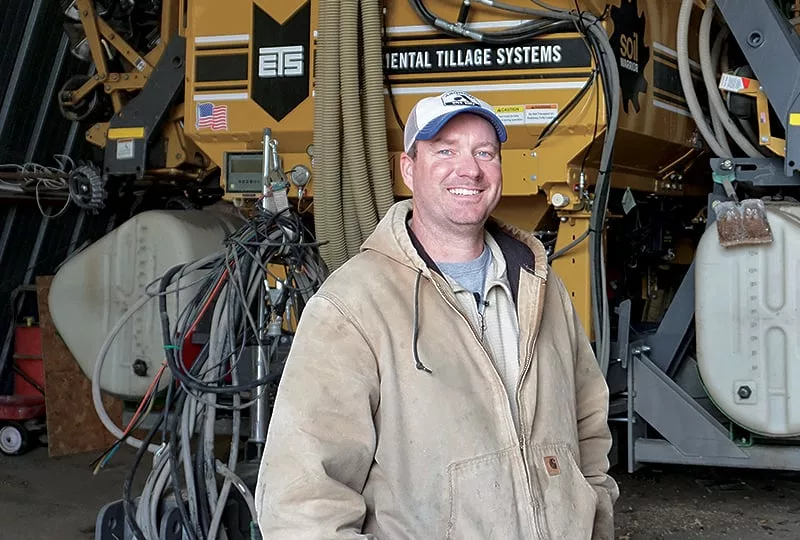
On this episode of the Strip-Till Farmer podcast, brought to you by Yetter Farm Equipment, we catch up with Brian Herbek for a deep dive into his strip-till nutrient management strategies.
Planning for the unexpected and managing variability are areas where Deweese, Neb., strip-tiller Brian Herbek has focused his nutrient management strategy since adopting the practice in 2009. Farming both dryland and irrigated farmland on his 1,900-acre corn and soybean operation, Herbek has embraced the challenge of finding more effective, efficient ways to apply fertilizer, conserve moisture and improve soil health.
Herbek explains the importance of balancing your nutrient management plan and discusses how many strip-tillers are leaving money on the table by overapplying or applying nutrients that have negative interactions with each other. He also dives into his strategies with humics and micronutrients and a new “game-changing” product he’s using that’s enabling him to cut his nitrogen use by 50%.




The Strip-Till Farmer podcast is brought to you by Yetter Farm Equipment.
Since 1930, Yetter Farm Equipment has been providing farmers with profitable solutions. From residue management and fertilizer placement to seedbed preparation, our equipment is designed to maximize your inputs, save you time, and deliver a strong return on investment. Explore our full line of planter attachments, precision fertilizer placement options, strip-till units, and stalk rollers at yetterco.com. Let Yetter help you prepare your equipment lineup for success today.
Full Transcript
Noah Newman:Hello, and welcome to the Strip-Till Farmer Podcast. Thanks again to our sponsor Yetter Farm Equipment for making this series possible. I'm your host, managing editor, Noah Newman, and boy, oh boy, we've got a good conversation for you today with Deweese, Nebraska strip-tiller, Brian Herbeck. So planning for the unexpected and managing variability are areas where Herbeck has really focused his nutrient management strategy since adopting the practice in 2009. And today, he's going to explain the importance of balancing your nutrient management plan, he'll also discuss how many strip-tillers are leaving money on the table by overapplying, and will dive deep into his strategies with micronutrients and a new product he's using that's enabling him to cut his nitrogen use by about 50%. Well, first thing is just tell us a little bit about your operation, where you're located, how big your farm is, and what kind of crops you grow.
Brian Herbeck:So, we're located in South Central Nebraska, full town called Deweese. We farm about 2000 acres, corn and beans. We're 100% strip-till fifth generation farmer.
Noah Newman:So, I was going to ask you how many acres were under strip-till. You're a fifth generation farmer, but are you a first generation strip-tiller or how long have you been strip-tilling?
Brian Herbeck:First generation. We adopted, let's see, I think it was in '06, I think we started dabbling with it, and in... Oh, I think in like 2010, I think is when we went to 100% on our row crop strip-till.
Noah Newman:And what was the motivation for getting into strip-till back then, if you recall?
Brian Herbeck:Some of it, when I first got into it, it was just trying to change the practice, trying something different, and then we realized the residue management was huge for us. We liked that. And then as we evolved into it and our operation grew, we understood the logistics of it as far as fuel savings, time savings. It's just me and my wife doing most of the day-to-day stuff, we don't really have a hired man or anything. So, we knew that taking on more acres, we needed to be more efficient. And so, that was a big play, and that's actually when we upgraded to, when we got involved with ETS. They're really the ones that made it possible. We tried their rental program for a while, and we were able to get in there and see the machine and utilize the nutrient placement, and that we were like, once we did that, we were sold, and like I said, we haven't looked back since.
Noah Newman:So, you're running a soil warrior, how big is it? 12 rows, 16 row?
Brian Herbeck:We actually have two of them now. We run a 16 row liquid, we have a 12 row dry and liquid, we have both systems on it. But right now we're evolving more into a liquid system. So, we're using the liquid most of the time in the spring. So, we fixed our nutrients, or we've got them closer to balance of what we like, and we're needing less and less. So, just again, one of those logistic things we've been able to cut back, and just apply what we need now, and now we're not needing the other machine quite as much.
Noah Newman:Yeah. I was going to dive into your nutrient management because I know we've done a few articles on you in the past, focusing on your usage of micronutrients and increasing your nutrient efficiency. So, let's start with your strip-till system. So, when are you building the strips and what are you applying when you're building the strips?
Brian Herbeck:So, right now, if we need any phosphorus or potassium or anything like that, we tend to try to apply those in the fall, hence that's where the dry box comes in. We're more efficient on that. So, any non-leachables, we try to get in on the fall, but again, we're predominantly switching over into the liquid side because we don't need those nutrients as much. So, on the liquid, we are applying our nitrogen, our base rate of nitrogen, we're applying humics, we will apply sulfur or [inaudible 00:04:47], in some cases, we'll apply some copper, some potassium if needed, phosphorus if needed. Yeah, we really focus on what our soil samples and tissue samples are telling us before we make an application.
Noah Newman:So, how does your-
Brian Herbeck:And another-
Noah Newman:Oh, go ahead.
Brian Herbeck:Another note on that that we've really, really been watching, and I really want to bring it to a lot of strip-tillers attention is, what we are doing in the solution, how much the pH of the solution is affecting our availability of what we're applying. We watched that really, really close now, and we've seen our efficiency levels just skyrocket here in the last few years since we've really been honing in on that. And every time that you make an application, there's always a reaction. And we're very conscientious now of the 4Rs program, that right place, right time, right rate, all of that, and how important that is, choosing the right product, the right amount, and how that affects just the availability to that plant. When we overload that system, we lose a lot of inefficiencies.
And I feel like in the strip-till community, we've lost a lot of that, where we think we're more efficient by putting it in the strip, if that makes sense, but sometimes with what we're adding to it, we can lose that efficiency in the same sense, if that makes sense at all.
Noah Newman:No, absolutely. It kind of reminds me of an analogy I heard. Going to a buffet, when you see all this food, you put it all on your plate, then you get back... You can't eat it all because you get too full. You're saying that's what happens with the plant, if you just throw all this stuff on it-
Brian Herbeck:Exactly. You put a piece of prime rib in front of you at the buffet, AKA nitrogen, what's it going to do? It's going to founder, it's going to take up all that prime rib, and now you don't have room for the meat and the potatoes, and the stuff that we really, really need to be efficient and be healthy for the longevity to make it to run the race. And we do that a lot in the strip-till. We don't realize we're doing it, but again, that's one of those things that we've really, really been watching is what is the effect that we are causing when we apply to the particular soil conditions that we have because it can vary so much. If we have high pH soils, we can go one way, if we have low pH soils, we can go another way.
Where's our CC? And how all of that takes a play in what we decide to apply. We're actually finding some cases we are having to pull some of that stuff out of the solution because we can't fix it. We're causing more harm than good, and you have to take that old... What's the old saying, the moron effect? You can't approach it that way. If a little bit's good, moron is better, it's not. We really, really have to watch that reaction that we're going to have when we make an application.
Noah Newman:Yeah. So, how do you dial in all these rates that you use? What's your soil testing process like? Are you doing that every year, or are you tissue testing, or...
Brian Herbeck:So, we base a lot of things... We start with our soil tests, that gives us a 30,000-foot view of, okay, what are we dealing with, and what we think is going to be the reaction, and from past data, we have a lot of data that shows with our tissue samples, especially, we extract a lot of that data, and we know where we need to be at certain levels, and when we're not hitting that mark, that's when we start to dive in as why? Why is our phosphorus levels not where we want them to be? Is it because we are lacking it in the soil, or is it because our calcium is out of whack, our zinc is out of whack? Did we raise the pH too quick in our strip to tie up some of the phosphorus? So, that's what we look at. So, soil samples, tissue samples, and then we're bringing in yield maps, how [inaudible 00:10:14] those numbers back to yield.
And sometimes, actually I've been pulling away from that. Yield is not everything. We really need to flip that [inaudible 00:10:30] over to efficiency. Because there's just... Everybody wants to raise 400 bushel corn, or 300 bushel corn, but economically and efficiency-wise, it may be off the table. But where can we hone that in and say, all right, 240 bushels or whatever that number is, is where we need to be with the numbers that we have. And when we have that data set or we have that capability to see into the future, we stop spending money, or we know that we need to make a change. We've tapped ourself at 240 bushel. If we want to go to 300, what are the things that we need to start pulling out, and what is that... The big coin phrase of, what is our limiting factor? And what is that? Where can we spend money efficiently?
It's different in an environment that we are right now when there's not a lot of meat on the table right now, so we need to be just as efficient as we can, and we're not going to be doing no fixing this year. We're going to be just trying to get by. But if we set ourselves up for that, and we know, hey, we've got to do this, this, this, to reach those goals, we'll be a lot more efficient on our money spent, if that makes sense.
Noah Newman:Yeah, absolutely. Now, what's one thing that you're doing differently now in your strip-till system that you weren't doing when you first started? In other words, how has your system evolved, and what do you think a lot of strip-tillers... What are some mistakes maybe, for lack of a better word, many strip-tillers make when they first get started? Does it just all tie back to that applying more than they need to, or?
Brian Herbeck:I think that's where I have evolved, went from making the strip for my residue management, that was step one. Step two was, hey, I've got this tool, now I'm going to put my nutrients down. And well, in the past I was putting on say 100 pounds of whatever, MAP DAP, whatever it was, across the whole field, and I was raising this crop. Well, now I'm putting it in the strip, I should be more efficient. There's a lot of guys that don't cut it back as much as they should, and I was one of them. I didn't quite understand the efficiency there and the concentration. And so, as I've looked at that more and more on how important it is now, then that's where I'm at in my journey now is what is my limitation? And there are limitations of, I don't care 200 bushel corn or 500 bushel corn, there's only so much that we can put in that... There's only so much prime rib that we can put on the buffet so that we don't throw ourselves out of balance.
And so, that's one of the things that I've really, really changed here in the last probably three years, is getting that efficiency rate down, and backing my rates back so that I'm not overapplying and overloading the system with whatever I'm applying. And when we do that, you see our biological activity will start to ramp up a lot more efficient, because it's not... The way I look at it, if you've got too much nitrogen out there, everything's trying to work on the nitrogen and do this and that, and it's wasting a lot of time and a lot of efficiency. Where, if we get just enough nitrogen, just enough phosphorus, just enough potassium, copper, boron, sulfur, you name it, right down the list of what that plant needs, dialing those numbers in for strip-till is even better, or even more... We need to watch it even more.
Because we have this mindset and a lot of it comes from the universities and a lot of trial data of... A lot of these recommendations are the whole profile of the soil, right? So, we've got every square inch of the farm needs 100 pounds of X, Y, Z or whatever it is, but when we get into the strip-till mindset, we're not applying that. So, now we're concentrating it, right? And we are throwing that ecosystem out of balance. And so, we really, really have to pay attention to quantity of... If we're only applying it... I go back to the soil warrior, say, they say that we're applying when we're going four to five inches deep, we're eight inches wide, we're disturbing 33%, or we're able to apply it in 33% of the profile of the soil, if that makes sense.
Noah Newman:Yep.
Brian Herbeck:So, when you look at that, I should be applying 33% of the recommended rate, and a lot of times that is true. So, if you're applying 100 pounds of nitrogen across the whole field, and you're getting it on every square inch, we should really only be applying about 33 pounds instead of 100 pounds, just so that we're not throwing that system out of balance. And every nutrient is the same. Now, do I have the magic number for every nutrient? No, not yet, that's what we're still working on. I do know that... I was actually out at the University of Illinois, I think it's Fred Below.
Noah Newman:Yep.
Brian Herbeck:I think that's where he's at.
Noah Newman:Yeah.
Brian Herbeck:Well, some of his... I think he's retiring, but some of his grad students, I was able to be out there this summer and visit with some of them, but one of his grad students, that's one of his projects now, is what reaction are we having with the fertilizers that we're applying? How are we changing the pH, or how are we changing the biological activities? He's supposed to be diving deeper into that. We had a pretty long conversation of it. First person I've ever had the chance to talk about it, and that we were bouncing ideas off of each other. So, I'm hoping that there's more and more data that will come out of looking at a system like this, and how important that it is that we need to be paying attention to that reaction that we're causing.
Noah Newman:Let's burn a quick timeout for a word from our sponsor, Yetter Farm Equipment. Looking for innovative solutions to maximize your farm's productivity? Look no further than Yetter Farm Equipment. They're dedicated to providing farmers with the highest quality equipment, from row cleaners and closing wheels, to fertilizer equipment, strip-till units, and stock devastators, yetter has the tools you need to optimize your farming operation. Visit yetterco.com. That's Y-E-T-T-E-R-C-O.com to learn more and find a dealer near you. Are you applying any nutrients in season, side dressing, or doing anything crazy in season?
Brian Herbeck:Yes. So, like I said, we've backed our rates off pre-plant with our strip-till quite a bit, and so doing the math, we know that we need to apply a lot more in season. So, we do predominantly most of our heavy loads are wide drop. So, we're adding a lot of nitrogen sulfur that's going to come through the wide drop application. And that may be one application or two applications, it all depends on... It all depends on our yield goal. If we're at a 240 bushel, we're a one application. If we're at a 300+, it's going to be two applications. Again, we go back to that, the moron is not always better, so we always try to find out what the right ratio is. And we do do some fertigation, that gives us another tool in the toolbox, and we'll do... We've been doing... And by doing this, we feel like we're raising... I don't have any scientific studies done on this, or this is purely observation.
But it seems like the more and more we do that, and we bring our nutrients more into balance, and we're not overloading that plant, we see our disease levels tend to be a lot less, and we feel like we're raising a better plant, a healthier plant, and it's able to combat a lot of those pathogens. We know over application of nitrogen, crown rot is direct correlation there, that if you've got crown rot, most generally, it's over application of nitrogen at one time, typically earlier in its life. And we feel like a lot of these [inaudible 00:21:58] pathogens are the same way. Tar spot, I can't say maybe southern rust, that's kind of a different... But tar spot, maybe gray leaf spot, bacterial leaf strike, anything that... Any disease, it's just like a human.
When we're on our game, and we're eating healthy, and everything is... We tend not to ... The sicknesses and that tend not to be as detrimental to us, and it's the same way with a plant. When we can keep that plant balanced, we feel like we're going to see less and less need on fungicides. And also the same way on insecticides also, because when a plant goes into stress... When you overload the plant, and you send it into a stressful situation, it emits hormones, and it's just the way God made it, we're going to take out the weakest in the bunch. And when that plant is releasing these hormones, typically you will see a higher population of bugs, bad bugs, if you might say. Because they're there to attack that crop and to kill it, they want to hurt that crop. Well, if we can keep that plant from signaling that, and keeping it more balanced, keeping it healthy, then I'm hoping that we're going to see a lot less need for pesticides in the future too.
And like I said, I don't have a lot of scientifics, but there's a lot of data out there showing that when you get your balance in your plant right, these things aren't as much of a detriment. Or the fungicides work better, or the insecticides work better because they're not trying to fight off the whole army, it's just easier that way.
Noah Newman:Yeah. It's a giant chain reaction. If you get your nutrient management right, it affects everything. So, looking-
Brian Herbeck:So much of that, yeah. And so much is about getting that plant off to the right start. And I don't know, I always use the analogy of a calf. We used to have a bunch of cows. If that calf doesn't get the colostrum within a certain amount of time, I don't care what the genetics are, I don't care what any of that is, if that calf doesn't get started off right, it will show it through its entire life all the way to the end. And I think there's a lot of us that are missing that boat, we're not getting that upfront nutrient and starting that plant like it should.
Noah Newman:Yeah, that's a good analogy. I might put you on the spot with this one, but what's one or two or a few... What are some micronutrients that you see most strip-tillers not applying that you think every strip-tiller should apply?
Brian Herbeck:I don't know if it's micronutrients, but humics, trying to get that carbon, probably copper. I don't know... I think there's a lot of guys already kind of running boron. Boron is kind of a touchy situation, you got to know what you're doing. Again, that goes to that balance thing. You can throw that strip out of balance real quick with boron.
Noah Newman:Yeah, that's a tough one. And like you said, every field's different.
Brian Herbeck:Yeah. I can't really say, put boron out there and you're going to see... Well, if you put boron, it's got to be in that right situation. But we look at all of... It's like what a good friend of mine says, David Hooley, he says, "It's a game of numbers, that's all it is." And if this farm or this plant needs copper, boron, molly, zinc, all of these, we got to put it out there. We got to balance that soil. And I'd say probably one of the most underlooked as far as balances to me that I see a lot of deficiency in is zinc. Zinc is probably one of the... There's a lot of guys using that, but I don't think they're using enough, or they're not using it in the right situation. So, zinc is very, very important, and a lot of things come available because the biology feeds off of zinc.
There's certain biology in the soil that feeds off of zinc. And when you get that in balance, you'll see phosphorous come more available, you see manganese come more available, copper, all of these things can be elevated just by adding or getting the zinc ratio right, or enough elemental pounds of zinc out there.
Noah Newman:Looking ahead-
Brian Herbeck:If that makes sense.
Noah Newman:Yeah, it makes sense. Looking ahead to 2026, anything new you're trying this year?
Brian Herbeck:So, right now we are actually... One of the big things that we had a really big success in last year, and we're going to dive a little more deeper into this, and I don't know if you want to name any products, but we got involved with a company called Redox Bio-nutrients, they're out of Burley, Idaho, but I don't know if you've heard of them or not. But they have a different mindset when it comes to this... They call it plant charge balance. And when you get that balance, how things, like we've been talking, how things become more efficient. But they have a product called RDXN, it's a nitrogen efficiency aid, it's a very low use rate that we can put... We've seen it last year, we cut our...
And I'm not recommending this, to go this route. But we've seen we cut our nitrogen rates in half by 50%, and our yields were better, and we used 50% less nitrogen. And I think something like that is going to be a big play in the environment. And also, when you start looking at that logistically, especially strip-till, when you can take a 1500 gallon tank and get over twice as many acres, you have less fill-ups, just logistically it's huge, but also when we start getting into some of these watersheds, environmental issues, I think something like this is going to be huge.
And that's I'm really excited about it. I think it's going to be a great fit for especially strip-tillers, because just like I was saying earlier, when we're concentrating a lot of that fertility into a smaller area, when we have to start backing some of those rates out, but now that we can put a product or change the metabolic pathways within that plant to be more efficient, but yet now we're still achieving the same yield goals, I think things like that. So, I'm really excited to get more involved in that, and try to get my nitrogen use efficiency down. Because I even think with the way that the new administration now, this is going to be something that's going to, whether administration changes or whatever, but healthier food, healthier environment, all of those things are going to be a big play.
If we can start applying 50% less nitrogen... The big ag isn't going to like it, not at all, they're probably going to buy some politicians, but who cares? We've got to start thinking of our water supply and building a healthier food system. And that's what I'm really, really excited about this year is diving deeper into the balance of nutrition, to the balance of nutrition in the product that I'm providing, what kind of nutrient value do I have within my... The corn that I grow, is my corn got a higher nutrient value to it than say my neighbors, or the guy that's across the street that's just farming for whatever? There's going to be value in that because that ultimately goes to the end user.
If my corn has more nutrient value in it and I sell it to the pig farmer, he, one, doesn't have to feed in there as much, but it also makes his pork, his beef, whatever it is, chickens, turkeys, a lot more efficient or a lot more nutrients in it for healthier consumption of humans. Anyway, that's my rant.
Noah Newman:No, well said. Very well said. Well, yeah, that's interesting, I had not heard of that. Redox, how do you spell that?
Brian Herbeck:R-E-D-O-X.
Noah Newman:R-E-D-O-X. Interesting. Have to look into that.
Brian Herbeck:I really do think it's going to be a game changer. And not only strip-till, but just the farming, the way that we are having to change, just like I was saying. People are understanding, we're raising strawberries or we're raising corn or whatever it is, looks like strawberry, half of them don't taste like a strawberry, but it sits on the Walmart shelf and we buy it. But when you dissect it, and you pull it apart, it doesn't have near the nutrient content it does when I go to my dad's garden and pick that strawberry out of there, and how much better that's going to be for society when we take that into... Because it's all tied together. My corn goes to feed the hogs or the turkeys or whatever, that gets consumed by my kids, my kids are healthier because we're not missing those nutrients that are very, very important to having a balanced diet.
Noah Newman:And that'll wrap things up for this edition of the Strip-Till Farmer Podcast. Big thanks to Brian for taking the time to talk with us, and also thanks to Yetter Farm Equipment for making this podcast series possible. YetterCo.com for more information about everything Yetter has to offer. Until next time for all things strip-till head to striptillfarmer.com. I'm Noah Newman, have a great day.