A trio of strip-tillers in Iowa are making big strides in their quest to improve water quality and prove that conservation practices are profitable and scalable.
Earlier this year on the Strip-Till Farmer podcast, James Hepp informed me about The Lobe Rangers — a new conservation group he founded with fellow Iowa strip-tillers Zack Smith and Matt Bormann. They named their group after the Des Moines Lobe — a “flat, tongue-shaped region in north central Iowa with some of the world’s most fertile soil,” as described by Iowa Public Radio.
“We feel like we’re going backwards in progress, even though our leaders are saying we’re doing better every year, especially in the Des Moines Lobe, the area we farm on,” Hepp told me at the time. “There’s a lot of heavy tillage and nitrate levels are really high in the water.”
Shortly after joining forces, The Lobe Rangers posted the following mission statement on their website:
We Are Three Farmers From the Des Moines Lobe.
We’ve been farming this land for over a decade using strip-till, cover crops, and in-season nitrogen application. Not as an experiment. Not as a PR strategy. As a business model that works.
We know firsthand that you can raise abundant, profitable crops while protecting soil and water. We are doing it.
But we are also fed up.
We’re tired of watching ag lobbying groups talk conservation at the podium while meaningful legislation dies in the statehouse. We’re tired of voluntary programs being praised as progress when, after 13 years, they haven’t moved the needle.
We’ve read the Iowa Nutrient Reduction Strategy. It clearly states that 60–80% of Iowa’s landscape must adopt both in-field and edge-of-field practices to see meaningful nitrate reduction. That level of change has not happened. And pretending otherwise doesn’t serve farmers or the public.
Like many Iowans, we have too many family members and friends dealing with cancer. We live in a state with the fastest-growing cancer rate in the country. That concerns us — not as activists, but as dads, neighbors, and community members.
It’s time Iowans heard from farmers who are thriving by adopting the changes required for cleaner water and a stronger future.
“We have a gubernatorial race coming up here in Iowa,” Hepp says. “So, we reached out to each candidate, and surprisingly, they all spoke to us. We had great conversations and a great dialogue with all of them. They listened. They asked good questions. We’re unbiased. We’re not political. We’re not going to endorse anybody. We’re just running right down the middle of the road, dropping truth bombs for everyone and letting them know that conservation farming is scalable.”
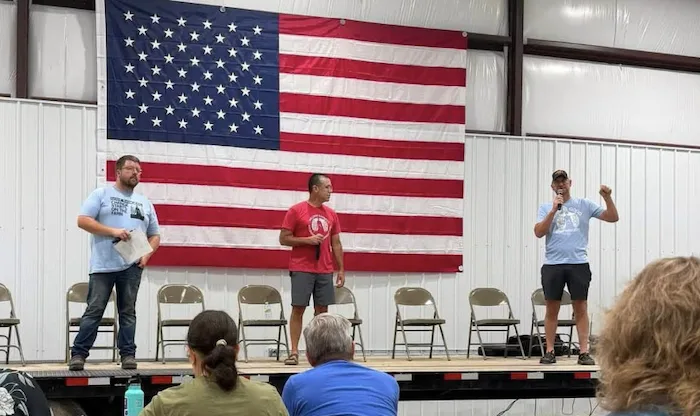
The Lobe Rangers dropped some of those truth bombs during their first field day at Hepp’s farm last Saturday (July 25) near Rockwell City. Unfortunately, I couldn’t make it because of a family matter, but roughly 200 people packed the place, including farmers, lawmakers, representatives from Des Moines Water Works and advocates for better water quality, according to Iowa Public Radio’s coverage of the event.
“We think regulation is coming, and I think that it's time that we start shaping that ourselves as farmers in our own terms,” Bormann told Iowa Public Radio. “We have science, plenty of it, that says this stuff (conservation practices) works, and farmers aren't going to go broke doing it. We as farmers need to set the bar ourselves before somebody else writes the rules for us.”
“One of the downfalls (of the Iowa Nutrient Reduction Strategy), in our opinions, is it relied on voluntary change to happen,” Smith said. “It was a good idea off the bat to give farmers time to adapt, but we're 13 years later and we haven't adapted at a rate where we can expect meaningful results.”
Attendees got an up-close look at some of Hepp’s conservation practices, which include strip-till and cover crops, strip-till equipment and a rainfall simulator demonstrating the effects of soil health management. There were also educational presentations and panel discussions.
“The big thing is we just want conversation,” Hepp says. “We’re not pointing fingers. We want people to try stuff. Most of this stuff is not new. There are guys that have been doing no-till, strip-till, in-season application for decades, so you're not going to bet the farm on this stuff and lose.
“The biggest drag we get is people will say, ‘Well, is that scalable?’ We let them know, it is scalable. This isn't crazy stuff you can only do on 80 acres. And a lot of people say, ‘Well, we can't afford to do it.’ That’s when I get out my calculator. It's like, OK, so you're going to go from two tillage passes conservatively, say $50. Sure, you might spend $30 or $40 on a cover crop, but remember you just saved $50 on tillage. You'll get cost share programs. They'll wipe out most of that cost for right now. You reduce your herbicide by a third. And not to mention, you're literally doing less passes.”
The Lobe Rangers are clearly going the extra mile and making a difference in their community. But that’s not a big surprise, after watching Hepp and Smith present at past National Strip-Tillage Conferences and seeing how well their messages resonated with fellow strip-tillers.
I look forward to following The Lobe Rangers’ journey and seeing what they have in store next!