
Brought to you by:
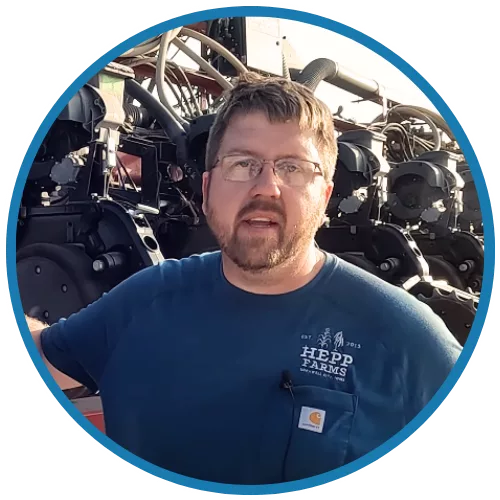
On this episode of the Strip-Till Farmer podcast, brought to you by Yetter Farm Equipment, we catch up with first-generation strip-tiller James Hepp in Rockwell City, Iowa.
Hepp shares tips for getting into strip-till with a limited budget, reallocating resources toward practices like sap testing and highlights his approach to making strips in both the fall and spring.
The first-generation farmer also discusses The Lobe Rangers — a new conservation group he formed with 2 other Iowa strip-tillers — and explains how they’re educating lawmakers and gubernatorial candidates about the impact and scalability of strip-till, no-till and cover crops
.




The Strip-Till Farmer podcast is brought to you by Yetter Farm Equipment.
Since 1930, Yetter Farm Equipment has been providing farmers with profitable solutions. From residue management and fertilizer placement to seedbed preparation, our equipment is designed to maximize your inputs, save you time, and deliver a strong return on investment. Explore our full line of planter attachments, precision fertilizer placement options, strip-till units, and stalk rollers at yetterco.com. Let Yetter help you prepare your equipment lineup for success today.
Full Transcript
Noah Newman:Hello and welcome to the Strip-Till Farmer Podcast, brought to you by Yetter Farm Equipment. I'm your host, managing editor, Noah Newman. Great to have you with us as always. Thanks for tuning in. All right, today we're headed to Rockwell City, Iowa to catch up with first generation strip-tiller, James Hepp. He'll share some tips for getting into strip-till with a limited budget, reallocating resources toward practices like SAP testing and highlight his approach to making strips in both the fall and spring. Plus, Hepp discusses the Lobe Rangers. It's a new conservation group he formed with two other Iowa strip-tillers, and he'll talk about some of the things they're doing to educate lawmakers about strip-till, no-till, and cover crops. Let's jump right in. What have you been up to? Are you getting ready to plant soon or what? How busy are things right now?
James Hepp:Yeah, today, well, yeah, we're pretty busy. My wife's pregnant with our third child due any day now, so I'm kind of on house arrest. Can't really go very far in case she needs me and one of those deals. And we're trying to haul corn to the ethanol plant. So I got a couple trucks running today and I'm running the auger for them. I got seed coming in, guys delivering seed, and I got my Spraytec products going out the door too. So we're delivering that. So we're kind of dishing it out and taking it in all at the same time.
Noah Newman:Wow. Where do you get the energy to keep up with all this, new baby, planting season? Do you drink a lot of coffee or what?
James Hepp:No, I don't know. I'm not really sure. It just happens, I guess.
Noah Newman:Very impressive. Well, congratulations on the baby.
James Hepp:Yeah. This one's a girl. So we'll have two boys and a girl.
Noah Newman:Oh, that's a perfect mix. My mom would be jealous. We're all boys, four boys.
James Hepp:Oh, yeah. I can see that.
Noah Newman:Well, anyways, let's talk a little strip-till before we dive into this conservation group that you started. But first, for people who aren't familiar with your background, how did you get into strip-till?
James Hepp:Sure. Well, kind of like in a nutshell, I'm a first generation farmer here in Central Iowa and took over a guy that was retiring and he had a lot of good equipment and he was doing a lot of strip-till also, and I just kind of took it to the next level. And so I kind of worked myself into strip-till. It wasn't my idea, I won't take credit for it. But I started working on it, making it better. And so that's kind of how I got into strip-till and no-till and all that stuff like we're doing right now.
Noah Newman:Do you make strips in the fall, spring, or both?
James Hepp:In the past, we were all fall. And then the last few winters, the way the wind's blown and no snow cover, I didn't really like all the dirt blowing, so I've kind of transitioned into spring. And a local guy has a really nice fancy machine that does it very reasonably. So I've been having him do some custom... Because my rig is mainly for fall. So I let him do the strips in the spring on some acres.
Noah Newman:What kind of strip-till rig do you own? And then what kind does your custom strip-tiller own?
James Hepp:So mine is a old, like a Blu‑Jet anhydrous bar basically is what it was in its original life. And then we swapped out the knives and some coulters and some of that stuff. So it's pretty simple. And honestly, it's about the best strip-till machine a guy could have on a budget. And then the most important thing I think is the cart. So it has a nice Montag cart that we pull behind and it holds about eight tons of fertilizer. It's just a single compartment, nothing fancy, but it is a very good quality cart and they're really good to work with. They're right up the road here from me and Emmetsburg, about an hour and 20 minutes. So parts are never an issue and we really haven't had any issues honestly with it. So that's what mine is. My custom guy, he has, I think it's, I don't know if you pronounce it right, but it's on a links or whatever.
Noah Newman:Yeah, links. Yep.
James Hepp:Yeah. Is it links?
Noah Newman:Yep.
James Hepp:Okay, gotcha. Yep. So he's got a links and it'll do fall or strip or in the spring. So he'll have it swapped out to coulter for the spring. He just got it last year and did some fall strips of his own. He didn't do any custom last fall. So the spring will be the first custom stuff that he does. So he's going to do a third to half my corn acres will be done with that. And then the other rest I'll be dabbling in no-till corn with cover crops.
Noah Newman:Now are you having him apply any nutrients with the strip-till rig in the spring?
James Hepp:Yeah. Yep. We'll have different rates. He'll be applying 32% UAN fertilizer in a blend with ATS, which is a sulfur product. So he'll be applying anywhere from 5 to 15 gallons per acre with that machine and covering it up. That's kind of the plan anyways, because we have a two or three stage nitrogen process where we'll do that and then I'll Y-Drop or we'll do that streamer bar and Y-Drop kind of combination. I like to have lots of tools in the toolbox, lots of different options.
Noah Newman:Yeah. And as you've said in the past, but your favorite tool though is the calculator, right?
James Hepp:Yep, that's right. Yeah, that's the tool everybody needs.
Noah Newman:I mean, because you're proof that you don't have to have a huge high dollar setup to strip-till.
James Hepp:Right. Yeah. And a lot of times you're probably better off to let somebody do it. I mean, I hate letting people do other stuff on my field, but you're better off to go do something, make money. If you can pay someone 20 or 25 bucks an acre to do it, you can't go spend a couple hundred grand on equipment and upgrade tractors and fuel and insurance and all that. I mean, especially if you're only doing a couple hundred acres, unless you got money burning a hole in your pocket, that's just not feasible. You're better off putting that money towards, like I said, a Y-Drops for your sprayer or something like that. Reallocate those dollars, just a better ROI, in my opinion.
Noah Newman:Yeah. I was just going to bring that up because that was one of the interesting things you talked about in your presentation was reallocating resources. And the one that you mentioned was SAP testing. I think you said you invested about 4 to $5,000 in that, and you think it saved you at least 30 to $35,000, right? The SAP testing. Tell us a little bit about that.
James Hepp:Yeah. And if a new guy started cold turkey, he'd probably save that much to more. I mean, and we were doing that. That was on about 600 acres of corn. We've been SAPping corn really hard. We're just starting to start SAP testing soybeans. And basically in a nutshell, SAP testing is like tissue testing on steroids where we take a leaf from the lower part of the plant and then the higher part of the plant, and then we send them off separately and get them tested. And if the bottom one, the oldest leaf starts losing nutrients, you'll see it ahead of time because the plant's cannibalizing.
So before your top new leaf shows a shortage, you'll see it long before, like several weeks in advance and you can stop that shortage. So it's kind of a big deal. And we've been doing it for about three years now. We're starting to chart a pretty good course. We're seeing patterns, so we're starting to add different nutrients at different times of the year to try and knock out some of these issues. And of course, anytime you fix one thing, you create two more problems, but we're definitely gaining.
Noah Newman:Yeah. So how does that work? Does it take a long time to get the results back from the SAP testing?
James Hepp:No. Nope, nope. I go out about every Monday morning on corn and I'll run around for about two, three hours and I'll grab a bottom leaf and a top leaf, keep them separate. Same spot, same spot all year long. And then our local parts store has a UPS drop off. So I put it on ice packs and a cooler and I send it off. I try and be done by 10:00, 11:00 and send it off on a Monday. It goes to a lab in Michigan from Iowa. And I normally will have something in my email Wednesday night probably, Wednesday night to Thursday morning. And we've flown as fast as Thursday afternoon before, once we got the results back and kind of knew what we were going to apply anyways, and we were out spraying. So you could easily, if you caught something, you could be doing something within a week easy.
Noah Newman:Wow, that is really fast. So strip-till, SAP testing, you mentioned no-till and cover crops. Are your cover crops only on your no-till fields or do you use cover crops with strip-till too?
James Hepp:Yeah, they're on everything. I have every acre cover cropped. Yep.
Noah Newman:Cereal rye or a mix or what do you use?
James Hepp:Yeah. So on corn stalks, going to soybeans, I have a three-way blend of rye, a little bit of triticale, and then a splash of camelina. And then I'm going to corn from on soybean stubble. Let's see, it's a triticale, a little bit of rye, and then the same splash of camelina. So we have kind of a three-species mix going. Triticale does not bother your corn like rye does, and rye just works really well in soybeans and doesn't bother it. So that's kind of why we run that.
Noah Newman:And do you have to terminate before you make strips through it or what's that process like?
James Hepp:Not really. With that coulter machine, it doesn't really matter. The big thing with termination and doing a good job with that, because we do a lot of non-GMO corn, so Roundup in the postpass is not an option. The big thing is you want to have, they say, two to three nights of 50 degree overnight temp before you terminate, and that just makes the termination a lot, lot better. So that's pretty important. I kind of follow that religiously.
If it ain't warm enough, I just don't spray. So we're not putting down a lot. There's only probably about 35 pounds of seed out there, so it's not too bad. And the machine can go right through it. And whatever the coulter machine will hit, it'll terminate and chop it up and probably kill three-fourths of it wherever it's running. So it's really not an issue. So we'll probably experiment with that. If it warms up, we might kill some early. If it don't, we might do it after he does the strip-till before we plant. Just kind of depends on the weather. Who knows? We're in for quite the weather this spring, it sounds like I've heard, about every forecast under the sun. Hot, cold, wet, who knows?
Noah Newman:Oh my gosh. It's unpredictable. I don't know about where you are in Iowa, but in Wisconsin here about a week ago, we had a blizzard on Monday.
James Hepp:Oh, yeah. Yeah. We had one Saturday, Sunday, was it last week or the week before? I can't remember. But yeah, it was pretty awful. We lucked out. We only got an inch or two of snow, so we had knee-high drifts, but you couldn't go anywhere for about a day and a half. It was 40 mile hour wind and about 40 foot visibility.
Noah Newman:Yeah. And then just a few days later, at least here, it was like 60 degrees. It was a huge swing in temperatures.
James Hepp:Well, today's Monday. Saturday, it was like 88, 90 degrees here.
Noah Newman:Wow.
James Hepp:And then last night it was 25.
Noah Newman:Let's burn a quick timeout for a word from our sponsor, Yetter Farm Equipment. Looking for innovative solutions to maximize your farm's productivity, look no further than Yetter Farm Equipment. They're dedicated to providing farmers with the highest quality equipment, from road cleaners and closing wheels to fertilizer equipment, strip-till units, and stock devastators. Yetter has the tools you need to optimize your farming operation. Visit yetterco.com. That's Y-E-T-T-E-R-C-O.com to learn more and find a dealer near you.
James Hepp:[inaudible 00:11:02]
Noah Newman:Does that do anything to affect your planning date or is that you don't really have that in mind yet?
James Hepp:Well, normally I'm pretty conservative. I'm not an extremist, so I'm never the guy out planting corn at 5:00 AM on April 10th, the plant date. I'm never that guy, so it doesn't really throw me off. Traditionally, I like to plant my beans first. I'll plant them a little deeper. I've never had any issues with that. So when April 15, insurance day rolls around, if it's fit, we're rolling on beans. And then if it looks nice and it's going to stay nice, then I'll start planting corn. But otherwise, I don't have any problem planting corn first week of May. Just have it come out of the ground in 10, 12 days versus 30 days. I like that better.
Noah Newman:Yeah. It seems like that's the perfect time right there in early May. All right, let's talk about the Lobe Rangers, this conservation group you started. Tell us a little bit about it.
James Hepp:Yeah. Well, my friend Matt, he's way up north of Humboldt. We started a group. It was a Snapchat group, a bunch of guys. We called us just a bunch of rogue farmers in Northern Iowa. It was called the Strip-Till Mafia, kind of a joke. And we just had a bunch of guys. In order to get in the group, you had to send a picture of disc ripped or chiseled soybean stubble. It was kind of a joke like initiation, but we were tired of constantly seeing... We feel like we're going backwards in progress, even though our leaders are saying we're doing better every year, especially in the Des Moines Lobe, which is kind of the area we farm on. There's just a lot of heavy tillage, a lot of front load for tillary going on in the fall. Nitrates are really high in the water.
And so there's three of us. There's about 15 in the group and about three of us were outspoken. And so then we got together and well, we reached out to some of the political... Because we have a pretty good gubernatorial race coming up here in Iowa. So we reached out to all the candidates and surprisingly, they all spoke to us and we had really great conversation, great dialogue with them. They listened. They asked a lot of good questions, a lot of good feedback. We've talked to them several times. We have a good Secretary of Ag race going on too. So we talked to a bunch of people and we're like, "Man, we're on something here. These guys really need us." And we try and be unbiased. We're not political. We're not going to endorse anybody. We're just running right down the middle of the road, just dropping truth bombs for everybody, telling people that, "You can farm in a conservation mind and it is scalable."
It's not something you just can do on aunt Edna's 80 acres. There's a lot of guys that are 5, 10,000 acres that are farming like us, so there's really no excuse for it. So then we decided, well, we needed a catchy name. And one night we were just talking and one of us come up with the Lobe Rangers and it just stuck. And ever since then, everybody's loved it. And so now we've been talking to a lot of groups. We have a lot of big news coming up here shortly this summer. We've been having constant Zoom calls with lots of groups and meetings. And our first video, we went live, I think it was two weeks ago probably. I think we're up to like 45,000 views on it within a week. We had over 25,000 within a couple days.
Noah Newman:My God.
James Hepp:So it was really taking off. And we have like 1,000 followers and stuff. And so it's really taken off. Everywhere we talk, talk to people. We've talked to hundreds of people by now. We're getting a lot of support, very little pushback. A lot of guys have reached out to us and said, "Hey, we're not going to verbally say what you're saying, but we agree. We do need to do better. We can do better." But obviously they're not going to speak out, which is fine. So we're getting a lot of good response from people on it.
Noah Newman:Yeah, that's incredible. Almost 50,000 views. And you guys are a new group too. And that's pretty amazing that all the lawmakers you spoke to all got back to you guys and wanted to have the conversation. And what were some of the biggest eyeopeners from those talks you had with some of the candidates and the lawmakers? Anything surprise you in those conversations or were they surprised by anything that you guys had to tell them?
James Hepp:Yeah, I would say most of them, as we get further and further removed from the farm, we lose that firsthand knowledge of stuff. And I would say all of them, without a doubt, were surprised at what we were doing on our farm. And some of them were even kind of grumpy and angry and they feel like they've been kind of lied to, which is probably accurate, that we're showing them firsthand like, "Hey, we do this. This guy does it." And now they started researching like, "Wow, you're right, you can do that." So yeah, so it's been overwhelming how much good ... They've come back to us. Some of these politicians, we have a group text with them. They'll message us every couple weeks, "Hey, I heard this. Is this true? What do you think about that?" So we just want to be that lighthouse in the storm.
And just if we talk to everybody, we always win because somebody's got to win the race, but we just want to be that source of info, non-bias. And like I said, the way the farm economy is with succession planning and all that, we really got to get something going here for profitability. And if we don't, I think it's going to get pretty ugly in the next 10, 20 years as we have one of the biggest land transfers ever in world history almost.
Noah Newman:Yeah. And you guys are actually doing something about it by starting this group offset, that's pretty impressive. I mean, a great job to you guys.
James Hepp:We never thought we would be able to do much, but we've been shocked by it. I don't want to say we're start a revolution, but I think it's coming. And our long-term goal is to keep this going forever. We want to get bigger and have other states have chapters and have it more local grassroots. Almost kind of like how some of our commodity groups are now, we want to have almost like a conservation group where people can get together and more regional and talk about problems and what works and what don't work. And overall, the biggest thing is we don't want to point fingers. We're not trying to point fingers. We just know everybody knows we have to do better, we need to do better, and let's just fix the problem. And if we fix the problem, we'll increase profitability. And if you increase profitability, the next generation will come back. So there's really no cons to doing this stuff. It's like all pros. It's just a win-win all the way around.
Noah Newman:Yeah. So if people want to learn more about you guys or watch your videos or read stuff from you, how can they find you? Are you guys on a social media platforms?
James Hepp:Yep. We're going to be on everything. Right now, if you go on Facebook, it's the Lobe Rangers. If you put that in on your search bar, you'll see us. Let's see, we're on Facebook, Instagram, TikTok's coming soon. We'll be on pretty much everything here within the next month. We have a media group we're working with now that's professional and way better at this stuff than we are, and they're doing a great job. Yeah, just keep an eye on our videos. Our goal is to drop about three videos a week, and these videos will be anywhere from kind of political information about the nutrient reduction stuff to what I do on my farm. And like I said, we have some big news coming. We can't let the cat out of the bag yet, but we got some stuff coming. So hopefully people will hit like and share.
And like I said, we'll be having events in Des Moines this summer. We'll let people know when that's going to be. So we'll be able to come out and talk. And big thing is we just want conversation. Like I said, we're not pointing fingers. We want conversation. We want people to try stuff. Most of this stuff is not new. There's guys that have been doing no-till, strip-till in season application for decades, so you're not going to bet the farm on this stuff and lose.
Noah Newman:Yeah. When I first took this job and I first started visiting some farmers, they'd tell me like, "Oh, yeah, my dad's been doing no-till since the '70s." They just never got the publicity or the coverage or wanted to really put it in the spotlight. So it's been going on a lot longer than you think.
James Hepp:Yeah. The biggest drag we get is people will say, "Well, is that scalable?" So we make sure we try and mention that almost like we're on a soapbox, just beating the dead horse, because it is scalable. Like I said, this isn't crazy stuff you can only do on 80 acres. So it is scalable. That's a big, big thing on that. And a lot of people say, "Well, we can't afford to do it." So then that's where I go with my calculator. It's like, okay, so you're going to go from two tillage passes conservatively, say 50 bucks. Sure, you might spend 30 or 40 bucks on a cover crop, but remember you just saved 50 bucks on tillage. You'll get cost share programs. They'll wipe out most of that cost for right now. You reduce your herbicide by a third. And not to mention, you're literally doing less passes.
You can spend more time with your family and get the same end results. So I'm not sure where you're getting the, "We can't afford to do this." It's kind of a pet peeve of mine, but we hear a lot of it. We're trying to get rid of these rumors. And we got some podcasts we're going to be on here too in the next few weeks. So hopefully you'll start seeing us everywhere. Like I said, we're getting good responses.
Noah Newman:Well, I'm sure we will start seeing you guys. You're making a name for yourself. So the Loeb Lobe Rangers. Yep. Okay.
James Hepp:Great.
Noah Newman:People in our audience will definitely look you guys up. I'm sure they'll be watching your videos.
James Hepp:Yeah. Yeah. And we do want feedback too. We're going to be making future videos over. We've been kind of keeping a score on what people say in the comments. And so if you see our videos and like it or don't like it, either way, leave a comment and we will keep building on the videos. So we want to answer questions for everybody and just try and influence people. Like I said, we're not going to pick politicians, but we're going to try and influence people to seek out the politicians that will create the change for cleaner water, healthier soils, like seek that out and just make our politicians work, make them get to work and make them solve problems for us.
Noah Newman:Yeah, absolutely. And you were telling me you're going to have a field day on your farm this summer, is that right?
James Hepp:Yeah. Yep. Yep. We're still working on the date. So if you have me personally, James Hepp, H-E-P-P on Facebook, it'll be on there. We'll try and share it a few other places, but probably be late June, early, mid-July is kind of when we normally do. We just finished up my shop project here. So we normally get 70, 80 people here. We'll be talking ROI and just conservation stuff, stuff you can do on your farm. I'll do my famous calculator speech like I did in St. Louis.
Noah Newman:Well, I'm going to do my best to make it out there, so I'll keep an eye out for a date for that.
James Hepp:Yep. Sounds good.
Noah Newman:Anything new that you're trying on your farm this year?
James Hepp:Yeah. So we're going to be doing more wide dropping, adding more nutrients in the wide drop. We're going to be trying different timing. We've upping our sulfur rates a lot. We're putting probably 60, 70 pounds of sulfur down on our corn and a pretty good shot on our soybeans, and we're seeing a really good response on that. So like usual, we'll be drinking from a fire hose, trying new things, spreading the nutrients out, doing more in season. Some of my nitrogen's not going to go out before we plant. Some of it's going to go out with stream bars like around V2, V3. So that will allow us to cut our nitrogen back even more and kind of apply it right at the right time, right time, and increase our efficiency. So kind of trying to find that sweet spot.
Noah Newman:Great stuff as always there from James Hepp. Thanks so much for tuning in. Thanks to our sponsor, Yetter Farm Equipment as well for making this podcast series possible. Once again, yetterco.com for more information about their offerings, that's yetterco.com. All right, until next time for all things strip-till, head to striptillfarmer.com. For all things Strip-Till Conference, head to striptillconference.com. Program's also out if you want to check it out. We're in Springfield, Illinois this year, August 6th through 7th. Thanks so much again for tuning in. I'm Noah Newman. Have a great day.