I spoke with Quint Pottinger, a young farmer from New Haven, Ky., the other day about some gutsy changes he made on his farm in 2025-2026.
Looking to slash equipment costs and keep his 8th-generation farm economically sustainable, he sold his two big-frame tractors and two 16-row planters and replaced them with a small 135-horsepower tractor and an 8-row planter.
But the big kicker? He was going to start planting all his crops autonomously.
“All the pieces for autonomy are there. Let’s put it together and do it now to save some money,” Pottinger said.
Autonomy Ingredients
He bought a Sabanto autonomy kit, which retrofits to the tractor. It includes antennas, a dual GNSS receiver, obstacle-detection sensors and video cameras.
Starlink and Precision Planting’s Panorama are the other key pieces to Pottinger’s autonomous puzzle. With Panorama, he can monitor what’s happening on the planter remotely and make key adjustments. Starlink provides Wi-Fi connectivity for the 20|20 monitor and serves as a backup for the Sabanto system, which relies heavily on cellular connectivity to maintain accuracy.
Autonomy in Action
Pottinger became the first farmer in the Bluegrass State to plant his entire crop with a driverless tractor, joining fewer than 50 farms nationwide, according to the Kentucky Department of Agriculture.
He spent about $200,000 total on the small tractor, planter and autonomy kit, significantly less than his old equipment setup, which cost about $750,000.
Last fall, Pottinger autonomously seeded wheat, rye and barley for the first time.
He took it a step further this spring, autonomously planting corn across 850 acres, many of which were no-tilled green into thick cereal rye.
“We had trouble getting seed depth at 3.5 mph, changed the gear and stuck it at 2.8,” Pottinger says. “It took an hour and a half longer to do the field, but it didn’t matter because it planted all night and got the job done. We had great seed depth and now we have a great stand.”
Smaller & Slower
While many seem to be going bigger and faster with equipment, Pottinger is going in the opposite direction with autonomy — smaller and slower. And so far, it’s working, he says.
“We’re planting at 3.5 mph and that sucker is running up to 20 hours a day. We’re getting good seed placement and better crop stands than we could’ve hoped for, especially in no-till.”
Pottinger says if autonomy can work on his irregular fields, shaped by creeks, rivers and hillsides, it can work anywhere.
“My family’s seen many changes over the years. The one constant is we keep adapting. If farmers are honest with themselves, they’ll look deeper in their history and say, ‘We can adapt and there are things we can do better that will serve the people around us.’”
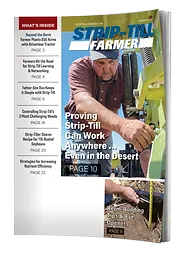
Pottinger’s story is a great way to kick off this summer edition of Strip-Till Farmer, which features our 2026 Strip-Till Innovator on page 10. In the face of rising input and equipment costs, are you considering making any drastic changes like Pottinger did? Let me know at NNewman@LessiterMedia.com.