Sabanto received a major boost in its effort to accelerate adoption of its autonomous retrofit technology, closing an oversubscribed Series B funding round led by Leaps by Bayer with participation from Sustainable Forward Capital, InnoVenture Iowa, Fulcrum Global Capital, DCVC and Yara.
“This investment represents a major step forward in bringing practical autonomy to more farms,” says Craig Rupp, CEO and founder of Sabanto. “We believe the workhorse of the future is smaller equipment. Our retrofit approach allows farmers to shift labor toward higher-value tasks, increase operating hours, and ultimately focus on growing their business and their bottom line. We’re seeing too many farms fold under economic pressure and our solution levels the playing field.”
Overall, the investment intends to support the following for Sabanto:
- Expanded commercialization and dealer network growth
- Increased retrofit kit production and deployment
- Continued software and autonomy platform development
- Expanded customer support and field operations
- Accelerated adoption within the row crop market
Inside the Investment
As the strategic investment unit of Bayer, Leaps has invested over $2.1 billion in more than 65 companies innovating emerging technologies in agriculture and health.
Paimun Amini, VP of agriculture venture investments at Leaps by Bayer, says Sabanto’s retrofit model stands out from the competition by offering a scalable and practical pathway to autonomy, especially in today’s challenging farm economy.
“We believe this technology offers options that can reshape how labor and equipment are utilized in row crop farming and beyond while also supporting more sustainable farming practices,” says Amini, who prioritizes team and technology when evaluating potential companies to invest in. “When we ran the unit economic check with farmers on what it would take to implement a retrofit system and move to an autonomous operation, there wasn’t a single instance where the math didn’t ink out in their favor.
“The second element was the Sabanto team,” he adds. “We know Craig Rupp from his days with 640 Labs. Knowing his team and the number of technological advancements they’ve made in the past, it was an easy decision to support them.”
Leaps has some experience in the autonomy space, but primarily with drone companies like American Autonomy. Through Monsanto Growth Ventures, the company also invested in Blue River before it was acquired by John Deere. The new investment in Sabanto will help open doors for the company to expand its customer base across North America and beyond.
“There are two elements of what we do well at Bayer — one is developing products and the other is helping products go to market,” Amini says. “Sabanto has hundreds of devices deployed already. Now, they’re looking at market expansion, not just in the U.S., but in places like Brazil, where I’m currently meeting with a bunch of our leading agri-dealers. It’s really all about opening those networks for Sabanto to expand commercial operations to broader markets.”
Sabanto currently has 11 dealers in California, Florida, Georgia, Kansas, Missouri, Montana, Ohio and Texas, and an additional 18 dealers in Australia. The company aims to expand its dealer footprint over the next 12 months and help more dealers deploy and sell the technology.
Proving Autonomy Works
Rupp says the investment from Leaps validates the direction Sabanto is headed and adds credibility to its product, marking a shift from asking “if” autonomy will work in agriculture to asking “when” it will be widely available.
“In the early days of the company, there were a lot of doubts about whether this was a credible technology,” Rupp says. “But as time went on, we proved it could work, and the very first thing we did, at minimum, was get a viable product in the farmer’s hands. They knew it needed some improvements and that it was only going to get better. Over the last couple years, we’ve been adding features and making those improvements.”
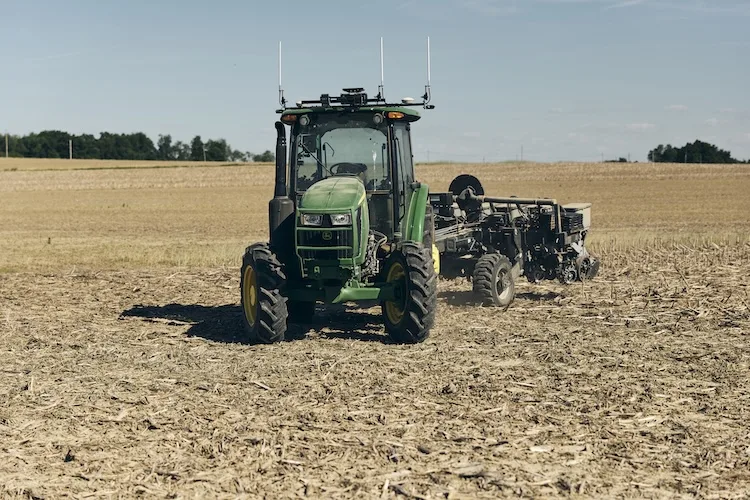
Sabanto’s retrofit kits have been commercially available for almost 3 years. “We went from zero systems out in the market to between 200-300 systems now,” Rupp says. The kits transform tractors into fully autonomous machines, with a cloud-connected communications system, multiple GNSS receivers, obstacle-detecting sensors, video cameras and an onboard AI processing unit.
Sabanto targeted the sod industry when it first went to market, but with a team rooted in Iowa and Illinois, its core focus has always been row crops, particularly corn and soybeans.
“I’m starting to see autonomous operations scale more rapidly, and there’s been more widespread acceptance of the technology,” Rupp says. “Farmers understand this is the future and that companies are working towards it. And a lot of them even believe there will be a day when they have an autonomous tractor operating on their farm. With each system we deploy, we’re getting closer and closer to that.”
All in on Autonomy
Rupp's vision became a reality on Quint Pottinger’s farm near New Haven, Ky., in 2026. The eighth-generation farmer used the Sabanto retrofit kit to autonomously seed and plant all his crops.
“Everybody seems to be saying autonomous planting is 5-10 years away,” Pottinger says. “We looked at it and said, ‘All the pieces are there. Let’s put it together and do it now to save some money.’”
Pottinger pushed all his chips in, selling his two big-frame 8000-series John Deere tractors and two 40-foot 16-row planters and replacing them with a small 135-horsepower John Deere tractor and a 20-foot 8-row planter.
“That was the defining moment,” Rupp says. “Quint realized he had too much capital on his books and that money was sitting every year depreciating and he could use it for something other than equipment. He could use it for cattle, and that’s exactly what he did. He’s buying cattle with that extra cash.
“When I started Sabanto, I looked at autonomy as something that could solve the labor problem,” Rupp adds. “But I also looked at it form a different point of view in that it’s going to fundamentally change the way field operations are performed. And it all came down to replacing capital expense with more hours. We’ve peaked in horsepower and now we’re going to move in the other direction because of autonomy.”
Equipped with Sabanto, Precision Planting’s Panorama and Starlink, Pottinger became the first farmer in the Bluegrass State to plant his entire crop with a driverless tractor, joining fewer than 50 farms nationwide, according to the Kentucky Department of Agriculture.
“We’re the first farm globally to do it at the farm level without being a research or company project,” Pottinger says. “We received no assistance and paid full retail price for our new equipment without having to go in debt.”
Pottinger spent about $200,000 total on the small tractor, planter and autonomy kit, significantly less than his old equipment setup, which came with a price tag of $750,000.
Last fall, Pottinger autonomously seeded his winter crops — wheat, rye and barley — for the first time. “I think a lot of people saw us do it in the fall and said, ‘Great, it works in grains but doing it in a row crop is different.’” He proved skeptics wrong this spring, autonomously planting corn across 850 acres, many of which were no-tilled green into thick cereal rye.
“We had trouble getting seed depth at 3.5 mph, changed the gear and stuck it at 2.8,” Pottinger says. “It took an hour and a half longer to do the field, but it didn’t matter because it planted all night and got the job done. We had great seed depth and now we have a great no-till corn stand.”
Smaller & Slower
While many operations seem to be going bigger and faster with equipment, Pottinger is going in the opposite direction with autonomy — smaller and slower. And so far, it’s working, he says.
“Spend the money so you can plant faster, till faster and get the crop in quickly — that’s the message coming from equipment manufacturers,” Pottinger says. “Their point is, don’t have two 40-foot planters, have one 40-foot planter that you can run 10 mph. We took a different approach. Instead of planting at 5 mph, we’re planting at 3.5 mph and that sucker is running up to 20 hours a day. We’re getting good seed placement and better crop stands than we could’ve hoped for, especially in no-till.”
“I was in New Haven a couple weeks ago and of course Quint was the talk of the town,” Rupp says. “He’s a trendsetter and marches to the beat of a different drum. But I think what’s more important is the bankers are taking notice. And when bankers take notice, the conversation has changed from technology to the economics of autonomy. And when I read that article about Quint, I was thinking, ‘Yes, it’s happening.’”
Pottinger says if autonomy can work on his irregular fields, shaped by creeks, rivers and hillsides, it can work anywhere.
“And with the ag economy the way it is, farmers are looking for new ways to cut costs and that’s important to keep these mid-south farms alive,” Pottinger says. “When you go smaller and you slow down, you start to look at other things you can change on your farm.”
Making Farming Possible
Many farmers have followed in Pottinger’s footsteps outside of the Corn Belt in states like Kansas, Montana and Oklahoma, to name a few.
“A lot of our customers have told me, ‘I wouldn’t be farming this year if it wasn’t for you guys.’ Obviously, everyone knows the economics of farming is in poor shape right now,” Rupp says. “It all comes down to if you want to keep farming, you must do one of two things. You must make more money or save money. And making money is exceedingly difficult right now. So, saving money is where a lot of farmers are heading.”
Sabanto’s retrofit kits are currently compatible with about 24 different tractor models, but the company is working to add more models to the list.
“We’re brand agnostic. I don’t care if your tractor’s green, red, yellow, orange, it doesn’t matter to us. I’m trying to leverage the equipment that’s already in the industry. We’ve always said that your next generation tractor is already sitting in your machine shed.”
To help continue making strides, Rupp put together an advisory board consisting of about 24 farmers. They meet with COO Cory Spaetti monthly. Spaetti fills them in on the latest developments with Sabanto.
“What they do is provide feedback to him,” Rupp says. “And it’s only Cory. I’m not in it. No sales. No marketing. These farmers really lead our product portfolio and help us make improvements. We don’t have customers, we have accomplices, and these farmers are an example of that. We’re completely transparent and show them the good, the bad and the ugly.”
Just over 6 years ago, Sabanto started building its first autonomy kit. Three years ago, Strip-Till Farmer sister publication Precision Farming Dealer visited with Spaetti as the company prepared to go to market. And now today, with a big investment from Leaps, Sabanto is poised to take the next big step in its journey.
“Three years from now, autonomy is going to be mainstream,” Rupp says. “The future I see is multiple smaller systems (in the field). It makes complete sense to me. Smaller systems are more scalable. They’re easier to work on. They’re less complicated. They’re more fuel efficient. Three years ago, if I said there’s going to be a day when a farmer’s going to farm all his corn acres autonomously, everyone would’ve laughed at me. If I said it a year ago, they would’ve said it’s not going to happen. Well, it happened already.”