
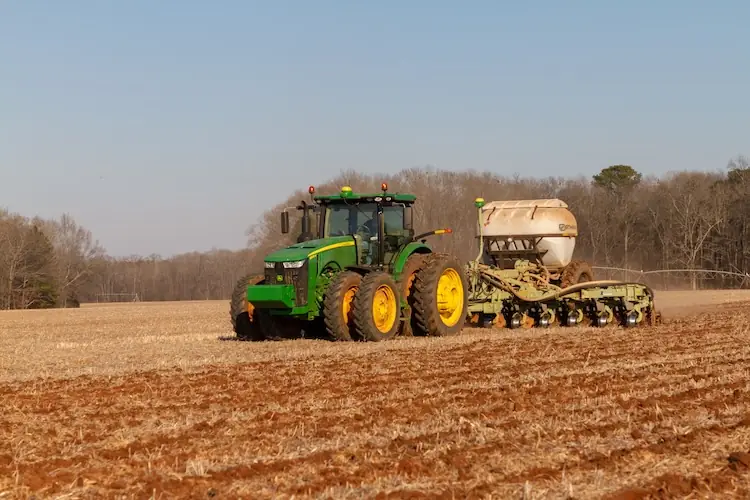
Strip-till provides growers with an opportunity to combine the benefits of no-till with the advantages of conventional tillage practices, disturbing only a narrow strip of soil while leaving crop residue between the rows. This practice reduces erosion, conserves moisture and creates a warmer, drier seedbed that often improves early plant growth. At the same time, it changes how potassium (K) is distributed in the soil profile.
Strip-till also allows growers to place nutrients beneath the soil surface and closer to the crop’s rooting zone through deep-banded fertilizer placement (typically placed 6 inches deep). For relatively immobile nutrients such as K, this subsurface placement can improve early-season access for roots and limit the buildup of K near the soil’s surface. Successfully managing K in a strip-till system requires finding the right balance between fertilizer placement, soil sampling accuracy, soil-test interpretation and long-term crop removal. The research discussed here comes from corn-soybean systems in the Midwest, so growers should interpret the results in light of their own soils and local recommendations.
Soil Sampling Considerations for Strip-Till
Accurate soil sampling is the foundation of any K management program. One of the greatest challenges in strip-till nutrient management is obtaining soil samples that accurately represent soil-test K. Another challenge is uneven nutrient distribution within the soil profile due to placement of concentrated fertilizer bands (deep banding). Repeated applications in approximately the same location can create differences in K concentrations both vertically and horizontally. Samples collected directly within a fertilizer band may contain substantially more K than samples collected between rows.
Research conducted by the Univ. of Illinois evaluated K distribution following repeated broadcast and deep-band fertilizer applications in strip-till systems. Deep-banded fertilizer increased K concentrations near placement depth. In contrast, broadcast applications increased concentrations closer to the soil surface. K concentrations near the soil surface were also greater within the crop row, because K can be released from decomposing plant material. Although deep-banded placement may position nutrients near developing roots, it also increases the importance of understanding how fertilizer placement influences soil-test results.
Soil sampling guidelines for strip-till systems using deep-banded fertilizer placement were developed from this research. The research found that a sampling ratio of one core within the crop row (that is, 4 evenly spaced samples pulled with respect to the crop row) for every 3 cores between crop rows adequately represents soil fertility across the conditions evaluated, as long as row and fertilizer-band locations remain consistent. This research provides a practical framework for better representing soil fertility levels in fields with repeated subsurface fertilizer placement.
Growers should consider these guidelines when collecting soil samples in a strip-till system:
- Know the fertilizer band location — maintain records of application depth and whether fertilizer bands remain aligned with future crop rows.
- Keep sampling depths consistent — soil-test interpretations depend on the depth used for calibration.
- Account for nutrient stratification — diagnostic sampling at multiple depths can help identify K accumulation near the surface or within subsurface bands. Verify whether sampling depths match soil-test interpretations.
- Use a representative sampling pattern — avoid collecting samples exclusively within fertilizer bands or exclusively between rows. The 1-to-3 sampling ratio protocol provides a research-supported approach.
- Evaluate trends over time — maintain consistent sampling protocols for monitoring long-term K fertility trends.
Potassium Placement Strategies in Strip-Till
K regulates water movement within plants, enzyme activity and numerous physiological processes. Unlike nitrogen (N), K is relatively immobile in soil, moving primarily through diffusion and root interception.
Decades of research have shown that fertilizer placement can influence K availability in conservation tillage systems. Placing fertilizer directly beneath the crop row often provides an opportunity to enhance nutrient-use efficiency compared with broadcast fertilizer applications. However, research suggests the relationship between fertilizer placement and crop response is not straightforward.
“Decades of research have shown that fertilizer placement can influence K availability in conservation tillage systems…”
Strip-till has been found to improve corn and soybean yields compared with no-till by creating a better seedbed and early rooting environment. In a long-term corn-soybean study conducted by the Univ. of Illinois, both strip-till methods — using broadcast fertilizer and deep banding — outperformed no-till. However, deep banding within strip-till did not raise yields above broadcast applications when soil-test K was already near or above critical levels. Critical level refers to the soil-test K value above which a yield response to added K is unlikely; it varies by state, laboratory and test method.
These results show a yield advantage associated with strip-till compared with no-till. However, there was no consistent yield advantage from deep-banded K compared with broadcasting in strip-till systems. Deep banding may offer agronomic benefits, but its economic value should be evaluated against additional equipment, fuel or fertilizer costs.
Should Potassium Fertilizer Rates Change Under Strip-Till?
One rationale for banding K is that it places nutrients where roots can reach them more readily. Some growers might question whether deep-band applications enable a reduction in K fertilizer rates without giving up yield. Available research does not always support this assumption.
Early studies on fertilizer placement in strip-till systems noted that localized bands support greater nutrient-use efficiency when soil tests are low or rainfall is limited. These studies also showed that placement differences often disappear once soil-test levels are high. A more recent short-term study from Purdue University examined full recommended rates versus reduced (half) K rates banded in a strip-till system for a corn-soybean rotation. K treatments were applied only ahead of corn years. In the first corn year, the half rate produced similar early-season whole-plant K concentrations and grain yields to those of the full rate. However, by the second corn year, the half rate showed lower early-season whole-plant K concentrations, but yields were not significantly different from those of the full rate.
The researchers concluded that short-term rate cuts may be feasible for soils already near critical levels. However, continued use of reduced rates — especially those below crop removal — risks gradually depleting exchangeable soil K. They advised that rate reductions with strip-till banding should be considered only when soils are well above critical levels and when both soil and tissue K are closely monitored.
These results support long-term Univ. of Illinois findings, in which soil-test K declined without adequate inputs and when critical soil-test values were equal to or higher than university recommendations. K removal also matters because high-yielding corn and soybean systems remove substantial amounts of K. Potassium fertilizer recommendations should be based on locally calibrated soil tests, expected crop removal, soil properties such as cation-exchange capacity and long-term fertility goals, regardless of whether the fertilizer is broadcast or deep-banded.
Making Strip-Till Potassium Management Work
Strip-till provides an opportunity to manage K more precisely, but fertilizer placement is only one component of an effective nutrient management strategy. Research demonstrates that deep banding can substantially change where K is located in the soil profile and that strip-till systems improve crop nutrient uptake and yield relative to no-till under certain conditions. Greater K availability within a concentrated fertilizer band does not guarantee an additional yield response, especially when soil-test levels are adequate or above established critical levels.
For growers, the best nutrient management approach is to combine accurate soil sampling, locally calibrated fertilizer recommendations and an understanding of crop K requirements. Monitoring should include the same sampling pattern and depth, along with occasional tissue sampling at early vegetative and reproductive growth stages to confirm that plants are obtaining enough K to support yields.
K management in strip-till should not come down to simply placing fertilizer in the crop row or cutting rates. When soil tests are near or below critical levels, full recommended rates are still warranted whether the fertilizer is broadcast or banded. Adjust fertilizer rates according to current university guidelines to prevent long-term depletion when soil tests are above critical levels. The goal is to ensure that K is available where and when the crop needs it while also maintaining optimal soil fertility and economic returns.