
From “modified” root type to “outstanding root” to “horizontal root architecture,” seed guides are full of descriptions of roots. But determining what those descriptions mean, let alone how the corn hybrid will perform with strip-till, isn’t obvious.
“The problem is not a lot of us know what hybrids are bred and released for strip-till,” says Jared Fender, senior research specialist at the University of Illinois Crop Physiology Lab. “Not every hybrid, even within brands, has the same root structure.”
Fender dug roots in late July to photograph for his presentation at the 2025 National Strip-Tillage Conference in Iowa City, Iowa. The images below show the differences in roots from the same hybrid when planted into conventionally tilled ground vs. a shank strip-till seedbed.
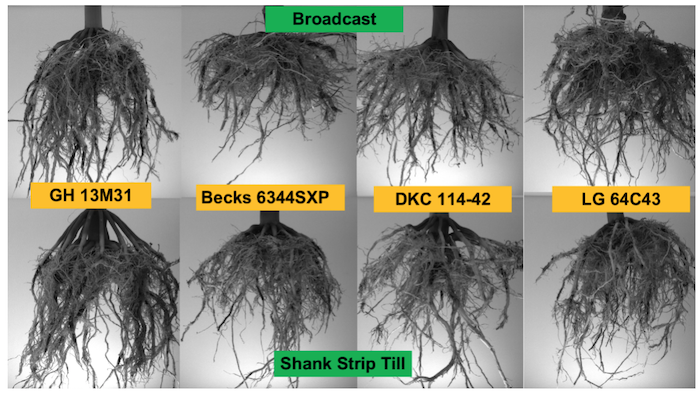
CROP COMPARISON. These photos from Jared Fender, senior research specialist at the University of Illinois Crop Physiology Lab, show how root structure changes based on fertility placement. He dug these roots in late July. All plots received spring fertility, but the strip-tilled plots developed deeper roots as they searched for nutrients.
The strip-till plants had fewer roots in the 0-2 inch range compared to the broadcast plants. Fender says the broadcast plant puts out roots where the nutrients are, which is in the top zone of the soil. Meanwhile, the shank strip-till root is growing down in search of fertility.
To help identify which hybrids might perform best in strip-till, Fender looked to 2021 yield data from the university’s corn hybrid MIP report. That year, researchers planted 28 different commercially available hybrids at each of their locations. Fender identified four hybrids from the 2021 trial to compare: Dekalb’s 65-95 and 67-37, 10D21 from Golden Harvest and Stone’s 1132 Trecepta. The Dekalb 6595 hybrid and Golden Harvest 10D21 didn’t respond well to fertilizer, Fender says, because the banded fertility produced about the same yield as the standard treatment.
The 1132 Trecepta hybrid from Stone and Dekalb 67-37 responded to banded fertilizer, increasing yields significantly. Just by banding fertility instead of broadcasting it, yield increased by 11 bushels for the Stone hybrid and 8 bushels for Dekalb’s 67-37.
“The small-rooted hybrids don’t have a lot of root mass to pick up phosphorus (P) and potassium (K),” Fender says, “whereas the large-rooted hybrids have the root mass to get that soil P and K.”
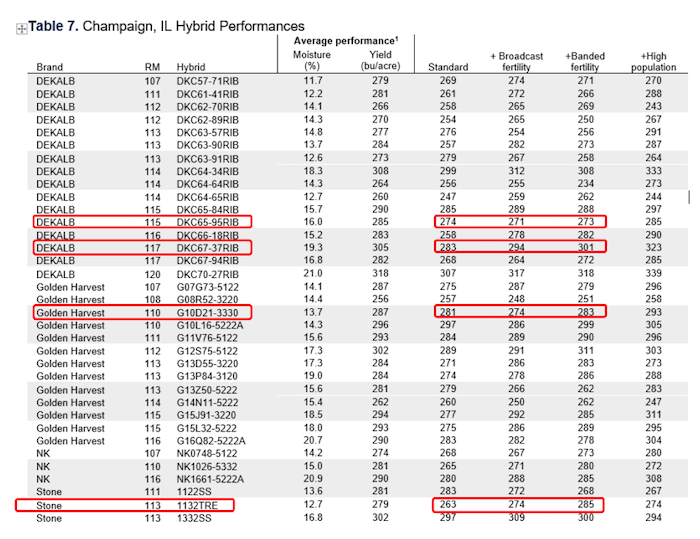
PERFORMANCE ASSESSMENT. This table with results from 2023 University of Illinois MIP trials shows hybrid response to banded vs. broadcasted fertility.
Fender says planting high populations will crash small-rooted populations because they don’t have enough root mass to scavenge nutrients.
“Large-rooted hybrids will maintain yields at higher populations because they have the root mass to find that fertility in that soil, making them seem really high-yielding,” Fender says. “They are not fertility responsive because they have the root mass to go out there and get that soil P and K.”
But if smaller-rooted hybrids are supplied fertility in a band, they’ll respond better to both population and fertility. Fender says strip-tillers should choose smaller-rooted hybrids, but again, it’s difficult to identify those in a seed guide.
“That's why we launched a new trial for 2025 that I called The Hybrid x Tillage x Placement trial,” Fender says. “We took the same fertility program that we had in 2023 with Bayer’s Channel 215-70 hybrid doing the same five tillage treatments and NPK fertility. But we're going to look at 16 hybrids from DeKalb, Golden Harvest, Beck’s, LG and Channel between five different tillage types and three different fertility placements.”
In 2023, Fender’s plots received 75 pounds per acre of P in the form of P2O5 from Mosaic MicroEssentials fertilizer (MESZ), 60 pounds per acre of K in the form of K2O from potash and 175 units of nitrogen (N) from spring-applied UAN32. The goal of the next generation of the trial is to determine which hybrid responds best to each tillage type and fertility placement.
“We're trying to get a whole bunch of different environments out there for each individual hybrid,” Fender says. “I’m not trying to show that one hybrid is better than another. I'm taking some small sub-samples to show different hybrids in different placements.”