The Univ. of Illinois Crop Physiology Lab recently published results from its 2025 Hybrid X Tillage Interactions Trial, conducted by Jared Fender, Sam Leskanich, Connor Sible and Fred Below.
Sixteen commercial corn hybrids representing five seed brands were evaluated across ten tillage and fertility combinations. All treatments were replicated five times and arranged in a randomized complete split-block experimental design, with tillage × fertility blocked by treatment pass and hybrids randomized within pass. All hybrids were planted to achieve a final plant population of 36,000 plants per acre. The soil was sampled prior to tillage and fertility applications to assess inherent levels of soil fertility.
Five different types of tillage were implemented on April 29 that included conventional, coulter strip-till, stratified shank strip-till, concentrated shank strip-till and a no-tillage control. All five tillage systems were evaluated with or without phosphorus and potassium fertilizer supplied as MicroEssentials-SZ (MESZ; 12-40-010S-1Zn) and muriate of potash (0-0-60) at rates of 75 lbs of P2O5 and 60 lbs K2O per acre, respectively. Fertilizer was supplied as a separate broadcast application for the conventional and no-till blocks, and concurrently with each of the respective strip-till applications.
Here are a few key observations from the report:
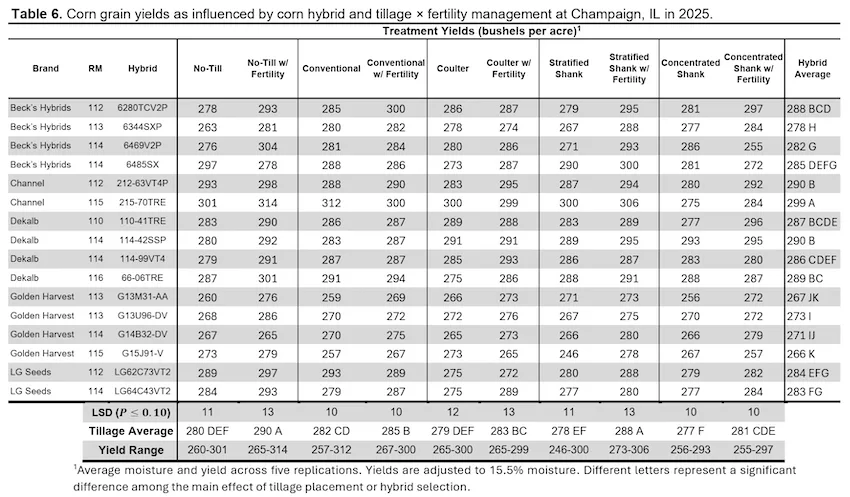
Final grain yields were exceptional, with an average across all plots of 282 bushels per acre within this study (Table 6). The tillage intensity had a relatively minor impact on grain yield in 2025, with just a 10 bushel per acre spread among the five different tillage treatments.
Averaged across the fertilizer applications, no-till produced the highest average yield of 290 bushels compared to the range of 281 to 288 bushels per acre for the other four tillage treatments. A known attribute of no-till systems compared to conventional tillage is the retention of soil moisture, which we believe was manifested in 2025 as Champaign received nine inches less (-36%) than normal rainfall between April and September.
“In the absence of fertilizer, both shank applications resulted in the lowest yields compared to the other three tillage systems…”
As the intensity of tillage and the burying of crop residue increases, the risk of soil drying also increases. Strip-till represents a compromise between conventional tillage and complete no-till, as tillage occurs only where the future crop row will be planted, keeping soil and residue undisturbed between the rows for moisture retention. However, one of the common concerns utilizing a shank for strip-till in the spring is the potential to create air pockets and a rougher tillage strip, and in the absence of fertilizer, both shank applications resulted in the lowest yields compared to the other three tillage systems (Table 6). It is important to note, however, that there was only a 6-bushel spread among the four tillage intensities, and while strip-till did not result in a yield advantage over conventional tillage in 2025, it does have the added benefit of the residue retention protecting the soil from wind and water erosion compared to conventional tillage systems
Tillage Intensity Influenced Fertility Response
Across the various tillage types, the greatest response to fertilizer applications in 2025 was observed with the no-till and stratified shank treatments, where both increased yield by 10 bushels per acre (Table 6). We hypothesize that these effects are due to better fertilizer solubilization as a result of higher soil moisture within the no-till treatments, as the lowest fertilizer responses were observed with the conventional (+3 bushels) and coulter (+4 bushels) systems, which had the greatest soil disturbance and aeration.
For the stratified shank, we believe the unique fertilizer placement throughout the rooting profile provided early nutrient availability in the surface layers followed by late season nutrient availability with the deeper placement. The stratified shank fertilizer placement contrasts with the concentrated shank, which placed the fertilizer near the bottom of the shank depth, and that only resulted in a 4-bushel yield response to fertilizer, likely because it was placed too deep for early season accessibility.
Hybrid is Still the Most Important Decision
We conducted this research and created this report because we know that choosing the right hybrid is one of the most important management decisions that a grower makes each year. We are continually looking for management practices that increase corn yields and identifying hybrids that can be paired with those management practices and fertility placements.
We believe that selecting a hybrid that best suits your tillage and fertility strategy can help you achieve top end yield, and we hope this report assists growers in selecting those hybrids. We are intrigued by the extensive variation among corn hybrids in their root architecture and we plan to further develop this root characterization concept to aid in matching hybrids to management practices including tillage and fertilizer placement.
Click here to read the full report from the Univ. of Illinois.