

Brought to you by:

On this episode of the Strip-Till Farmer podcast, brought to you by Yetter Farm Equipment, Jared Fender, senior research specialist at the Univ. of Illinois Crop Physiology Lab, shares new insights from the first full year of a massive strip-till trial.
The Univ. of Illinois’ strip-till fertility trial compared corn yields from strip-till with a coulter, shank stratified strip-till, shank concentrated strip-till, conventional tillage with broadcast fertilizer and no-till with broadcast fertilizer. The stratified shank application placed the fertilizer at all depths of the furrow, while the concentrated shank application placed it at the bottom.
The study ultimately compares the effect of tillage methods, fertility placement and strip-till timing on yield. On this episode of the podcast, Fender breaks down yield data and shares his biggest takeaways from the trial so far. He also touches on corn hybrid selection with strip-till, how fertility and placement affect root development in strip-till systems and much more!




The Strip-Till Farmer podcast is brought to you by Yetter Farm Equipment.
Since 1930, Yetter Farm Equipment has been providing farmers with profitable solutions. From residue management and fertilizer placement to seedbed preparation, our equipment is designed to maximize your inputs, save you time, and deliver a strong return on investment. Explore our full line of planter attachments, precision fertilizer placement options, strip-till units, and stalk rollers at yetterco.com. Let Yetter help you prepare your equipment lineup for success today.
Full Transcript
Noah Newman:Hello, and welcome to the Strip-Till Farmer Podcast. I'm your host, Noah Newman. Great to have you with us as always. Also, big thanks to our sponsor, Yetter Farm Equipment for making this podcast series possible. We'll share a special message from them later in the program.
Today, Jared Fender, Senior Research Specialist at the University of Illinois Crop Physiology Lab shares new insights from the first full year of a massive strip-till trial. There's a lot of interesting takeaways here about the effect of tillage methods, fertility placement, and strip-till timing on yield. And this is from part of Jared Fender's presentation at the 2025 National Strip-Tillage Conference. So let's dive in. Jared, take it away.
Jared Fender:I actually work under Dr. Fred Below there at the University of Illinois in Urbana-Champaign. A little bit about me. Started with him actually in the fall of 2016 as an undergrad. 2017, started full-time with him. Actually there in the window, you can see I'm wearing the Harvest for a Cure sweatshirt. Started taking over a lot of our nutrient management trials there, running the equipment, running our banding toolbar, all that type stuff within our research. And actually, obviously, 2024, still here. 2025, this harvest actually makes my 10th year under Dr. Fred Below there at the university.
So as his senior research specialist here at the University of Illinois, I get to manage all of this equipment that you see here on the left. That is all the equipment that it takes to do all of our research across the state at three locations. Two different semis now, about seven trucks, seven trailers, two tractors, a lot of different things. So I have a lot of things to do on my list every single day. And then, now I've actually started integrating strip-till into all of my workload here. So I'm a quite busy man now at the University of Illinois.
And actually, as Noah hinted at earlier, last year I was here in 2024 kind of going over some of our first look stuff at our first strip-till trial. Last year, I talked a lot about soil samples. Didn't have yield data because last year was the first year for that trial. However, good news for you guys. I have the yield data. I have more data to show you about what's happening within our strip-till trials. So if you were here last year, this will be review. But this is our 2024 fertility program for our strip-till trial. So we have a untreated control as a no-till broadcast, still looking at no-till.
We had our conventional till, and then we have three different types of strip-till. We have our NPK program is 175 units of 32% sprayed over the top, obviously, because we have different tillages, different fertilizer placements. We had to spray it over the top. We couldn't include it in the band through the strip-till. And then, our phosphorus was 75 pounds an acre. And then, our potassium was 60 pounds an acre. So that's about a 200, 100 typical rate for Champaign, Illinois farmers. And then, we also have the fall versus spring timing within this trial.
So as I said earlier, we have three different strip-till placements, broadcast and conventional till. I like pictures. So here's how our fertility program looks. Top left, we have a broadcast application where it's just laid on the surface through a drop spreader. And then the top right, we have our coulter application, which is about a six-inch wide by six-inch down box that we like to call that our fertilizers are going to be in. And then we have a, I'm going to work down to the right, concentrated shank application where it's going to be all the way down at the bottom of your tillage depth with your knife.
And then on the bottom left, our stratified shank is going to be a mix between everything. Stratified, we're going to drop that fertility down through behind the knife, but not try and concentrate it either all the way at the top or all the way at the bottom. It's going to layer in there with the soil as the soil fills that shank trench back in. And so like I said, this was a fall versus spring trial. So I have to show you weather data. The fall was actually in 2023, and then we progressed into 2024. So the orange line is actually our average daily temperature. And then, the blue bars are our rainfall amounts for those days that we received rainfall.
So fall of '23, this trial went out. I believe it was November 13th, November 11th, somewhere around there. Had a nice dry window after harvest to go put out this trial. The one thing I do want to point out here is our fall application in fall of '23 was one of the mildest winters that we've ever had in Champaign for our research trials. As you can see, all the way until about January 15th, 16th, we were above freezing. Our soils were active. That fertility was being broken down. Our microbes were alive all the way until January because we did not drop below 30. And when we did drop below 30, we dropped fast all the way down to negative.
But then about five days later, we go right back up, and never freeze again. So our soils were active for very long periods of time after that fall application. And then our spring application, we kind of went backwards here. We had a very wet spring, lots of rainfall and everything else. So it was a little bit later than what we had originally hoped for. This was, again, around May 11th, May 13th time through there. Trying to dodge the rain, trying to get out there, trying to run a knife in the spring. That's when we got it out there.
And then planting time was a little bit after that, again, because of rain, because we were trying to let things mellow out a little bit. So we were a little bit later on the planting side. It was about May 21st for the planting of this trial. So after planting, we got our soil test samples back. They were sent to ANL. And then our organic matter for this trial was 3.8%, about typical for Champaign, Illinois, CEC of 18. And then our phos was 42 PPM. And then our K levels were about 221. According to ANL, three of these four are actually high for us, even though that we're going to see a growth response later on in my presentation, that ANL still says we're high on these P&K values.
And then this hybrid that was planted in this trial, which you see on the left in one of my strip-till treatments was Channel 215-70. We chose that because it has a very good fertility response, and we thought that it had an overall root structure that would not favor one placement versus the other placement in this trial. So one of the first things that I presented on last year was, Where's my fertility? We took soil samples at tassel time within the crop row to see what that plant is going to notice throughout the year. So tassel, we're hitting right at peak uptake for a lot of nutrients. So we were looking at to see where our P&K was within that time.
So our first zone that we're going to look at is 0 to 4 here. We did three different zones from 0 to 12, split it out. So our first one's 0 to 4. And then as you can see, we're going to call our no-till broadcast kind of our untreated control, our basic minimum here. And then, we work down to our three strip-till treatments down here at the bottom. First one I want to point out is that our fall broadcast had a lot higher K test compared to our spring. Well, if you remember, our soils were very active, our residue was breaking down. When we broadcasted, we broadcasted MESZ.
So we get some nitrogen, we get some phosphorus, we get all that stuff out there that might... We're starting to release that fertility out through there a little bit better than what our spring broadcast is. And then opposite side of that, we look at our coulter treatment. Again, fall, we had a higher P test through there. And then as we work down on my graph here, these two, the stratified shank and our concentrated shank, we're not looking for changes within these because we're not trying to apply those nutrients in this zone. So kind of focusing more on the no-till and the coulter for this depth here. Then, we move forward into our four to eight inch zone, the middle zone.
What we're looking for here is that the no-till really isn't changing because we're not trying to move that no-till fertility all the way down to six inches down. But then this is where our coulter, our shank, and our concentrated shank is starting to highlight here because we're starting to work down through the profile and get those nutrients in this four to eight zone. So as you can see here, our stratified shank, the one that layers it completely down through the profile here to your tillage depth, we increase our potassium down in the springtime. Four to eight inches, it's kind of hard to get a little bit of a potassium response down there on your soil test just because your four to eight inch zone isn't as active as your zero to four.
And then when we look at our coulter, we see no change because our coulter is only designed to run about five to six inches down. We're not placing a hundred percent of that fertility in this zone. So our coulter really did not change our fertility levels, whether it be fall tillage, spring tillage, application time within this four to eight inch zone. And then working further down, our eight to 12 inch zone. Again, our no-till should not be changed here because this is minimum eight inches separated from our application point. Our coulter is largely unchanged again. And then our stratified shank changed a little bit. And then our concentrated shank, the one that places it all the way down there at the bottom.
And for this trial, the concentrated shank was running about nine inches deep. So this 8 to 12 inch zone is perfectly highlighting how much the concentrated shank will increase your fertility within that zone because it's placing a hundred percent of that all within this zone here. And then as you can see, we had a four times increase just by doing it in the spring of our phosphorus level here. And then next, our coulter did kind of start pushing some of that potassium downwards, just starting to leach and move downwards through the soil profile. So we're starting to get some nutrient movement through there just by releasing it with water.
And then next, some of our later on in season samples here we have. We have Sam Leskanich. He's holding up one of his tried and true roots that we have here at the lab holding his shovel, just like the antique photo of the man and the woman holding the pitchfork. That's what he's trying to reenact here. That's him on digging roots for day one. And why are we digging roots? Well, ever since I started in this lab at 2016, 2017, Dr. Below always has one line. He's pretty sure that roots take up our nutrients for our plants. So roots are obviously very important to this plant. So in order to see how our nutrients are taken up through the plant, we have to look at the roots, and that's why we dig roots.
And so, here's our pressure washing setup. You can see on the top left, we have soaking stations, three pressure washers. And then down at the bottom, that's where our staging area is where we clip all of them to the same height and everything else. So we're standardizing the process. And then at the end of 2024, our back room looks like this with a lot of roots. That's a lot of boxes. There's a lot of roots that fit in those boxes. And actually, there is 3,216 roots all in that area of our back room. That's a lot of corn roots when you dig them one by one and wash them one by one. And so, 3,216 total roots takes us about six days.
And then as you can see, Dr. Scott Foxhoven looks a lot different than what Sam did on his first day. And then actually, Dr. Connor Sible now, after washing for six straight days, does not look the happiest either. So 3,200 roots takes us a good while. It drains the team. But again, that's why we have such a large team is so we can rotate people in and out. And then, why do we wash these roots? Why do we look at them one by one? Why do we do anything with roots? Well, last year we started this whole joint adventure here with another group at the University of Illinois.
We purchased one of these crop boxes, as we call it, which is a corn root observation platform. It takes a single root. As you can see in the photo, has a camera up top and a camera on the side. So we can get top down photos and we can get 360 degree round photos of that root one by one. We don't have to measure anything by hand. It all takes it. And then as you can see on the far right there, those are the images that we're getting out just by these cameras. It was developed at the University of Illinois. We're working with the team that made this, trying to help get some data points out there, trying to make the system better to hopefully try and push it out to the market later, so other people can use this technology as well.
And so, what do we get from this box and why is it important? The first one we get is pixel accumulation. We turn that into a relative surface area. So how much of that surface did your root take up? We can gauge how big that root is and everything else. We can get an asymmetry measurement. So if it grew heavy to the left side, to the right side, do we have compaction? Does it favor fertility on this side? Whatever that root likes, we can quantify that number. Then, we also get root angle. Root angle I'll talk about later. And then, stock diameter. Now, we don't have to measure each individual root with a ruler. It will take that photo and know that it's 1.96 centimeters wide. It saves us a lot of time doing that.
And then, we also get root ball depth. So we can take all those roots. We can figure out how deep they grew, whether it's six, seven, eight inches. It will quantify that for us all based upon pixels. And then lastly, we get fractals, which is basically a measurement of your complexity. So if you had a lot of proliferation, it's going to be a lot complex. It's going to measure out, and then we'll get more fractals, and then we can quantify that. So the first root measurement that we took this year, which is actually not through the crop box, is root mass. So I'm going to express this in grams.
But when we look at it from a fertility standpoint alone, what we saw last year in 2024 with all the roots is that as we push our fertility timing closer to springtime, we see bigger root mass. So as we push it further away from planting, we see less root mass. So the closer you move your application time to planting, we see a lot bigger of a root mass. And as you can see, we had a significant increase just between fall and spring by one gram. I know one gram doesn't seem like a whole lot. But here in a second, we'll see that. And then when we break it out to the tillage effect within strip-till, we see the same thing.
Just looking at the fertility proponent alone, as we fertilize in the spring, we build bigger root mass versus the fall. And then, again, for most of them, the tillage component alone makes bigger roots in the spring. And so going back to the one gram gain here, this is one of the example image of what we get from the crop box here. So on the left, we have a fall shank at 15.3 grams. These are both the same fertility treatments. So this is concentrated shank. So placing that fertility eight inches down. The only difference is fall versus spring. Two and a half gram difference between these two roots.
And you can see on the right, it's building a lot more root mass lower down in the profile, most likely trying to search for that fertility. So it's finding it, it's putting on more root mass, and then also it gets a lot smaller on its angle when we do this. And then the next one, which we get from the crop box again is root angle. So from common sense standpoint, if we have a coulter versus a shank and everything else, we have a wider tillage intensity versus a smaller tillage intensity. You would think the concentrated shank only run it about an inch and a half, two inches wide through the ground, it would basically grow a root that just grows straight down through path of least resistance.
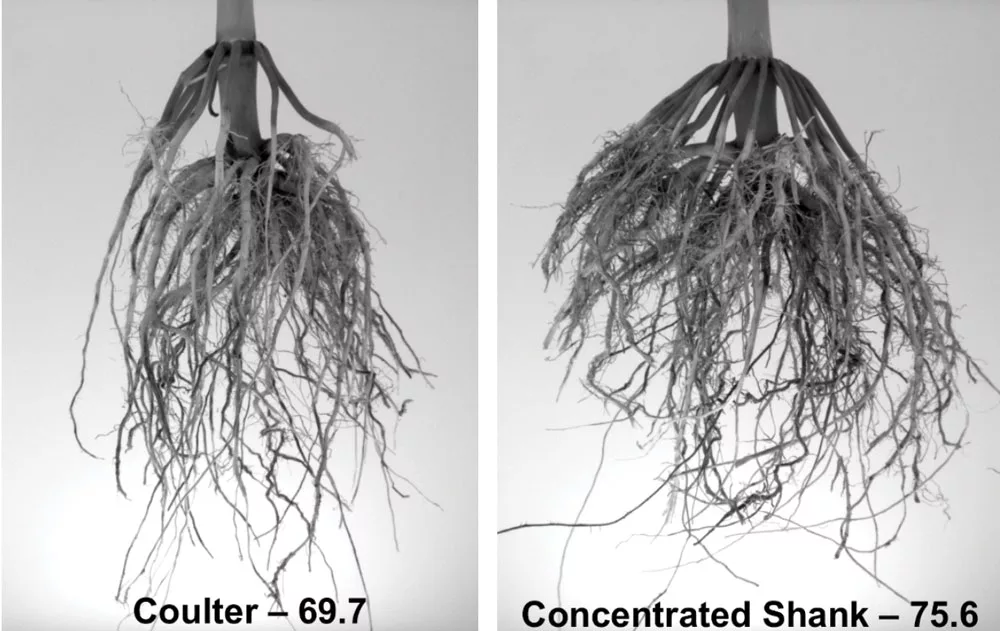
Actually through this trial, what we saw is that it's backwards. Your coulter that has a tillage zone of about six inches wide, we see less root angle through it. And it's actually growing straighter downward than our concentrated shank or even our stratified shank. And what this looks like here is one of these. So again, crop box pictures here. Same fertility treatment. This was spring fertility. The only difference was coulter on the left versus concentrated shank on the right.
And as you can see, the right one with the shank has a lot wider of a root angle. And then actually on the left, I do have to note that the brace roots on top at the top node there in the picture are actually not counted in the measurement. It is taking it from ground level node and those brace roots right there. So those top ones there on the left are not even counted in this picture. And so, you can see there that our root angle did increase quite a bit just by tillage effect here.
And so when we break it out to the three strip-till treatments here, we can see. Again, shanks have a larger root angle here. And then also, our fall has a lot more angle than our spring fertility. Why? We tend to think that in the fall, we kind of tie up some of that fertility. We lose it, whether it gets pushed out of the soil and to where the roots can't get it. But that root is trying to grow, whether it be wide or down, trying to find that nutrient that's down there, and that's why we're getting more angle in the fall versus the spring here.
And so the most important part of this trial, what everybody's going to ask about. Grain yields. So this is the first time most people have seen the grain yields for this trial. So our UTC was our no-till 259 for unfertilized. And then, the asterisk here was when we fertilized and no-till, our yield went down. I'll explain that here in a little bit. And then next, we look at our conventional tillage. We have a pretty good fertility response here. We see plus eight to the fall fertility. And then, we lost a bushel. We only went plus seven in the spring, probably because the spring was a little wetter when we went out there and everything else.
And then the whole idea between the three strip-till types here is that we're trying to prove that whether it be one of these three here, we're trying to prove that it's equal or greater than conventional till through this. So as you can see here, just on the unfertilized side, most of our treatments did prove that it is equal or greater than the conventional tillage. And then when you add P&K into it, and then you get the same pass or two different actions, tillage and fertility within the same pass, we are keeping yield levels relatively the same compared to conventional till here.
And so, one treatment that I want to highlight is our stratified shank. Just between fall versus spring. Or sorry, spring timing, but we're adding the fertility into the spring, we see a plus 11 bushel gain here just by placing that fertility all the way throughout that tillage zone instead of concentrating it at the top or the bottom here. And then, every researcher's not favorite part every single year is when they have to take lodging notes. They don't like when we have to take lodging notes, that means something happened that you can't control.
And if anybody knows anything about Channel 215-70, it has a very high green snap potential. It grows very big, very fast, screams through vegetative states. When you get wind, green snap. So we had to take lodging notes on this trial last year, and these were taken at harvest. I took them in the combine. It's my trial. I took them. And then, the numbers that I want to highlight here is the no-till. So unfertilized, we had a relatively low lodging rating of 3.3. But then when we fertilized in the spring, we went way up. We went up to 5 and 5.8. Well, if you remember, the no-till was the one that lost yield when we fertilized. This is half the story of why.
And then as we worked down to our strip-till, the numbers stayed relatively the same. So we weren't changing anything on placement, tillage, or anything else on the lodging ratings, keeping it basically the same throughout the trial. So what this looked like, again, I mentioned green snap. What happened here is, if you look at this really tall blue bar right in the middle of July, three and a half inches in one day. Pretty sure you guys are all farmers. You guys watched the weather. You guys know that if you get three and a half inches of rain in one day, you guys had a pretty catastrophic wind event, and everything else, you had some pretty bad storms probably were in your basement at some point.
So actually, we had 42 mile an hour straight line winds that day. That's why our lodging ratings happened. That's why we had green snap. And so, what did that green snap actually do to this trial for kernel number? Yield components, kernel number is half of it. Actually on our no-till, we had basically 4,200 kernels per square meter, but then here's where we lost the yield in the no-till. So perfect reason why yield components is half of your yield. We lost about 400 kernels per square meter just based upon the lodging and breaking the top half the plant off after tassel. It didn't feed the year. It actually aborted kernels.
But then where our yield gain was on a stratified shank was we actually picked up about 260 kernels per square meter on the stratified shank. So picking up kernels, we fed them, we brought them all the way to maturity. We were able to keep that yield, which is obviously very important on kernel number. So what did we learn in 2024? We learned that tillage timing does affect your performance of strip-till through our soil samples, through our root structures, everything else here in East Central Illinois. We learned about a fertility by placement interaction through the soil samples through our root angles. And then, we also learned about nutrient movement influenced by tracking that nutrient through the soil profile.
As we work down, some of them don't change, some of them do get bigger. And then also, lastly, fertility and placement does affect your root development. Again, this was one hybrid, static through the whole trial. And then you saw the different root angles, the root depths. So we are affecting our root development just by fertility and placement. So we have a question. The last one was a dry fertility trial. In 2024, we added liquid onto our strip-till bar. And the question was, do liquids perform the same as drys? Liquids, you use a lot lower rates, you're reallocating it, a lot better efficiency. You're putting it right there in the zone in a liquid form.
So we looked at one company's product. For this, our untreated control was 30 gallons with our toolbar, and 20 gallons sprayed over the top, because obviously we've felt a little uneasy about trying to push 52 gallons of UAN in our strip and coming back and planting on it. So we split it up. Their base mix was a three-way mix between NACHURS Alpine Solutions products. We supplied some phosphorus, potassium, sulfur, boron, zinc, manganese, copper, molybdenum, a whole bunch of micros within this. So this was really feed the whole plant approach with macros and micros within here. And then, this was also a placement and rate study as well, as you can see.
When I say coulter and surface, that was coulter five gallon an acre, but then we also dribbled five gallons on the surface right in front of the containment coulters to kind of layer it with some soil, that way we didn't volatilize anything in that mix. And then, we have two shank treatments. The very bottom one has a one and a half X rate. That was an accidental. Obviously, but we kept it the whole year just to see what was going to happen. It had 50% more fertility than the rest of the trial. And so, when we look at the root area, you didn't see that from this last trial. Root area, we take pixels, convert it over, and everything else from the crop box.
But as you can see, as we increase the fertility and as we push it further down into the profile, we are building more root area. That root is actively trying to search for it. And so, that is possibly the reason why we see a significant increase on root area when we increase fertility down there. And then, again, the one and a half X rate, you think it might be a little hot, but we do see the biggest surface area through that treatment. And what this looks like is we have our coulter 15 gallon an acre on the left, and then our shank on the right. So there's about 15 centimeters squared difference between those two. And the right root is obviously growing a lot deeper and it's more spread out root hairs and everything else through that root.
Noah Newman:Let's burn a quick timeout for a word from our sponsor, Yetter Farm Equipment. Looking for innovative solutions to maximize your farm's productivity? Look no further than Yetter Farm Equipment. They're dedicated to providing farmers with the highest quality equipment, from row cleaners and closing wheels to fertilizer equipment, strip-till units, and stalk devastators. Yetter has the tools you need to optimize your farming operation. Visit yetterco.com. That's Y-E-T-T-E-R-C-O.com to learn more and find a dealer near you.
Jared Fender:Taking pictures of roots, looking at them one by one is all great. But our next step actually is what we call the SAM rating. So looking at one by one does you great, but can you make conclusions when they're all from different trials? No. So we're trying to standardize this and trying to look at this. So our SAM rating integrates surface area, angle, and mass into one root characterization per hybrid. So we look at that, and then it separates each measurement into two groups. So for surface area, you have small and large. You can, obviously, from the past couple pictures, you can figure out what a small surface area is versus a large. I just showed one on the liquid side. And then our angle, which is narrow and wide, versus our mass, which is small and large. So you put those three parameters together, you get the SAAM Root Rating, which gives you eight different SAAM ratings to characterize hybrid root architecture.
And actually, this was thought of in our lab and has actually operated. And a lot of the roots that we dig every year is for this trial, which is actually for Sam Leskanich. So you can kind of pick why he picked the SAAM Root Rating, kind of matches his first name. So he's making a claim for fame within itself. And then what this looks like in Champaign from last year. It's a lot of bar graphs. It's kind of a messy graph, but this is every single hybrid that we dug. I think it's 32, if I remember right, last year. You can see that there are some very big differences between just one single hybrid. Not every single hybrid is the same root structure compared to another one. And then when I break it out, there's three different genetics here, Beck's, Bayer, and Golden Harvest. And then, there's some of the hybrids at the bottom.
So you can kind of pick and choose which hybrids you want to look at. Not every single hybrid even within brand has the same root structure. So moving forward, bringing it back into 2025 here. So these are some roots that I actually dug last week before coming here. There's four hybrids on this slide, two different placements. All taken from the crop box here. So at the top, this would be a conventional tilled broadcast root. And then down here at the bottom, we have a stratified shank strip-till root that we put out. Both were spring fertility. They're a little dark. I apologize. They're big roots for right now. At the bottom, you can notice that we have less roots in that zero to two-inch range compared to the broadcast. That broadcast root is putting on a lot of roots and proliferating where that fertility is in the broadcast.
So it's putting it on very high versus the shank strip-till root, which is trying to grow down into that fertility and search for it. And then again, like I said, four different hybrids that are on the market today, Golden Harvest 13M31. These are actually three of the four are new for 2025. The LG hybrid was released, I think, about two or three years ago if I remember right. And then, we have different trait packages. Everything else, SmartStax Pro, SmartStax, VT, Double Pro, everything else. So when you look at those four hybrids that I just pictured up there and you look at that seed guide, and you're trying to pick out which hybrid do I want to grow for my operation? You're going to look at the LG. It is LG, but I pulled up an AgriGold book here. And if you notice down there at the bottom, it says root type is modified.
Well, if you go to the Golden Harvest book, 13M11, it says outstanding root. You go to the Beck's guide. 634, new for this year. It says horizontal root architecture. And then you look down here at the DEKALB one that's new for 2025. If you follow the graph all the way over, it just gives it a three on root strength. What does all this mean? Do you guys know what three on root strength means? I don't. We don't even know what horizontal root structure is from Beck's. And then what does outstanding roots mean from Syngenta? Pretty sure every single corn hybrid might have outstanding roots because it stays up straight, but I could be wrong. So if you're using a coulter setup, which root would you choose? Problem is not a lot of us know what hybrids are bred and released for strip-till.
So I dove back into some past information here from our 2021 corn hybrid MIP report where we grow a lot of commercially available hybrids every single year. I think in 2021, it was 28, if I remember right, at every location. Looked at our yield data. 2021 was the last year that we actually banded fertility within this trial. And then, looked at broadcast as well. So I'm going to pick out four different hybrids here within this MIP trial here. The first one's going to be 65-95. And if you look, plant it and grow it was 274. You broadcast the fertility, you lost three bushels. But then you banded it, and you brought it back up to 273. So basically wherever you place that fertility, it was a net wash. Didn't really matter. That hybrid doesn't respond to fertility well. 67-37, however, does. We saw 283, if I read that right, 294, and then 301, fertility responsive.
65-95 have been on the market for a good while now. 67-37, same with that. 10D21 from Golden Harvest, same thing, older hybrid, is not fertility responsive. It's kind of a net wash again, just like 65-95. And then the last hybrid I want to look at is 11-32 Trecepta from Stone. I'm going to say that one's about a four-year-old hybrid now. But that one is fertility responsive, 263 to 285 just by banding that fertility and placing it a little bit better than broadcasting it. Why do these four hybrids matter and why do the two responses matter within this? Well, again, Dr. Scott Foxhoven, the guy that looked almost like you should check on them after root digging, came up with this theory and this nice animation here. So we're going to split those out between small-rooted hybrids and large-rooted hybrids. Small is at the top, large is at the bottom.
And when we look at that with soil P&K, you can probably already guess where I'm going with this. The small-rooted hybrids at the top don't have a lot of root mass to pick up that P&K that's spread out there. Whereas the large hybrids, large-rooted hybrids have the root mass to go out there and get that soil P&K. And then when you put them at low populations or high populations, the high populations we lose root mass kind of even makes the small-rooted hybrids worse. And they still don't have enough root mass to go out there and find that fertility, whether it be from fertilizer or the soil. And then large-rooted hybrids, they have enough root mass to go through there and find it. So small-rooted hybrids will crash at higher populations. I'll put an asterisk on that real quick. I will fix that here in a second. Hang with me here.
And then large-rooted hybrids will maintain yields at higher pops, because they have the root mass to go out there and find that fertility and that soil, making them seem really high yielding. These ones are not the ones that are fertility responsive. Why? They have the root mass to go out there and get that soil P, that soil K. And so what happens if we supply better fertility through a band, through a strip, whatever your options are? Small-rooted hybrids will have a better response to both population fertility. That might be why on that last slide we saw 20 bushel gain on some of those hybrids just by placing that fertility in a band. Versus the large-rooted hybrids didn't respond whether you broadcasted it or banded it. So large-rooted hybrids, again, they have that root mass to go out there and find what they need.
So taking this, we know that small-rooted hybrids are going to be the ones that you guys are going to prefer for strip-till. But the problem is, like I just showed, you have no idea when you open up a seed guide, what are the small-rooted hybrids? And that's why we launched this new trial for 2025 that I effectively called The Hybrid by Tillage by Placement. Really complex trial, as you can already see. We took the same fertility program that we had in 2023 that I presented on with the Channel hybrid, doing the same five tillage treatments, same NPK fertility study. This one's going to be spring only, because we didn't get to it in the fall. But where we're going to change this study is we're actually going to look at five different hybrid groups here. So we're going to look at DEKALB, Golden Harvest Beck's, LG, Channel.
We're going to look at the major players in the game. And we're going to look at four different hybrids for the three. And then LG and Channel, we get two. So we're going to look at 16 different hybrids between five different tillage types and three different fertility placements here. So this is, again, kind of just a rebranded hybrid study that we used to do in the past. We're going to figure out which hybrid likes banded fertility, whether it be the stratified shank, whether it be conventional. Or we're going to find out that one of these hybrids really likes broadcast, and nothing else. So this kind of brings our MIP trial back up, and then allows us to help kind of characterize hybrids based upon your fertility placement.
And so, why did we choose these hybrids? Well, again, you listen to me talk about the SAAM Root Rating where we take surface area, angle, and mass. What we're going to do is these four hybrids from DEKALB, just as examples. They're vastly different in root architectures. We have three smalls on surface area, one large. But then we have narrow, wide, narrow, wide angle. And then we have small, small, large, small mass. So we're getting different types of root architecture out there, trying to figure out which hybrids on which rating prefer which fertility placement or even just bare tillage type. And so, what does that look like here in 2025? Again, this is a new trial. Don't have any yield data from it. These were taken obviously before pollination time about three weeks ago.
You can see there is a growth response between the right row and the left row. These are two different plots. And what we have here is the left is a no-till broadcast. And then, the right plot is our stratified shank with P&K. Again, this is a hybrid study. So to make it further complicated, I can't say that that is strictly P&K response. What I can say is that it is a combination of P&K, but also the hybrid response because there's two different hybrids there. And this is what we're trying to quantify. Does Beck's 62-80 really like this treatment? Or does 64C43 from LG really like no-till broadcast? We don't know. We're trying to get a whole bunch of different environments out there for each individual hybrid. And then, moving on here. We look at the left row, which is concentrated shank tillage only. So if you don't have fertility on your bar, that's kind of what this is, where you're looking at tillage only.
And then the right is, again, the same treatment with P&K as a stratified shank. We flip-flopped the hybrids now. We have a Beck's number on the right, 64-69 new for 2025, and then 114-99, the DEKALB hybrid on the left. And again, I'm not trying to show that one hybrid is better than the other one in any of these. I'm just trying to take some small sub samples and try and show you different hybrids in different placements here. Because on this one, we have concentrated shank tillage only again on the left, but then stratified shank P&K on the right. And we noticed that Beck's was on the good side, two slides in a row. Now, Beck's is on the bad side, a little bit smaller than its neighbor, 66-06 here. So as you can see, it's not just one hybrid beating everything. It's obviously related to tillage and fertility within this.
So the last one I actually have for you here on the corn side is we have coulter P&K. And then the coulter only on the right, no P&K. So this is a P&K response here. But then, we're looking at 13U96. And if you remember that last slide, 66-06 looked the best or looked better than the two, the one that I was compared to. But actually in this one, 66-06 with no P&K is actually tightly rolled. It's starting to roll its margins, look like a pineapple farm versus 13U that has the coulter P&K that's just loving life, unrolled, taking in all that photosynthesis out there. And so, I have two other lab mates, past lab mates out here. They can contest to this. But Dr. Below will tell me that when I think of something there at the lab, and I want to do it, I hit the ground running, throw everything I can at it. If I fail, bring it back. I'll try and make it work. So big corn study. Then, now I'm doubling down.
We're adding nine different varieties to this. So we're doing a soybean variety trial where we're looking at different placements within that same study, but looking at the variety component. Do soybeans actually care where their fertility placement is or their tillage type? So this year, again, no yield data. But what we're seeing here is no-till, no fertilizer there on the left. And then on the coulter, we have a lower rate of phosphorus. And then, we switched products. We went from MESZ to now on the soybeans, we're using MESZ 10. So we're getting a little bit more sulfur out there, and then 60 pounds of potash. And then on the left, we have a 3.0 Golden Harvest variety versus Asgrow's new 4.0 on the right. Beans are a little hard to try and estimate yield, but I can go ahead and pretty well make a 99% assumption that the 4.0 on the right is going to have more nodes, more pods than the one on the left. But we'll find out when the combine rolls through in 2025, and be able to figure out which placement, which tillage type those nine varieties liked.
And so, conclusions over my whole presentation here. Most important part is that your hybrid and variety should be carefully selected for strip-till. Start pushing your seed guys to realize what that root structure looks like, depending on those hybrids that you're picking. Try and find the small-rooted hybrids if you're strip-tilling with P&K. Try and find those small-rooted hybrids, that way you do get that fertility response. That way, you get the most out of that hybrid that you're paying for, because as we all know, P&K is not cheap, your hybrids aren't cheap. So do your homework on those. We're going to try and help you out in the future. We're going to try and push the 16 hybrids and the nine variety report out, try and get you some more information to help you pick hybrids.
And then, rooting structure will vary within strip-till. Just because you have two different placements, your rooting structure's going to change a tiny bit throughout that switch in tillage types. And then, your fertilizer placement seems to affect above ground growth just by the beauty contest pictures that I had of the hybrid by tillage study. And then lastly, your fertility and placement will affect your root development through there, as you saw from all the crop root pictures that I showed. And then, I do have to give my thanks to my whole team that is actually back in Champaign still. I'm here, air conditioning, presenting in front of you guys. Three quarters of our team went down to our Southern Illinois location, and had to take 480 plots of soil samples while I'm here.
So thank you guys for having me. Kind of glad that I missed out on the soil samples, because that's a long day. And then actually, the new thing I have with this slide is I actually now have two different bosses because Dr. Connor Sible is now a research professor. And then we still have Dr. Below, who is still my main boss, but I have two chains of command to report to now. And then, we're still as big as ever with our lab, 12, 13, 14, 15 people. We cover a lot of topics within our lab. And then lastly, thank you for National Strip-Till Conference for having me again for the second year in a row. Obviously, thank you to Marion Calmer who couldn't be here today for sponsoring my talk. And now, I'd be happy to open it up to any questions in the crowd that you guys might have for me.
Noah Newman:I have a question for you. Throughout this trial so far, is there anything that surprised you or anything you found out that you're like, "I wasn't expecting that?"
Jared Fender:In my presentation, I call it the concentrated shank. A lot of people go down, they think that placing that fertility eight, 10 inches down, the roots aren't really going to grow to it. And then every single year that we test it, we look at it. The roots will find that fertility the deeper you place it no matter what. And so, we are starting to see that treatment of concentrated shank with P&K highlight in multiple years.
And so, one of the questions that we're answering this year is, do you pay for yield in your roots? Is your roots growing too far down, and then damaging the rest of the plant on top end yield? That's a question we're trying to answer for this year. But the concentrated shank, again, is still kind of backwards from what you would think, the plant wouldn't grow to it. We're starting to see that now with growth responses.
Noah Newman:Got one right here.
Speaker 3:Hey, Jared, thanks. This is the kind of work we need to see and be doing, especially because it's replicated. I can do a lot of stuff on my farm, but this replicated stuff is really good. So question around, are you doing any work with corn-on-corn as it relates to the different fertilizer placements and the different tillage systems and strip-till at all? Or that seems like it's getting to be a more important thing for us as we go, so just curious on the corn-on-corn.
Jared Fender:That is in our master plan here in the future. However, we just started diving into strip-till two years ago. So we're still fresh. Last year was our first trial ever with strip-till working with that. This year's second year. Third year, I might start looking at corn-on-corn. We do actually have a 20-year corn-on-corn site, so that would be a perfect place to try that and get some numbers out of that. That is what we're looking for next year. We're starting to build up a little bit here and there. But no, I don't have anything right now. But in the future, that's an avenue that we are looking to dive into.
Speaker 4:Are you going to do the same root research with soybeans that you are with corn?
Jared Fender:No. So actually, the hybrid by tillage and the variety by tillage, we're not going to dig those. We have over 4,000 roots this year before I even add any of those on. This year, we're just not going to have enough time to dig them. So that's where I kind of started grouping in SAAM's Root Rating onto my yield levels. That way we can get the same idea without making more work for ourselves.
But this year, that's just not in our cards this year for our lab to try and dig all of those roots, whether it be corn or soybeans. I might dig them to get example pictures, but they're not going to be analyzed. They're just going to kind of be beauty contest photos, but yeah.
Noah Newman:Did Fred Below have any commentary on the trial yet? Anything stick out that you've heard from him?
Jared Fender:I sent him, again, some of the beauty contest photos, but he really didn't know why, or he really liked the aspect that the physiology is changing between P&K, no P&K, tillage types, whatever. Because as you saw in those four different sets of photos that I had, some of them were wilting a lot quicker than the other one. So that's a hybrid play, a fertilizer play that strikes his mind. So now, he's curious about how 16 hybrids are going to yield later on because they obviously have different stress level mitigation between different hybrids. So that's what he's looking for this year.
Noah Newman:So what's next? What are you most excited to see in the coming year in this trial?
Jared Fender:Really, what I'm trying to see is trying to get information out to you guys out there. Trying to find you guys information to help make better hybrid choices, get the most efficiency out of your hybrid, put it on the right acre. We have highly productive soils, lower productive soils. We know what hybrids stick on those. Do we know what hybrids to stick in strip-till? Not mostly effectively as we have in the past years with everything else. So trying to get that out.
That's what I'm mostly looking for is trying to help you guys, because obviously you guys are the reasons why we're doing this research. But then also just like the question that I had, corn-on-corn. Some people are starting to do that more, trying to increase organic matter. How can strip-till fit into long-term corn-on-corn rotations like that? So that's what I'm looking forward to in the future and everything else as we start to progress into our strip-till adventure here at the lab.
Noah Newman:That'll wrap things up for this edition of the Strip-Till Farmer Podcast. Thanks once again to Jared Fender and our sponsor, Yetter Farm Equipment, for making this series possible. And if you want to get a headstart and reserve your spot for the 2026 National Strip-Tillage Conference in Springfield, Illinois, you can head to striptillconference.com. All right. Merry Christmas, Happy New Year. I hope you have a great holiday season. And hey, we'll see you in 2026. Thanks for tuning in.