A new planter technology study from Purdue Univ. shows once again that the value of precision technology goes well beyond yield.
Here’s the tale of the tape …
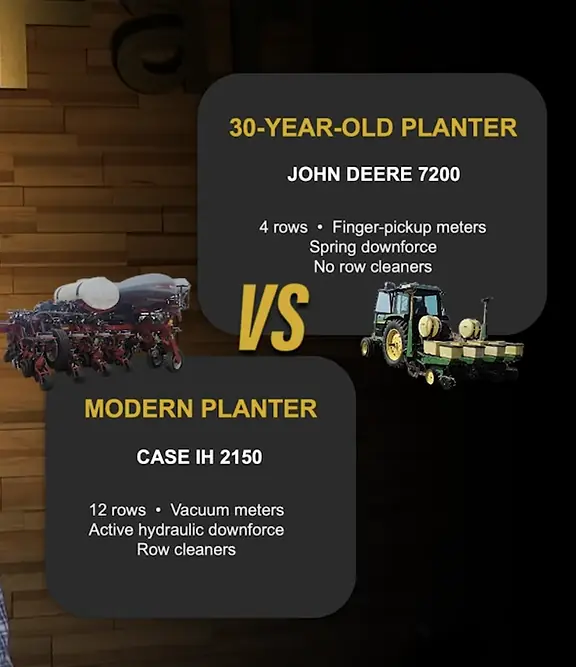
Purdue researchers put planter technology to the test by comparing a modern Case IH 2150 planter to a 30-year-old John Deere 7200 last growing season.
The Case IH planter had 12 rows, vacuum meters, active hydraulic downforce and row cleaners. The Deere planter had 4 rows, finger-pickup meters, spring downforce and no row cleaners.
The trial was conducted on a 20-acre field at the Pinney Purdue Agricultural Center, and the 2 planters ran in alternating strips across the field. Researchers harvested the middle 6 rows to remove border effects, cleaned yield monitor data and used proven statistical methods to account for differences across the field.
When the dust settled, Jonah Armstrong was surprised by the results.
“Under the conditions of this trial, the modern planter did not produce a measurable yield advantage over the 30-year-old planter,” says the ag economic master’s student at the Purdue Center for Commercial Agriculture. “That’s a pretty striking result when you consider the technology differences between the two. But before everyone puts their current planter on sale and starts dragging the old one out from the bushes behind the shop, the are several reasons why the new planter can be valuable.”
Armstrong hits the nail on the head; as many of you already know, bushels per acre isn’t the only metric that should be used to evaluate the ROI of new technology.
What about hours on the clock?
Less downtime, fewer errors, less seed waste and more acres covered in shorter amounts of time are all huge benefits that come with new planter technology.
With active downforce and row cleaners that can easily adjust to field conditions, operators can stay in the cab longer than before. Section control reduces seed waste, and planters can run longer without running out of seed.
New planter technology could improve the overall economics of your operation even if it doesn’t necessarily boost yields on every field.
Armstrong says you should always ask one big question when evaluating potential upgrades on your farm: How will this new technology help my bottom line?
“Maybe it’s yield. Maybe it’s labor. Maybe it means you have less risk because you can cover your acres faster,” he says. “The value of these improvements will look very different from one farm to another. Keep the specifics of your farm in mind when deciding on large technology upgrades.
“The takeaway from this trial isn’t necessarily that all farmers should go back to 30-year-old planters,” Armstrong adds. “But we need to be careful thinking that all new technologies are no-brainer upgrades over the old way of doing things.”
Click here for the full breakdown of the study.