Takeaways
- Strip-till can deliver multiple benefits in any region — even in the most challenging conditions — but it takes a certain level of commitment to make it work.
- Be patient and willing to call an audible with your strip-till gameplan if it’s too wet or too dry to make strips.
Joey Hanson has seen the good, bad and ugly sides of strip-till, both in his own farming operation and while custom strip-tilling in Iowa, Nebraska and South Dakota.
Hanson hails from Elk Point, S.D., an area tucked between the Big Sioux and Missouri Rivers in the far southeast corner of the state, close to the Iowa and Nebraska borders. He primarily grows corn and soybeans in regional soils marked by heavy clay. His family farm had long been in conventional tillage, except for a brief attempt at no-till in the 1990s, which was ultimately unsuccessful.
Hanson launched his custom strip-tilling and crop consultation business in the summer of 2013. He’d been working in ag retail for 6 years, and, after a disastrous drought year in 2012, he couldn’t help but notice the inefficiencies in conventional tillage going on around him. Hanson saw opportunity. He called up his banker on a Friday afternoon, and 1.5 hours later the plan for the business that would become Diversified Agronomy was born.
“We started to see a little bit more no-till actually in the southeastern South Dakota region at that time,” Hanson says. “Farmers were predominantly no-tilling soybeans. We didn't have a whole lot of minimum-till, it wasn't that popular back then. There was a little ridge-till, but it came with a lot of challenges also, and I saw people going away from it. So, I really felt like strip-till was that next step. Strip-till did exactly what we were looking to do. We wanted to take some of the value of the current practices of conventional tillage and combine it with the benefits of no-till.”
The Early Days
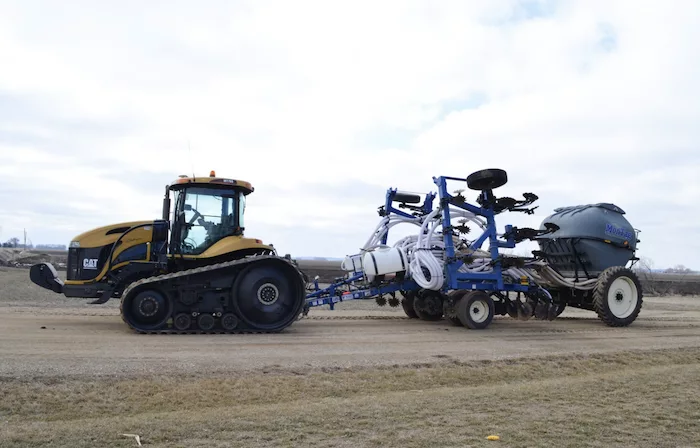
After much research, Hanson decided to focus on strip-till, which he saw as the best of both worlds between conventional tillage and no-till. The first set-up he bought was a Cat 765 tractor and a 12-row Blu-Jet Legacy with a Montag 9-ton twin bin, setting him back $180,000, a sum that felt mind-boggling at the time.
Equipment on hand, Hanson went into the fall of 2013 with plenty of ambition and high hopes. Those hopes, however, soon ran head-first into reality. The fall of 2013 was extremely wet, with rain seemingly for the better part of every single week. Just getting into the fields was a challenge.
And yet even a bigger obstacle to success was skepticism. In the mid-90s, a retailer in the region tried custom strip-tilling, but with only a glorified anhydrous toolbar and little experience. Farmers had no idea what to do with the new — and poorly implemented — method, and so the experiment was considered a failure, not unlike Hanson’s own home farm’s brief attempt at adopting no-till.
This was a clear lesson, though painful: half-heartedly trying a new practice or committing to it only tentatively could have lasting consequences. After a bad, albeit brief, experience with strip- till, many farmers were reluctant to give it another chance when Hanson came along. Between the rain and the resistance, he managed to cover only 1,350 acres, and he thought that his disastrous first fall might be his last.
In December of that year, Hanson met with his banker again, and admitted his own possible defeat. He’d planned to strip-till 4,000 or so acres and had only done about a third of that. After making the tractor payment, there was nothing left for the bank. The banker, thankfully, tabled the issue; they could meet again the following July, and if nothing had changed, they’d sell the equipment then.
“If you want strip-till to succeed, it will. If you don’t want strip-till to succeed, it won’t...
Strip-Till Success
A few months made all the difference. Customers were pleased with the job Hanson had done in the fall and gave him another shot. Word of mouth began to spread. In the fall of 2014, Hanson was handling 3,000 acres. The next fall, he was up to 4,500 acres across 3 states, a growth pattern based on results. Slowly, year by year, Diversified Agronomy had begun to prove itself and overcome the skepticism surrounding strip-till that some in the region had harbored for almost 20 years.
Every year that followed was unique and had its own challenges and successes. Hanson swapped the original Blu-Jet for a Kuhn Krause Gladiator in 2018 and then upgraded to a 16-row machine in 2019.
2019 was another extremely wet year, with record prevent plant policies being called in in an area that typically has very few. Despite the weather, and largely because he had started working early in September, Hanson managed to grow his custom strip-till acres to nearly 6,500 for the season, a sizable increase.
He was covering all those acres on his own, and by the fall of 2021 it was up to over 10,000, at a rate of 190 acres per day worked. It was exhausting, and unsustainable. In 2022, Diversified Agronomy brought on a second 16-row Gladiator and grew the number of custom acres again to almost 15,000. With some acreage to strip-till in the spring and a great deal to tend to in the fall, all seemed to be going well. Until 2024.
Overcoming Adversity
The first and truest lesson farming teaches is to always expect the unexpected. Any profession built around the twin challenges of machinery and Mother Nature will always demand patience, and, unfortunately, a degree of caution.
After another spring with record-high rainfall, Hanson suffered a gruesome injury in mid- September. He accidentally blew open his knee with a pressure washer, and landed in the hospital, avoiding amputation by only a few hours.
After a first surgery, a lingering infection required a second, and the prognosis was that Hanson would need 6 weeks of recovery before he could get back in a tractor. Thankfully, a friend was able to start the season’s strip-tilling, and, on crutches, Hanson was back in the cab a mere 10 days after arriving home. It was an awful start to a fall that would only get more challenging.
“I couldn't move at all,” Hanson recalls. “But that wasn't even what made 2024 the worst fall. We made it through. I still have both legs. 2024 was the hardest fall we've ever experienced in our entire life. I can tell you every weak point on a Gladiator because I think we've run 8 or 9 of them over the years, and we've broke about everything, until 2024.”
The rains had stopped by mid-July, and a drenched spring turned into a dry fall. The ground was practically too hard to work, and the bone-dry soil took its toll on the machinery. It seemed everything that could break on the equipment did, and at a certain point in the season they just had to stop and wait for rain to soften things up. It was a brutal time. But even with the challenge of the weather and the machinery, Hanson managed to strip-till over 10,000 acres that fall – and escaped the year with both legs still attached.
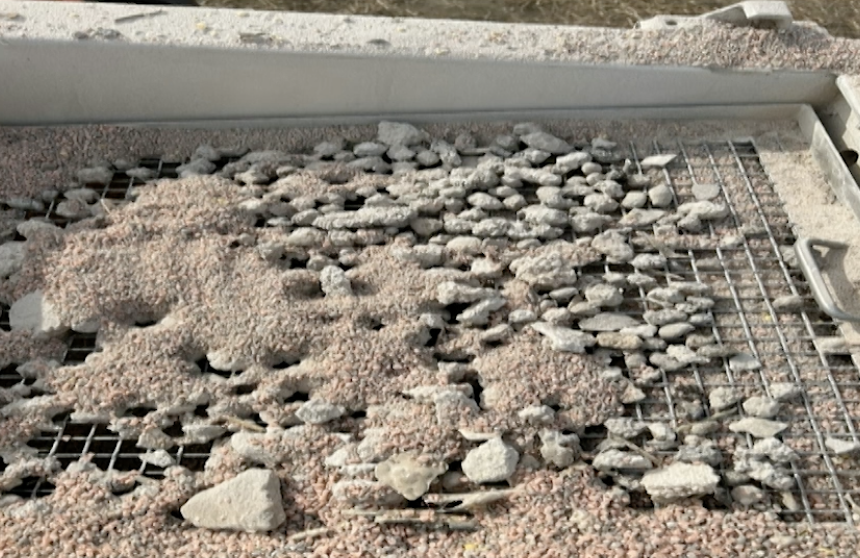
ROCKY SOILS. Hanson found ways to make strip-till work even on his rocky soils. The key is being able to adapt and build a strip-till plan that works for your own unique situation, he says. Source: Joey Hanson
Strip-Till Lessons Learned
If Hanson has one takeaway from all his experience, it’s the importance of change and adaptability. Whether it’s South Dakota, Iowa, or Nebraska, every region is different, with its own soils and its own challenges. Being able to tailor the strip-till plan from farm to farm and even from section to section is key to a successful custom strip-till business.
Weather also dictates operations, and not the other way around. There will be too much rain, or too little, and any plan is apt to get spoiled. Regardless of how well you prepare, you will end up strip-tilling in the snow, or finding rocks the hard way, or getting bogged down in unforeseen low spots. The only thing to do is stay flexible, and keep going.
In some ways, the most challenging factor of all will always be the human component. One key to success in custom strip-tilling is accuracy, getting dialed in to sub-inch precision on the rows because high accuracy equates to job success, and a happy customer. And keeping repeat customers satisfied is key to any successful business. A bad experience in one season could sour a farmer on strip-till for a decade or more.
“I'd love to say that everybody I started strip-tilling with is still with me,” Hanson says. “I bet in 12 years, we've probably lost 20 some growers. They tried it, they left, they maybe came back and tried it again a couple years. We felt like we were going in the right direction, and then they left. And what we've learned over those years is it really is a mentality. If they come to me and they're like, ‘We'd like to try 80 acres of strip-till,’ I won't do it. Because the likelihood of you succeeding and wanting to succeed with that program is very, very low.
Insights from Joey Hanson's Strip-Till Journey
During his presentation at the 2025 National Strip-Tillage Conference, Joey Hanson shared brand-new insights from his strip-till journey — on equipment setups, fertility placement, common landmines to avoid and more — to help both beginners and strip-till veterans maximize their chances of success. The National Strip-Tillage Conference Video Replays are brought to you by HUMA.
“If you come to me and say, ‘Man, I'd really like to try this. I've looked at this a lot,’ and they're excited about it, they're passionate about it, you could tell they're not just going to be a one and done. Or they're not going to be the kind of person that says, ‘We really did it just to prove to ourselves that the current practice we're doing is better than what he's doing.’ Those are the people that we have success with. And we have quite a few customers that have been stripping with us for 10-plus years, and continuous strip-till, both corn stalks and bean stubble. So, we did a lot of trial and error. We’ve failed miserably in the last 12 years. But don't be afraid to change, and success will come.”
It's important for farmers to know why they’re getting into strip-till in the first place, too. An attitude of skepticism, or a willingness to be only half committed, will go nowhere. The switch from conventional tillage to strip-till can be a tough adjustment, and while there are clear savings in fuel and machine costs, an increase in yield might not happen immediately. It takes a certain amount of time, and a level of commitment, to make strip-till work out, and it’s important to manage expectations up front.
After 12 years in the business and well over 100,000 acres strip-tilled, Hanson can sum things up in one simple but important truism: “If you want strip-till to succeed, it will. If you don’t want strip-till to succeed, it won’t."