
Mick Goedeken has seen just about everything in his career as an agronomist. For years, the Polk, Neb., native has helped strip-tillers dial in their nutrient programs across the globe while working for organizations that include WayPoint Analytical, Orthman Manufacturing and Central Valley Ag. He believes there’s always room for growth on every farm.
“Nothing is ever good enough for me. I can always improve,” Goedeken says. “And my wife hates when I say that every day. But we can get better. Strip-till is an avenue to get better and improve efficiency.”
Goedeken compares strip-till to a 3-legged stool. The 3 legs are compaction reduction, nutrient placement and seedbed preparation. Each leg maximizes your shot at success.
“I like to shoot guns,” Goedeken says. “With a tripod, I can hit the bullseye every time. I liken that tripod to the 3-legged stool of strip-till. Whereas if I use a monopod when I shoot, my accuracy goes down. I wobble and shake.”
Back to Your Roots
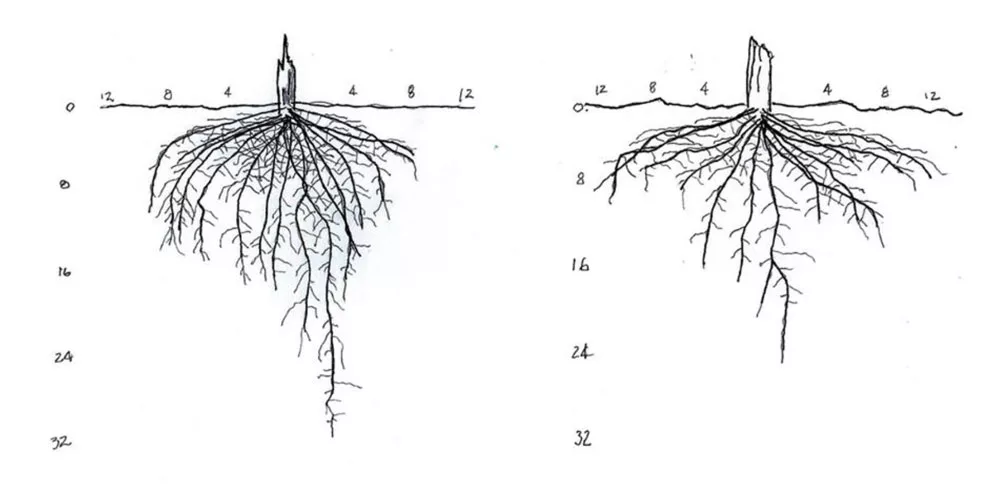
Before diving into strip-till fertility, Goedeken says it’s important for farmers to understand the power and function of roots.
“Healthy roots help prepare you for the storm,” he says. “Every year is different, but there’s always going to be a storm of some sort, I guarantee it.”
The primary roles of roots include nutrient acquisition, plant temperature regulation and anchorage. Goedeken points out that 99% of the nutrition in a corn plant comes from its root system.
“Sure, we can apply a foliar, but can we get 100% of our nutrition from a foliar? Absolutely not,” Goedeken says. “I compare foliars to vitamins. I take supplemental vitamins to boost my immune system. But I eat steak with my mouth. The corn plant’s mouth is its roots. We need to think about producing healthy roots.”
“Be patient with strip-till. Year 1 or 2 might be difficult. Year 3 is when things start to happen…”
Corn roots prefer a temperature between 53-65 F, while soybeans prefer 58-68 F, Goedeken says.
“Roots near the surface will desiccate,” Goedeken says. “They don’t like high temperatures. When those soil temperatures go between 90-95 degrees, the roots dry up and die.”
Studies show that optimum root growth happens at 72.5 psi resistance in the soil, Goedeken says. As the resistance increases, the roots shorten up because they can’t fight through the compaction.
“Roots have push power,” Goedeken says. “As the plant gets older, that push power becomes more. At V2-V4, they can push through 60 psi. At VT-R2, they can push through 400 psi.”
In-Season Observations
Goedeken often finds himself in the middle of the classic fall vs. spring strip-till debate. When farmers ask if they should make strips in the fall or spring, he tells them, “Yes.”
“Truly, it depends on your operation,” he says. “Labor, timing and fertilizer sources all factor into it. If I had my way, because I’m picky about things and I live in a semi-arid environment, I’d say that dry fertilizer goes in the fall and liquid fertilizer goes in the spring.”
Goedeken conducted trials with multiple farmers during the 2024 growing season, comparing compaction in spring strips, fall strips and no-tilled fields.
In one trial, using his penetrometer on a clay loam field in the middle of June, he found that there was less compaction in spring strips than fall strips. But there were multiple factors at play.
“This field was in its first year of strip-till,” Goedeken says. “I also found out 2 days after I sampled that the farmer planted in the fall strips when it was a little wet. Even so, there wasn’t a lot of compaction there compared to what I saw in the fall strips when we tested the field before he ran the planter.”
In another trial, Goedeken compared spring strip-till to no-till on a clay loam field that was in its 2nd year of spring strip-till. The strips were moved 15 inches each year. He found that compaction was lower on average by 9.3 psi overall in the spring strips.
Goedeken also found a 19.7 psi advantage for strip-till over no-till in pinch rows, and a whopping 74.1 psi difference in favor of strip-till in guess rows.
“I always tell farmers they have to be patient with strip-till,” Goedeken says. “Year 1 or 2 might be difficult. Year 3 is when things start to happen. That’s when your microbial activity takes over and starts to improve.”
Digging Deeper
Strip-tillers should focus on placing nutrients in the top 12 inches of the soil, Goedeken says. Ideally, that means hitting it with nutrients in 5 different spots: 4-5 inches, 6-7 inches, 8-9 inches, 10-11 inches and 12 inches. He also believes starter fertilizer is a must.
“10-34-0 is not a starter fertilizer. You have to do better,” Goedeken says. “A starter needs to have N, P, maybe K, sulfur, zinc, other micronutrients and some sort of growth promoter or enhancer.”
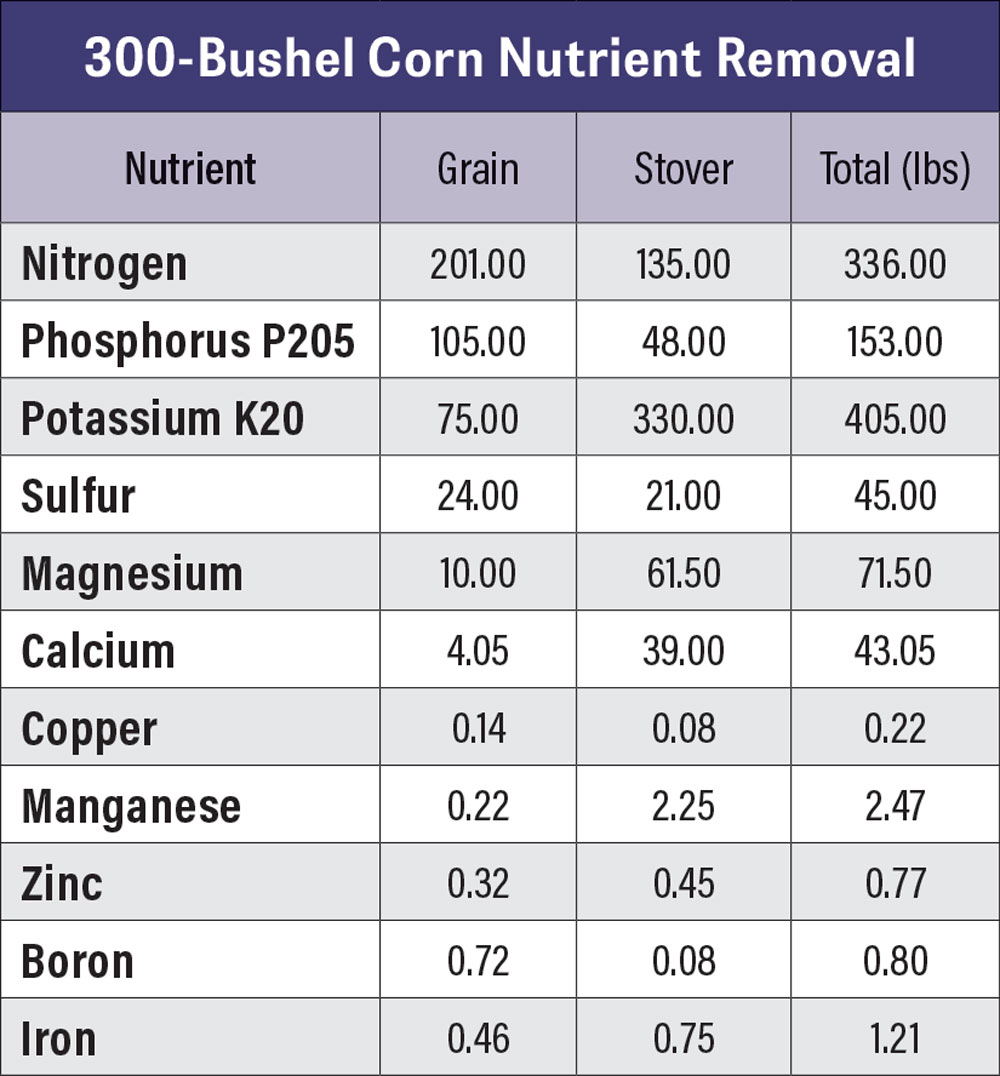
RIGHT RATES. Looking at this nutrient removal chart for corn, Mick Goedeken says at least 201 pounds of applied nitrogen (N) is necessary for a 300-bushel crop. Mick Goedeken
Goedeken points to a nutrient removal chart for 300-bushel corn as a good baseline for application rates. For example, in the chart, there’s 135 pounds of N in the stover column and 201 pounds of N in the grain column for a total of 336 pounds of N. “I will never produce 300-bushel corn with less than 201 pounds of N,” Goedeken says. That means 0.67 pounds of N per bushel would be an efficient target for 300-bushel corn.
“When you look at the chart, the corn crop only requires about 0.2 pounds of copper. So, if you have someone out there trying to sell you pounds of copper, start thinking about that,” he adds.
Nitrogen & Sulfur
Farmers applying N with their strip-till rigs can get by with about 25-30 pounds at 6-8 inches deep, Goedeken says. He believes there’s room for improvement with N efficiency in most operations.
“The goal of strip-till is not nitrogen,” he says. “It’s too volatile and easy to lose. I’ve worked with software that predicts nitrogen availability, and it always ends up being less efficient when applied in the fall. There are several other ways to apply nitrogen when the crop needs it — topdress, sidedress, fertigate. We all deal with weeds right? A pre-emerge weed spray in the spring would be a great way to apply 10 gallons of UAN or 32%.”
Goedeken is a big proponent of applying sulfur with every N application. He used to recommend 1 pound of sulfur for every 10 pounds of N, but that’s changed over the years.
“We don’t get that free sulfur from the atmosphere anymore that we used to,” he says. “I’ve moved to a 5 pounds of nitrogen to 1 pound of sulfur ratio. But after looking into it, the number is somewhere between 3:1 and 2:1 west of the Missouri River. The higher organic matter soils hold more sulfur. Just like nitrogen, later applications of sulfur are more efficient. Place it 6-8 inches deep and with every nitrogen application.”
Phosphorus & Potassium
Phosphorus (P) can be applied 6-8 inches deep with the strip-till rig, Goedeken says, and incorporated in different ways throughout the growing season to match when P uptake is at its highest.
“Phosphorus is taken in at V6 and V14-VT. Place the phosphorus to match that. We can get more efficient by doing this and applying it at 4-6 inches, 6-8 inches and 10-12 inches,” Goedeken says. “This also allows the phosphorus to match the soil warming at different depths. Mycorrhizal activity takes off at soil temperatures of about 60 degrees. Early planted corn in cool, wet springs tends to show phosphorus deficiencies because those soils aren’t releasing P until they hit 65-70 degrees.”
Exploring Better Nutrient Placement
Mick Goedeken discussed how to get the most bang for your buck with strip-till inputs during a classroom at the 2025 National Strip-Tillage Conference. Click here to watch the session. The 2025 NSTC Video Replays are brought to you by HUMA.
A 300-bushel corn crop from V8-VT is pulling up 11.5 pounds of potassium (K) per day, Goedeken says, which is why late-season K applications are a good idea.
“We have to provide potassium to the crop when it needs it,” Goedeken says. “The uptake happens from V3-V5, again at V8-V9 and then it really takes off at VT-R2. Whether it’s a sidedress application or through the pivot, we’ve seen yield responses to late-season potassium applications, even in the western Corn Belt where it’s naturally high in the soils.”
Zinc, Boron & Other Micronutrients
Zinc and P work well together, says Goedeken, who likes to see a 10:1 P to zinc ratio in his soil tests.
“There’s steady zinc uptake from emergence to V8,” Goedeken says. “Products like MicroEssentials work so well because they’re balancing the phosphorus and the zinc.”
A low rate of boron meanwhile is needed about 40 days after emergence and again about 75 days after emergence, Goedeken adds.
“It moves slow in plants and too much of it can equal toxicity,” Goedeken says. “Keep it in the strip at less than 1 pound per acre.”
Iron, copper and manganese are also essential nutrients in Goedeken’s notebook, and he recommends using micronutrient prills if you run a dry fertilizer system.
Final Word
Several years ago, Goedeken put together what he calls an “oops plot” in York, Neb.
“I was going to set the world on fire; I put 9 pounds of boron in furrow.”
Something happened that he wasn’t expecting though. It rained 22 inches between planting and early June.
“I ended up looking like a hero with the 9 pounds of boron in furrow. If we have a dry season and we have 1 pound of boron, I’m hoping there’s some rainfall to leach some of it before those roots hit it. But no matter what you do, Mother Nature is always in charge.”