
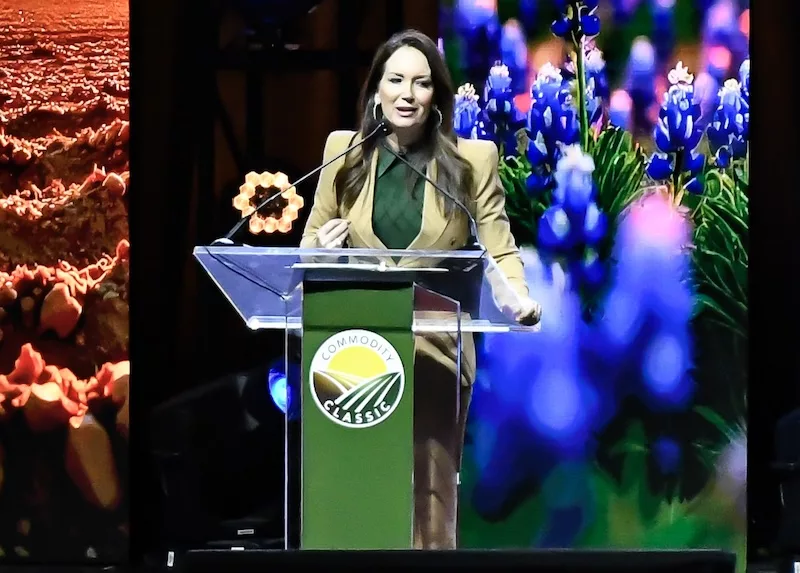
SAN ANTONIO — Dozens of ag media were present for a press conference at last week’s Commodity Classic in San Antonio with USDA Secretary Brooke Rollins, who took office facing a daunting slate of challenges, from rising input costs to high interest rates to trade deficits and invasive species.
Here is a summary of what Rollins said in response to several questions in San Antonio about the state of the farm economy and what to expect in 2026.
TRADE DEALS: Much has been made about the trade situation. Rollins says the change in administration has resulted in 15 new “trade deals and frameworks,” noting no new trade deals were struck during the Biden administration. The agreements have been with the European Union, Japan, Mexico and Southeast Asia. The U.K. had an additional $5 billion in ag export opportunities, she says, including $700 million in new ethanol and better market access for beef.
Indonesia agreed to eliminate 99% of the previously established tariffs on U.S. exports, including for all agricultural products.
Japan agreed to increase U.S. rice imports by 75% and purchase over $8 billion in agricultural products, and the EU agreed to $750 billion worth of American energy.
China, the biggest importer of U.S. soybeans, has committed to buying about 87 million metric tons of beans in the next several import cycles, although the farm industry is watching the follow-through closely, as is Rollins and other USDA officials. Rollins said a recent phone call President Trump had with China President Xi Jinping have been “very encouraging.”
There are other crop sectors that need attention as well, Rollins noted, including milo and cotton. “So we're going to keep focusing on soybeans, focusing on China purchasing, but also opening up the markets so we're not so reliant on China for soybeans, and so we have other opportunities for a lot of our other row croppers that are really struggling.”
TRADE DEFICIT. Rollins said the forecasts for the U.S. trade deficit this year is $35 billion, which is still high but down from the $41.5 deficit logged last year. U.S. tree nut exports were up 11%, ethanol exports were up 11%, dairy exports were up 15% and corn exports were up 29% in 2025. Rollins said the USDA is also focusing on rebuilding the domestic market.
“After four years of that deficit just skyrocketing, we're moving in the right direction in a pretty significant way,” she said.
INPUT COSTS: There seems to be some disagreement on what’s happening with input costs. One media member said a panel of ag economists, including the recently departed chief USDA economist, said they their data doesn’t point to input costs were declining.
Rollins said she hadn’t seen their data but she maintained there is a projected “moderate” 1.7% decline this year in feed, fertilizer, seed and other input costs compared to last year. She is also expecting a “very significant” decline this year fuel, labor and interest rates.
Another reporter asked Rollins if the continued government payment would actually exacerbate the overproduction issues here and keep marginal land in production.
“I'm sure you've all seen the charts that show that these payments barely keep them in business year to year. It's a struggle, while a lot of our input companies increase costs by 20%, 30% or 40%, and you can track it. When there is a government payment, you can see it happening in real time,” she said.
The feds said in recent months they would be looking into market monopolies in the fertilizer industry.
“I talked about this with the president multiple times. I talked about it in the Cabinet room multiple times. I think we must get to the bottom of this very, very quickly,” Rollins said. “We must ensure we’re supporting the farmer and we’re not compromising the food supply or crashing anything unnecessarily.
“But it is a question that I am very, very focused on and will remain so.”
E-15 NEEDED. Trump was in Iowa recently and told a group he would defer the mission of establishing E15 for year-round sales to the GOP leaders, then the legislation was referred to a committee, causing more delays. A media person asked whether Trump will get what he wants on this issue and if the White House could exert more pressure, or grant an emergency waiver so the industry could prepare itself for making higher blends.
“I wish you all knew how much E-15 has been discussed in the Oval Office and in the Capitol and what a priority it is,” Rollins answered. “I have been given assurances that it is going to happen. Of course, there’s only so much we can control from the White House.”
ON THE MOVE: Moving trucks will continue to be a theme for USDA staff this year. Headquarters staff will be disbursed to regional hubs in Kansas City, Salt Lake City, Raleigh, Indianapolis and Colorado Springs as the agency announced plans to vacate the massive South Building in Washington D.C.
Rollins wants the migration of staff into the heartland to finish before school starts so families can find homes and adjust. The South Building will be released back to the General Services Administration, where it could be sold or see some other fate.
The South Building is 432,000 square feet with about 7,000 offices. In the 1950s and 60s, “it was teeming with activity,” Rollins says, adding that only about 600 offices are being used the structure needs about $600 million in maintenance. “For years, no one would do anything about it.”
Rollins said the eventual abandonment of the South Building, “was an encouraging day for those of us that believe that government should be closest to the people that it serves. It was not a great day for people who love the consolidation of power in Washington D.C.”