
Brought to you by:
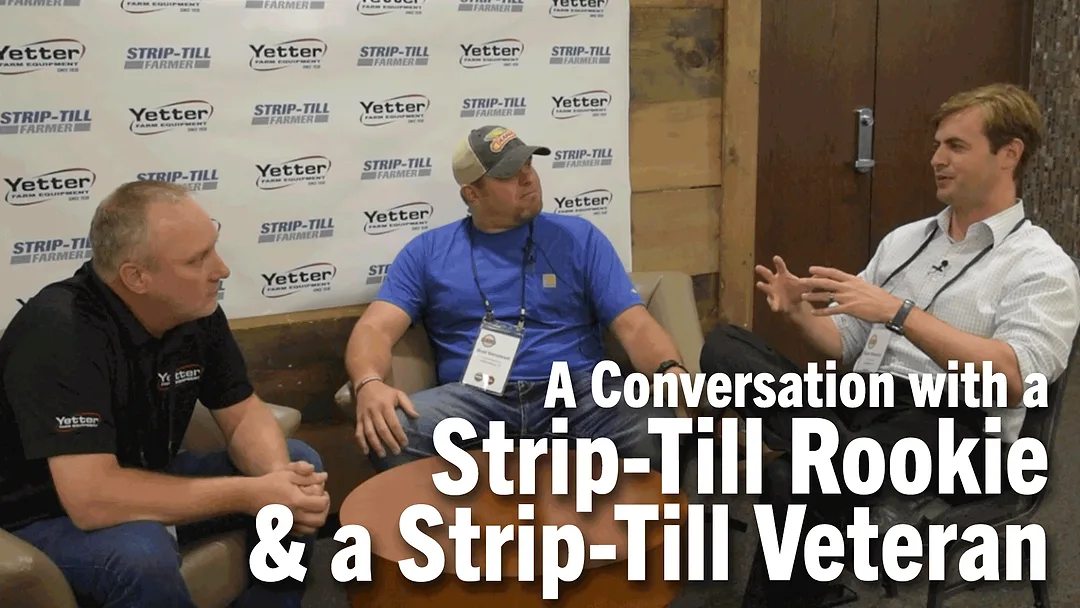
On this episode of the Strip-Till Farmer podcast, brought to you by Yetter Farm Equipment, we catch up with a first-time National Strip-Tillage Conference attendee and a longtime attendee during a live recording at the 13th annual event in Springfield, Ill.
Brad Niensteadt, Kinze product specialist, attended the National Strip-Tillage Conference for the first time, while Andy Thompson, Yetter strip-till lead product specialist, was making his 13th appearance at the conference.
We sat down with both guys to get their key takeaways from the event and their overall outlook on the evolution of strip-till. Niensteadt and Thompson also discuss the recent strip-till partnership between Kinze and Yetter.




The Strip-Till Farmer podcast is brought to you by Yetter Farm Equipment.
Since 1930, Yetter Farm Equipment has been providing farmers with profitable solutions. From residue management and fertilizer placement to seedbed preparation, our equipment is designed to maximize your inputs, save you time, and deliver a strong return on investment. Explore our full line of planter attachments, precision fertilizer placement options, strip-till units, and stalk rollers at yetterco.com. Let Yetter help you prepare your equipment lineup for success today.
Full Transcript
Noah Newman:
Hello, and welcome to another edition of the Strip-Till Farmer Podcast, brought to you by Yetter Farm Equipment. I'm your host, managing editor, Noah Newman, and today we're doing something a little different. We're catching up with a strip-till newbie and a strip-till veteran. So Brad Nienstedt, Kinsey product specialist, attended the National Strip Tillage Conference for the very first time earlier this month in Springfield, Illinois, while Andy Thompson, Yetter Strip-till lead product specialist, was making his 13th appearance at the conference. So we sat down with both guys to get their key takeaways from the event and talk about their overall outlook on the evolution of strip-till. Nienstedt and Thompson also discussed the recent strip-till partnership between the two companies, Kinsey and Yetter. So this was recorded live at the conference. Let's listen in. All right, we are recording live from the National Strip Tillage Conference. We have Andy Thompson with us from Yetter.
We have Brad Nienstedt from Kinzie, and we want to get both of you together because we'll dive into the partnership between Yetter and Kinzie here in a minute, but this is your first strip-till conference, Brad. So what are your impressions so far of the event?
Brad Niensteadt:
I didn't know what to expect initially as a whole coming in. I would say the neatest part is the camaraderie that is here at the Strip-Till Conference. I've been other conferences, obviously many larger, many smaller, but very unique to just, it's like a bunch of old friends getting together, which is really cool. It was very impressive to see this morning. I'm not the only first timer as well, so there's a lot of new people here as well. So it was kind of interesting. I sat with a gentleman this morning. It was his first time, just wants to learn, what's it all about? Hearing more about it, becoming more prevalent in the marketplace. So yeah, it's been interesting. I've learned a lot in the first half a day, three quarters of a
Noah Newman:
Day already. Great to hear it. Yeah, you're actually one of the 57% of attendees who are here at the Strip Till Conference for the first time. Andy is someone who's been coming to the conference for a long
Andy Thompson:
Time. Every one of them?
Noah Newman:
Yeah, you've been to every single -
Andy Thompson:
Every single one of them.
Noah Newman:
Andy's been to every single one. What do you think when you hear a number like that, that there's so many new people attending?
Andy Thompson:
Yeah, you got the rookie and the veteran here, I guess. So no, I mean, that was one of the things I was excited about to come to Springfield. I really felt as though that we were going to get a lot of geographic that has not been here before. And I think that that's exactly what we're seeing. 57% is a phenomenal number to me. And I would say, maybe it's the venue or whatever, but it looks like this is one of the best attended, one of the most attended that we've had out of the 13. So very encouraged by that. That doesn't surprise me to be honest with where we're at with strip till right now. I mean, interest is extremely high. We've been very busy getting a lot of calls, talking a lot of strip till over the last 18 months. And I really certainly feel as though that we're still going upwards toward that peak.
So that's all very encouraging, kind of reinforced to come here to see so many new first timers and just overall the crowd. It's been pretty phenomenal so far today.
Noah Newman:
Yeah, it's been great and look forward to seeing what the final attendance number is because from my perspective, it does seem like there's a lot of people here and a tough year for farmers. So for them to make this commitment to come out here, I think that speaks volumes about strip till. And of course, Brad Kinsey entering the strip till market with the partnership with Yetter, the Falcon, which we covered on striptillfarmer.com when it debuted at your innovation day out in Williamsburg, Iowa. What can you tell us about this partnership between Kinsey and Yetter?
Brad Niensteadt:
So a lot of people think that maybe it just happened just because of Strip Till. We've been partners with Yetter for several years working on some of our planter attachments from a residue standpoint and those type of things. So it's not anything new. We've been together for a while. It made sense. They were looking for a good solution for a heavy duty tool bar that, again, matched more planter capability and planter sizes. And again, matching a row size that isn't really that readily available in the marketplace, specifically 20 and 22 inch rows. We had a tool bar that's been in the market for a long time. It's got a very good reputation. Kinsey has a very good reputation for durability, reliability, et cetera, and it just made sense. So been a good partnership. It's kind of been a whirlwind tour as we've talked to get one out and together.
It's been a short development timeline, but that's kind of the benefit of two privately held companies. We can be nimble and make those changes quickly.
Noah Newman:
Yeah, it seemed like the whole thing came together pretty quickly. Have you been talking to a lot of people here at the conference about the Falcon?
Andy Thompson:
Sure. We certainly saw the short period after the release, especially that first week, just a lot of buzz in the marketplace. But then now here we come a month later, we come here and yes, there's not too many people here that had not heard that information. And even with a lot of first timers, I've talked to a lot of people that are not yet strip-tilling here, which is very encouraging, but yet they had already heard about that. They brought up to me, a number of people have today about the Falcon, about the Kinzie machine. And so yes, the buzz has been very strong from the release over the last month.
Noah Newman:
Now, Brad, were you pretty familiar with Strip Till before this entire partnership or just kind of talk about your strip till background and why you guys really wanted to get into it.
Brad Niensteadt:
Sure. I have known about it and you hear it and I think the more I get involved into it, strip till means a lot of different things. And I was probably the stereotypical, it's a heavy tillage, high horsepower, all those type of applications when we get into it and start dealing with Yoder. And again, learn a lot today that that's not just the case. There's many, many versions of it and many versions to fit your operation. It's not a one size fits all. Kind of goes right back to the planter market. There's not one every planter's the same. Strip till is very similar to that. So yeah, learned a little bit. As he said, I'm the rookie and definitely learn a lot every hour, especially today.
Noah Newman:
I'm probably going to butcher this quote, but Monty Botton's Cambridge, Illinois farmer said it one time, you might know it, Andy, it's something like the concept of strip till is universal, but the practices are local. So as you were touching on, it's different depending on where it could be. It's not just one thing, it could be multiple different concepts. But what's your definition of strip till, Andy? Because I know you share it a lot.
Andy Thompson:
Yep, exactly. We've talked about this before that everybody, whether they strip till or not, everybody thinks that they know what strip till is. I've been knowing this for 25 years and 10, 15 years ago, 20 years ago, we would ask if you knew what strip till was and maybe people weren't familiar with it. Today, everybody's familiar with it or they think so. But then when we start having the conversations, we start to realize, oh, well, that's the machine, that's the knife. And so we've been talking for a number of years that strip till is not the tool. Strip till is the system. And so our definition is a farming system that manages residue and provides controlled seedbed preparation within specific zones within the field. Now that's very broad, very basic, and that's on purpose because as I've seen over the years, some people will say, "Well, you're not strip-tilling." I say, "Why is that?" "Well, because you're not going 12 inches deep.
""Why do we have to go 12 inches deep?" "Well, because that's what strip-till is. "Or just somewhat recently I saw on a Facebook group, on a strip-till Facebook group, somebody was applying anhydrous and they were calling it strip-till and somebody said," Well, you're not strip-till." And you said, "Why is that?" "Because you're only putting his on. "Wait a minute. So why only. So the problem is we've used past experience and then we've tried to then apply that as a universal truth. And that's our whole point here is the universal truths of strip-till is that we're specific in those zones. And that's where our sacred ground, as I always call it, that's where we are doing is we are managing residue and we are performing a seed bed preparation in that. And that's it. That's all that really it takes. Now that allows us, that freeing thought process allows us to be able to start tailoring it to each farm.
We come to no-till conference and every farmer there would call themselves a no-tiller. And then you find out, well, one guy actually runs a vertical tillage machine. One guy runs a no-till inline rip or whatever. Well, everybody's definition of that no-till is a little bit different, right? USDA says you have to do less than 67% or something like that disturbance. Well, the strip-till is not just a specific tool or the past, it's the system. And now I feel like over the last few years we better define that system and more people now are realizing that, wait a minute, I though that I had to do this. No, I'm a little bit more able to make my own decisions for my farm. It's just these certain principles that have to be taken into account. And when we do that and we help them better understand that, I feel like that they're making better decisions for their own farm.
Noah Newman:
Let's burn a quick time out for a word from our sponsor, Yetter Farm Equipment. Looking for innovative solutions to maximize your farm's productivity? Look no further than Yetter Farm Equipment. They're dedicated to providing farmers with the highest quality equipment, from row cleaners and closing wheels, to fertilizer equipment, strip till units, and stock devastators. Yetter has the tools you need to optimize your farming operation. Visit yetterco.com. That's Y-E-T-T-E-R-C-O.com to learn more and find a dealer near you. And you see people tinker with their strip till systems, it seems like. For example, Chris Perkins who gave the presentation earlier. Now when I visited him a couple years ago, he was anti-cover crops. I'm never going to plant a cover crop. Now he's planting cover crops with strip-till and he's loving the results. So that's pretty interesting development. It seems like cover crops and strip-till are pretty good pairing.
Andy Thompson:
Yep, absolutely. And the fall versus spring seems like that's the biggest debate in strip-till or knife versus colt or there, whatever. But when we start looking at the principles of strip-till, conservation is a big part of that. And so now if we are going out there months in advance and we're doing a lot of tillage, if we're doing that recklessly where we're not doing a good job with that, we are more prone to erosion. And so for me personally, that was my transition when I stopped doing so much of the fall strip-till was because of feeling like I was doing everything right, and yet I still had erosion. And what I started realizing is I don't know that there's anything we can do six months in advance and then hope Mother Nature doesn't come in and change that. And so it's hard to predict and getting harder and harder to predict what Mother Nature's going to throw at us.
So the message, not the message, but my tone or the specifics of Strip Till may be a little bit different today than it was a few years ago or five years ago just in the case of Chris Perkins. And that's part of the evolution of strip till. As we yet have been doing it for 35 years, our messages have kind of changed, right? We have evolved this and I feel as though that experience can really help a lot of people in understanding that and then maybe help them maybe get past some of them learning curves or stumbling blocks that we've had in the past.
Noah Newman:
All right, Brad. So I think as we were talking about before we went on camera here, you look familiar. I feel like we've crossed paths at some farm shows before. Sure. Are you going to be at any upcoming shows showcasing the Falcon talking about it? And if you are, what are some key features or highlights that you really want people to know about it?
Brad Niensteadt:
Yep. So it'll obviously be at Farm Progress Show here coming up soon. It'll be on our booth for, again, guys to ask questions, see. And again, we always have it on hand at our Kinsey Innovation Center as well here at Kinsey and Blanksburg. I think the big thing about it is that toolbar, again, is proven in the marketplace. It's been out in the field for several years in all of our frame sizes. We basically took the planting things off and put the other components on there. Again, it's a three section frame built for high speed. It's built for high speed planting, built for hydraulic downforce, built for high capacity, liquid fertilizer, seed, all those options we put on the planter. It's just a great transition right into the strip till market. It again still has our hydraulic weight transfer. We pioneered that back in 2009.
This toolbar continues on with that to, again, help keep those wings in the ground, especially as you get to high speed, because as everybody's talked about here, a big advantage of strip till, especially in shallower depths, is efficiency and speed. You got to have a toolbar that's going to support it, but you also need to keep consistent depth. Another item that everybody talks about as well, no different than planting, it's just a tillage pass instead. So a lot of unique features with it. Again, Kinsey reliability that's been around for well over 65 years.
Noah Newman:
So day one of the strip till conference here, from the conversations you've had with people or maybe one of the presentations you watched, what's something that's jumped out? Any key moments, anything that surprised you or anything new you learned or that you weren't expecting to hear? Both of you could jump in on this one.
Brad Niensteadt:
To me, the best comment so far was when we were talking about a presenter, and I can't remember his name off the top of my head, gentleman from Minnesota said the biggest thing or hangup that you might have is right here in your head. Mental. That was probably the best comment I heard. It wasn't price or concern or anything like that. It was purely, if you're going to do it, do it. And that was a good view. I liked the take on it of the only one holding you back is yourself and it's the gray matter between your ears, as he said. So that was a good quote.
Andy Thompson:
Absolutely.
Brad Niensteadt:
That
Andy Thompson:
Was a good quote. For me, one of the things was talking with Chris Perkins and Chris Caston, and as they were talking about their tissue testing and their different testing methods here, I found that very interesting, something that I feel as though that I can apply to my situation. And so I'm very intrigued and interested in that. And then back to from a supplier or vendor standpoint here was how many first-timers? I feel like that in the past, we've sometimes struggled on getting first-timers. Sometimes we struggled on getting veterans. In my opinion, I feel like that the people that I've talked to today, we have a great group of interested people looking to get into strip-till as well as industry veterans that have been doing this a long time. And so I've just been very, very pleased with that today and looking forward to a lot more great conversations.
Noah Newman:
Yeah, it's interesting seeing people from all different kinds of farming operations. Some are doing cover crops, maybe some not. Some people maybe aren't strip-tilling yet, but they're thinking about getting into it. And then we have those Hall of Fame banners over there featuring people who've been strip-tilling for over 30 years. So when you get that mix, it seems like that's when the magic happens, people learning from each other. Yetter, I know you guys have been in the headlines a lot this year. Any other partnerships you'd like to touch on or some expansion you'd like to let our audience in on?
Andy Thompson:
We had a classroom in there and that's one of the things that we talked about was our philosophy of strip-till and of equipment, 96 years family owned still based right here in Illinois. And so we do a lot of things well, and one of the things that I feel like that we really have a lot of great things going on right now is our new or fairly new industry relationships, Kinsey being the latest one that we've announced here. Of course, then we have the fast relationship as well, working with the great people with Fast Ag Solutions. Earlier this year we announced the acquisition of Martin Industries. And so there's just a lot of great momentum right now, just a lot of things that are really happening great for our company, but we're still, as Brad pointed out, family owned and the way that this partnership with Kinsey worked, probably there was a lot of people that would be very surprised at how smooth and how quick this really went and how this worked.
There was a lot of great things that more or less started with the handshake and the rest of it filled in. It's just really been a great experience and a great partnership so far with working with them. As Brad said, it's not necessarily a new partnership, it's just on another level. It just really went great. And so yeah, we have a lot of other things in the works. Stay tuned. We'll have some more things coming out soon.
Noah Newman:
All right. That'll do it for this episode of the Strip Till Farmer Podcast. Thanks once again to Yetter Farm Equipment for making this podcast series possible. That was a fun conversation. We also had a blast at the Strip Till Conference earlier this month in Springfield, Illinois. Hope you were able to make it. If not, hope to see you next year in the Quad Cities in early August. And for more coverage from the event, stay tuned on striptillfarmer.com. Thanks for tuning in. Have a great day.