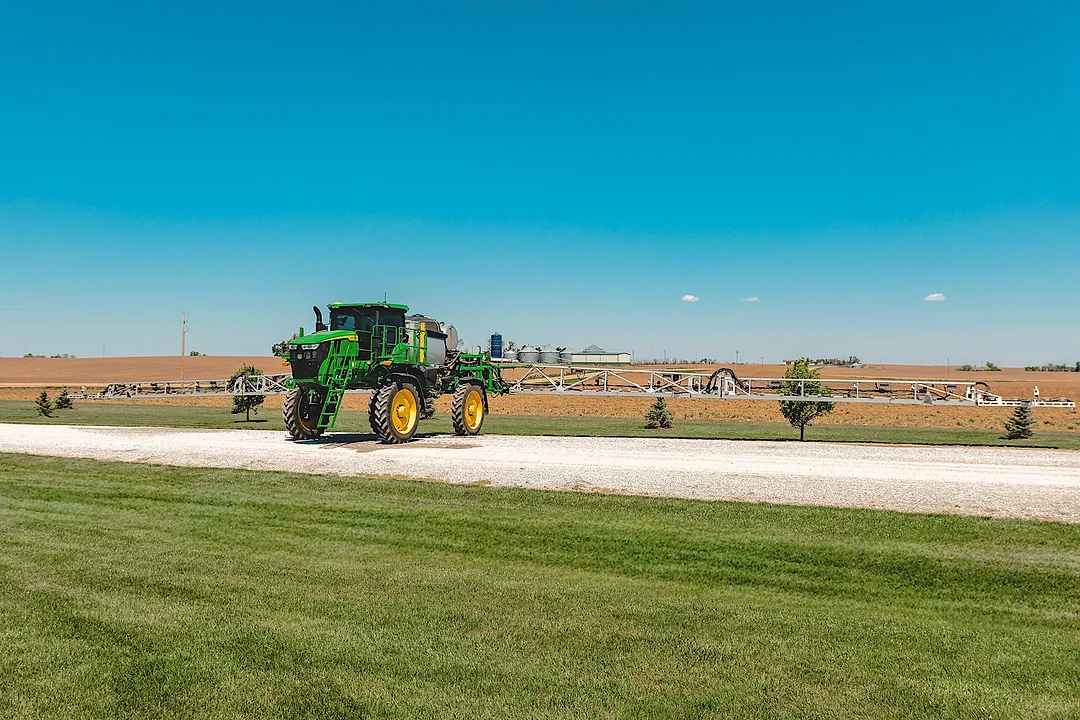
Greeneye Technology, the maker of AI-enhanced targeted spraying technology for agriculture, announced this week it would open a North American headquarters in Salina, Kan. after taking possession of the site this fall.
The company, founded by Nadav Bocher, Itzhak Khait and Alon Klein Orback, is privately owned and funded by multiple investors and strategic partners, including Deep Insight, Syngenta, AGCO Corp., Farmers Business Network and Jerusalem Venture Partners.
We caught up with Keith Crow, general manager of North America at Greeneye, to talk about the goals for the company’s U.S. expansion, how the company’s technology is updated, and how new crops are added to its AI-enhanced platform.
What led to this investment and why did you choose Salina?
Crow: This is something we've been talking about now for the last four or five months. We met with eight different states and ultimately we're excited to choose Salina due to its proximity to agriculture. You don't have to look far outside of Salina to see a lot of successful companies already that exist in the ag ecosystem.
What can you tell us about the site location and what will be happening there?
Crow: We're hoping to take possession of the site in November. It’s new construction but wasn’t completely done so we’re able to customize it to meet our needs. And it also hit our timeline of trying to really have impact for the 2027 season. For phase one we’re focused on operations and increasing our operational capacity before spring 2027 for both installation work and inventory management.
With Salina you can get to 80% of the U.S. in two days from an inventory perspective, so the ability to get service and parts out quickly to our field technicians and to our dealer partners, as well as growers directly, is certainly a meaningful impact for us. Another piece of phase one is engineering. We’ve started to work with local farmers in the area to get access to land where we can do more testing
Our audience is mostly no-till and strip-till. I’ve had a few farmers ask if this technology will work in a field with a lot of crop residue in it. How will this machine work in in less-than-perfect field conditions?
Crow: There's a few different settings that I think apply well to no-till farmers. One is those that do a fall burndown, a green-on-brown solution, to go through the field and anything that is green, to be able to target and not spray corn residue or bean residue — just weeds in the space.
This spring we did beta testing to do broadleaf and cover crops. For those doing cover crops to improve soil health they can run a targeted pass and just hit broadleaf weeds throughout the cover crop and not damage it. The nice thing about our system is a dual-line, dual-tank configuration so farmers can lay down a residual program on the same pass as a burndown, which shows efficiency benefits — especially with prices of diesel today — but also to come back through and just target weeds in crop as you need it. Overall our customers last year that used the dual-line configuration saw an 81% savings on non-residual herbicides.
What challenges did you have trying to get the new crops integrated into your system? How did you meet that challenge?
Crow: We’ve been commercially available in the U.S. for four years, so every year we’re trying to add additional crop types based on market demand. One way we go about it is our current customers that are covering acres that are not part of our current algorithms or crop types we support. There’s a data-collection mode where our current customers help us capture images throughout the growth stages by running their sprayer over different crops.
The other way we build out our algorithms is a methodical engineering effort with our team going out and capturing images. We have a both a test sprayer and a scouter machine that's like an ATV with cameras on it. We'll cover the same acres week after week, capturing different images of plants at different growth stages.
What do you think is driving overall interest in this technology based on what you're hearing from farmers? What are they reaching out for going to this solution?
Crow: We’ve seen a shift over the last four years as more farmers understand this type of targeted spraying technology is the future. I think there’s much more interest in, ‘How does this work for my operation? What's the ROI look like?’ It's less about disbelief and more about ‘How do I make this work for me?’
This past year after the season we interviewed all our current customers. It’s amazing to hear a farmer from Nebraska say, ‘Hey, I actually think I might have paid this off within a year just based on the chemical savings alone.’ And we heard stories of farmers visually being able to see a difference in the soybeans that were sprayed versus those not sprayed and see the impact it had from a yield perspective.
Related Content: [Press Release] Greeneye Technology Establishes North American Headquarters in Salina, Kansas Following Record Year