Growing corn 3 years in a row presents equal portions of opportunity and challenge, especially when you’re also trying to minimize tillage and other input costs.
If the fuel and fertilizer prices experienced this year persist, you can bet I’ll be looking for even more places to cut back. In fact, I’m testing a few options in this year’s crop, including using a biological product that’s supposed to produce nitrogen (N) naturally instead of applying all synthetic N.
On my family’s Sioux Rapids, Iowa, farm we currently no-till soybeans and cover crops and strip-till corn. This year we only have 350 of our 3,000 crop acres seeded to soybeans. We’re very focused on corn and have had good results, even with third-year corn-on-corn.
In 2023, flooding threw a wrench in my rotation. I had to replant a lot of corn acres to soybeans which led to rotating a disproportionate number of my acres to corn the next year.
If I didn’t grow some corn-on-corn in 2025, I would have ended up with a lot of soybean acres in 2026. What I found in 2025 was the corn-on-corn fields performed equally if not better than those where we had rotated from soybeans the year before. With that experience, I pushed even further. I planted more corn-on-corn acres and planted a third year of corn on the previous corn-on-corn acres. So far, it’s looking good.
The way I found out I could grow continuous corn was by not being afraid to try a new thing and then keep pushing it. While I’m not afraid to try new things and take a risk, I do also like to back my choices up with data and carefully evaluate the products and strategies I try.
Spring Strip-Till
Our crops should never have a bad day, which to me means gathering not only long-term data trends, but also timely in-season information. We use research, data and testing to guide applications of nutrients and other products. This not only tends to the crop stewards our bottom line. We’re looking for the most cost-effective products, application methods and application timing to maximize return on investment.
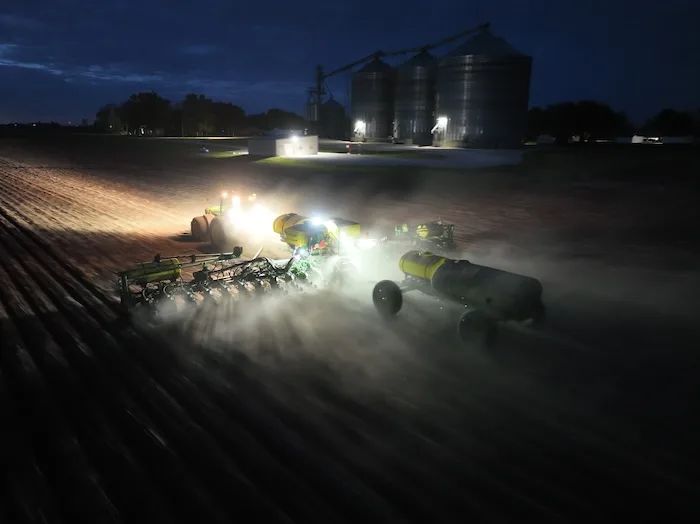
Our John Deere ExactEmerge planter is equipped with the 360 Yield Center Bandit and configured to apply prescription seeding rates and fertilizer both in-furrow and 2-by-2. Despite strip-tilling ahead of corn, the planter delivers the first fertilizer the field sees. Using the planter to apply fertilizer is part of an ongoing evolution in our nutrient management strategy.
We used to strip-till in the fall applying dry fertilizer. Then we switched to strip-tilling in the spring and applying liquid nitrogen (N) in that pass. Now the planter runs all the spring fertilizer, partly because the strip-till equipment I use is aging and isn’t really fit to carry 9 tons of fertilizer anymore.
The Dawn Pluribus runs just a coulter that clears a shallow 3 to 4-inch strip. Especially in corn-on-corn, this pass serves to clear out old root balls so the planter can work uninhibited allowing me to plant at higher rates of speed and be more fuel efficient.
The variable rate application of seed and fertilizer starts with soil testing. We soil sample in zones using the BW Fusion Agronomy 365 system. This strategy does soil sampling based on how water moves through the field. Eroded knolls and hills are one zone while areas that tend to shed water are another. Other zones include depressions where water tends to collect and zones that are on varying slopes. According to the program, these zones help take into account water availability and soil productivity.
Sampling using this system has shown us that there are dramatically different needs in these zones. Some might benefit from more N, some may not need any phosphorus (P) at all due to past chicken litter applications.
With the planter we’re running 10-34-0 in furrow and 32% N in the 2-by-2 system. In the past I would variable-rate the 32% application, but this year I used a straight rate of 80 pounds of N for corn-on-corn and 50 pounds of N on the rest of the corn. The in-furrow applications range from zero to 15 gallons per acre based on need. Fields generally average out to around 5 gallons of 10-34-0 per acre. This works because with our system the in-furrow applications actually sit about ¾-inch away from the seed. That allows application of a lot more product without having to worry about salts impacting the seed.
This was our first year pushing P up to 15 gallons. This decision was made due to noticing severe early-season P deficiency in some of the crop. In a flat field where there shouldn’t have been much variability we noticed that in one area the corn was 6 inches taller and leaf ahead than the rest of the field. Upon pulling tissue samples from where the corn was good and where it was struggling, we discovered the thriving area had all the P the plant could want. There was probably a pile of chicken litter dumped there at some point the rest of the field didn’t get. It made a 30-bushel-per acre difference at harvest.
With information showing what the plant could do with more P, I saw there was potential for improvement. I want to make sure the plant has easy access to what it needs early when it’s not as established and can’t move nutrients as effectively as it can later in the season. I say early, because when we did tissue testing later in the season there wasn’t a deficiency. The yield loss came from the early-season stress, not the overall availability of P.
When the deficiency was occurring isn’t something we would have realized if we weren’t evaluating our crops throughout the season. My goal is to tissue sample at V5 when the plant is no longer relying on the seed and is pulling from the environment. I sample again during rapid growth at V8-V10, R2 and R5. I want to see what’s happening at the beginning of reproduction and again at the end.
Incorporating Biologicals
I’ve used a variety of biological products for various purposes with good success. That includes tank-mixing BW Relax RX with herbicide applications. The product contains amino acids and micronutrients that work to mitigate crop stress due to post-emergence herbicide applications.
Whenever a plant is sprayed it will experience some stress. When there’s overlap the effect is amplified. Again, I never want my corn to have a bad day. I use it for my post-emergence herbicide pass and I don’t see any issues in my field. However I also do custom spraying for other farmers. When I wasn’t using the amino acid and micronutrient product I could absolutely tell where there was spray overlap. You could see the stress on the crop, which confirmed to me the benefit of using this type of product in my own fields.
Corn-on-corn does create a lot of crop residue, especially when you’re limiting tillage. In fact, I’m exploring how successful I can be with no-till in my cropping system. This year I’ve got trials out where I no-tilled corn following soybeans and following corn-on-corn. To strip-till you need an application window in fall or spring. That doesn’t always happen, so I’m investigating how to manage in situations when the weather and costs like diesel conspire against us.
This year I applied a biological product, BW Meltdown, that includes microbes, organic acids and a small amount of N as part of my pre-emergence herbicide pass. The product is supposed to help break down the tough corn residue and make the carbon more accessible to the plants more quickly.
It looks to have worked. I applied it in April/May and by September residue was significantly more decomposed than I would have otherwise expected. In fields that were planted to soybeans the previous year you’d be hard pressed to say the field wasn’t cultivated.
In continuous corn I would expect to find a lot of stalks standing, but most of the stalks are laying down on the ground, and some rows there’s no stalks at all. I plant SmartStacks Pro, so there’s every reason for me to still have a lot of stalk residue, but it seems to be melting away.
I also use the biological beneficial bacteria product Environoc 401 in-furrow. It serves as a plant stimulant that is supposed to also boost soil life and lend vigor to the emerging crop.