
Information on pre-corn harvest combine inspection and tune-ups is readily available — usually concentrating on replacements of wear parts and the need for lubrication and leak repairs.
To get beyond the typical “pre-flight bullet points,” Strip-Till Farmer has sourced some harvest checkpoints to put more clean grain in the tank and provide a better residue spread in the path of the combine.
We’re calling them the 3 C’s for Boosting Harvest Payday: Calibration, Cutting components and Concaves. None of the adjustments require much time and few require huge expenditures unless obvious wear parts need replacement.
The aftermarket parts included in the discussion are only recommended by folks who’ve used, tested and benefited from them.
The Need for Calibration
Marcel Kringe, founder and CEO of BranValt (formerly Bushel Plus, Ltd.), a leader in harvest optimization technology, says one of the most overlooked, yet most impactful, management practices is measuring harvest loss to fine-tune combine calibration and settings.
According to Kringe, many farmers underestimate the financial impact of improperly calibrated combines and often rely too heavily on factory presets or onboard sensors rather than verifying actual grain loss in the field.
“Factory settings are a starting point, not a precision solution. And built-in sensors often can’t account for key variables like terrain, machine wear or crop type,” he says. “If you want accurate data, you need to get out behind the combine and measure actual loss in the field to calibrate those loss sensors properly.”
He suggests calculating grain loss per acre from harvesting a measured distance and using that to ensure the in-cab readings of loss sensors match actual losses.
Counting Harvest Loss Cost
To better understand the economic impact of harvest loss, it helps to translate lost bushels into lost dollars. The following examples illustrate how quickly revenue can disappear when grain is left in the field.
For corn, a 3% harvest loss on a 200 bushel-per-acre yield at $4.05 per bushel equates to 6 bushels left in the field. That’s a loss of $24.30 per acre. Multiply that across 1,000 acres, and that’s $24,300 in lost revenue. At a 5% loss, the figure jumps to $40,500.
In soybeans, a 3% loss on a 70 bushel-per-acre crop at $10.05 per bushel means $21.11 per acre — or $21,110 over 1,000 acres. At 5% the loss climbs to over $35,000.
Kringe says knowing how much grain is being lost, and why, allows growers to calibrate harvester component settings before and during the early stages of harvest to protect those profits.
“A crucial setting vital to proper combine operation includes calibrating and leveling concaves,” he says. “If the clearance between the rotor and the concave is off physically from what the in-cab monitor indicates, then the entire ‘thinking’ of the threshing monitor will be confused. If the monitor shows a 5 mm or quarter-inch clearance but it’s really ¾-inch open, there will be little grain threshed for the tank, and a lot of grain on the ground behind the combine.”
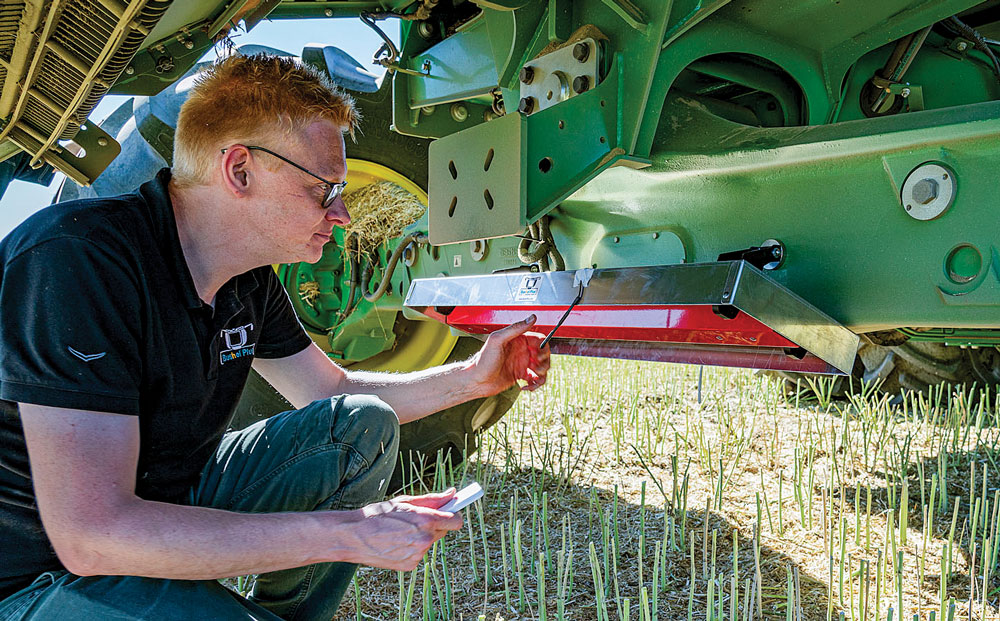
GROUND TRUTH. Measuring actual grain losses ensures accurate calibration of loss sensors to in-cab loss monitors. Here, BranValt CEO Marcel Kringe, installs a drop pan used to collect loss samples for research on his company’s SmartPan in cooperator fields. BranValt
He adds, “We suggest inspecting and adjusting the rotor-concave clearance according to user manual settings as good starting point. Every combine is different, but all have rotor-concave adjustments. Opening the machine up and using a steel rule or tape measure to reset clearances for the crop you’re harvesting will help put grain in the tank and money in the bank.”
Kringe also emphasizes the need to check the level of the concaves versus the rotor noting the clearance along the full length of the components needs to be parallel for smooth material handling and “balanced” threshing.
He says the measuring and leveling needs to be repeated if the machine gets plugged during harvest, or if the threshing components encounter a rock or other foreign object damage.
Another calibration chore that can only be done after harvest begins includes ensuring grain loss monitors in the cab match actual grain loss at the rotor or the sieves.
“Grain loss monitors have been around several decades but they nearly all work the same — as impact sensors,” Kringe says. “If there’s a lot of grain hitting the sensor, the cab display should read like a speedometer, more impact equals higher grain loss, and vice versa. But there’s a problem — most manufacturers include an in-cab sensitivity control that can lead you astray.”
He says if the monitor is reading high grain loss, it could be only because the sensitivity is adjusted too high. “What might be an acceptable loss rate is ‘inflated’ on the monitor by the sensitivity of the system. The same way a low sensitivity might miss grain loss going out the back.”
Kringe recommends using a drop pan and a small-time investment at the beginning of harvest to ground-truth differences between actual grain losses and in-cab loss sensor readings.
“With a drop pan attached to the back of the combine, usually under the back axle, growers can catch a sample of actual losses at the same time they record their loss meter readings, which is a simple way to move from guesswork to data-driven insights about grain loss,” he says.
Kringe’s company sells a remote-control tool called the SmartPan System which allows an operator to set the sensitivity of loss monitors at the halfway mark and drop the pan at that time, leaving the pan in the combine’s path as evidence of actual grain loss.
Cutting Components
A combine is a very complex machine that depends upon a smooth, even flow of material from the header through the threshing and separation components to put clean grain in the tank and evenly eject and spread crop residue out the back, Kringe says. This is necessary for proper decomposition and improved planting conditions the following season.
“You can have the best combine, with the best concaves, the best set-ups inside the machine, and if the header isn’t delivering the crop to the feeder house smoothly and at the right angle, it’s going to be difficult to thresh the crop properly,” he says.
For crops like wheat, canola or soybeans that means the crop falls onto the draper, or towards the feeder house.
“An auger header drags or elevates the crop toward the center and into the feeder house. If that step is hindered by broken or worn knives or guards the crop isn’t presented to the rotor and concaves in a manner for optimal grain collection,” he says.
Andy Theisen, marketing strategy manager at Kondex, a harvester wear-part supplier, agrees, saying cutting performance is where the crop flow starts and sets the tone for the entire harvest process.
“You can’t use a corn concave to harvest soybeans, if you want to do it right…”
Theisen, a mechanical engineer with two decades of experience consulting with farmers across North America, Australia and Europe, says if the crop isn’t cut cleanly and fed evenly into the machine, the rest of the combine is reacting to problems you’ve created at the start.
“First, be sure you have proper knife/guard clearances,” he says. “When that clearance is off the crop is torn instead of being cut cleanly and increases the chance of breakage and clogging.”
He recommends adjusting the knife/guard clearance to 0.003-inch (about the thickness of a business or credit card. “That will ensure a smooth scissoring action.”
Kringe says corn growers need to pay special attention to deck plate adjustments on the header.
“We worked with a grower last fall setting up his combine to reduce losses through concave adjustments, but we found the biggest problem on that machine was the deck plates were getting stuck,” he recalls. “They’re supposed to dependably open just wider than the thickness of the corn stalk, allowing the cob to be pulled down, but every couple of hundred feet the machine was plugging or hitting and breaking the cobs.”
Concaves
In northwest Illinois, Alpha, Ill., strip-tiller Marion Calmer has spent years experimenting with methods to improve combine efficiency and says concave selection is crucial.
“You can’t use a corn concave to harvest soybeans, if you want to do it right,” he says, noting the benefits of using proper inserts and cover plates to improve grain collection in the heart of the threshing section.
“One of the problems we have in soybeans is pods in the grain tank, and that starts in the concave where openings between round bars are wide enough to allow pods to drop directly into the auger bed and onto the top sieve and down to the bottom sieve,” he says. “Folks try to tighten the sieves, but that never seems to help.”
To combat that problem, Calmer developed a homebuilt plastic cover plate to block the first 12-inches of concaves to maintain harvest material in the rotor longer to ensure threshing of pods. “With the cover plate in place, the pods get threshed, crop on crop, the soybeans fall right through, and the threshed pod material moves on back through the rotor.”
He says it’s imperative to keep the non-grain material in the rotor long enough for proper threshing and cover plates are a simple solution that also helps improve residue flow through the rest of the combine and helps prevent overloading the cleaning system.
Calmer’s experience as CEO of Calmer Corn Heads also leads him to recommend installing inserts in concaves to achieve proper retention of crop plant material. His takeaway on concave openings suggests the following ideals: ¾-inch for corn-only harvest, and ½-inch for soybean and other small grains.
“I’ve found Shoup Manufacturing to be a good source for inserts for various color combines,” Calmer explains, noting the time and effort to match the gap between round bars to the crop being harvested also provides a good financial return on investment with more grain in the tank, and better residue spread on the field.