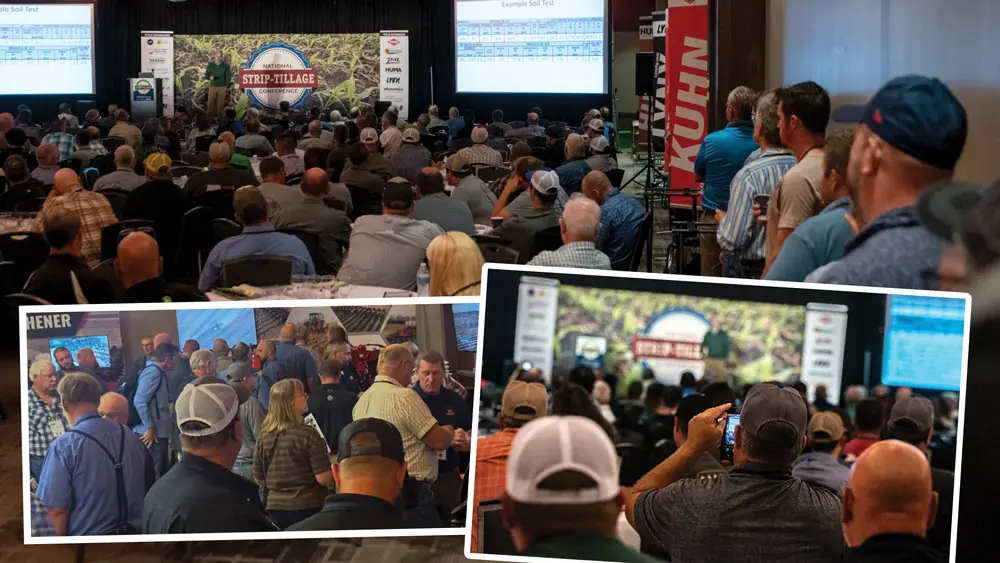
Over 400 farmers, agronomists, researchers, educators and manufacturers from all over the U.S. and other countries including Canada and France packed the President Abraham Lincoln Hotel and BOS Center in downtown Springfield, Ill., Aug. 6-7, for the 13th annual National Strip-Tillage Conference.
The conference featured 6 general sessions, 14 roundtable discussions and 13 breakout classroom presentations covering all the strip-till bases from soil health and cover crops to toolbar setups, nutrient management and precision technology.
Know Your Soils
It was nearly standing room only for Brian Hefty’s dynamic kickoff session, “Feeding and Weeding Your Strip-Tilled Crops.”
The longtime Baltic, S.D., strip-tiller and co-host of the popular Ag PhD shows delivered a thought-provoking, meat and potatoes-style presentation on nutrient management and weed control, setting the tone for an action-packed 2 days full of practical learning and networking.
Hefty stressed the importance of being able to read soil tests correctly before investing your fertilizer dollars.
“How do you read your soil test? I’ve got 16 things on the test that I use and talk to farmers and agronomists about all the time,” Hefty says. “Let’s start with soil organic matter. That’s the number one thing. For every 1% of soil organic matter, your soil is releasing a whole bunch of nitrogen, phosphate and sulfur for free every single year. For example, if I had 5% organic matter, I’m going to get 100-150 free pounds of nitrogen every single year. And if you don’t factor that in, you’re overapplying your nitrogen.”
Mental Hurdles Cleared
Osage, Iowa, strip-tiller Dean Sponheim followed Hefty’s talk with a look at the wins, setbacks and hard lessons learned from his 30-year strip-till and no-till journey.
The fourth-generation farmer reflected on the moment he decided to pursue strip-till and no-till after repeatedly struggling with drainage on tight clay soils.
“Every year after we planted, we would have to replant 50-75% of that farm, no matter how late we planted,” Sponheim recalls. “It got so bad that I told my dad, ‘We’re not going to plant this until after May 25. Then in 1995, I went to a conference at Iowa State Univ., and there was a presentation about strip-till. It wasn’t until 1999 that I finally got the nerve to give it a try. I pulled an anhydrous bar with covering discs. That’s how I started. That spring when I planted into those strips, a light bulb went off. It was the best seedbed I had ever planted into.”
To confirm strip-till’s potential on his soils, Sponheim conducted a 5-year on-farm trial where he strip-tilled 5 acres and moldboard-plowed 5 acres. It wasn’t until about year 4 when he started to see the payoff in soil health improvements.
“The underground livestock (earthworms) were sucking all that residue down. Now, I could have 300-bushel corn, and by June, I barely see any old corn stalks.”
Sponheim also touched on the psychological challenges of making big changes on the farm, sharing strategies for dealing with the feelings of being overwhelmed that hold some farmers back from making key adjustments.
“Throughout my years of doing custom strip-till, the biggest barrier I’ve seen is right here — the gray matter between your ears. And to this day, it still bothers me sometimes. Anytime we try something new, I have sleepless nights. Why do we change? What motivates us? It all really comes down to you.”
Attendees also got an up-close look at the latest strip-till innovations from the event’s 16 title sponsors: Ag Leader, AgSynergy, Case IH, Dawn, Environmental Tillage Systems, ForGround by Bayer, Huma, Kuhn Krause, LandLuvr, Lynx, eKonomics, Total Farm Marketing, Unverferth, Vulcan Equipment, Yetter and Zimmerman Manufacturing.
Early registration is underway at StripTillConference.com for the 2027 conference, taking place in the Quad Cities (Davenport, Iowa), Aug. 5-6.