
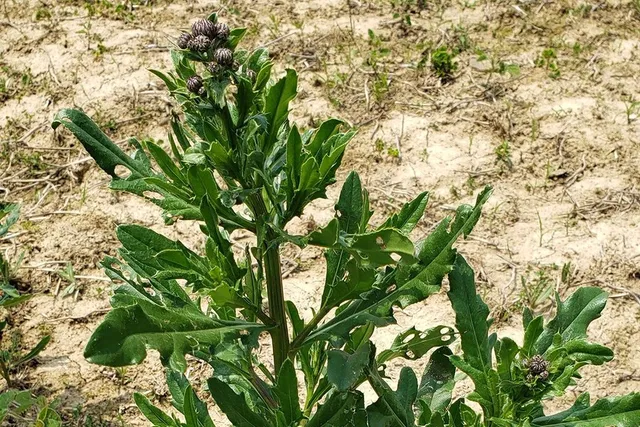
As temperatures get colder and even a few snowflakes start to appear, some people wonder if it is too late to control weeds, namely winter annuals and perennials. However, occasionally, milder weather occurs in late October and even into November, so it could be a good time to consider spraying. In the fall, foliar-applied herbicides can be effective if the plants are green and appear healthy and actively growing.
Should herbicides be sprayed in cover crops?
If you are growing pure-stand cereal rye, wheat, or triticale for a cover crop and broadleaf weeds like marestail, chickweed, henbit, and other winter annuals are a problem, consider spraying it with 2,4-D, dicamba, or Harmony Extra/Audit 1:1 so it doesn’t turn into a weedy mess in the spring. Keep in mind that if the small grain is mixed with a legume (clover, pea, etc.), brassica (radish), or other broadleaves, then none of these herbicides can be sprayed; otherwise, significant crop injury can result.
What about perennial weed control in pastures?
In general, for grass pasture or hayfields, the herbicide application window runs from early September through October, depending on where you are in the region and what weeds you are targeting. However, if it is mild in November, certain weeds can still be controlled. Warm-season perennials such as horsenettle, hemp dogbane, common milkweed, smooth groundcherry, pokeweed, bindweed, poison ivy, and brambles usually can be sprayed with a systemic herbicide (such as 2,4-D, dicamba, triclopyr, metsulfuron, etc.) through October or before a hard frost. However, with both biennial and perennial species, adequate green leaf tissue must be present, and it should be reasonably healthy to absorb the herbicide. If the weeds are turning yellow or brown, they have already started to go dormant for the season, and the herbicide will likely not be absorbed. But certain perennials, such as Canada thistle, quackgrass, and dandelion, can be effectively controlled after several light frosts, so a few extra weeks into November can exist for these species because of their cool-season habit of growth (more details below).
Fall burndown considerations
Fall is the best time to control dandelion, while both fall and early spring are good times to control winter annuals, including marestail. In most fallow fields (i.e., no cover crop planted), a basic tank mixture of 2,4-D ester (1 pint/A) plus glyphosate (1 quart) plus metribuzin (3-5 oz DF) tends to provide adequate control of marestail and other weed species such as dandelion. It is relatively economical when sprayed in the fall. Application of 2,4-D alone controls many winter annual weeds, but 2,4-D will not control chickweed and is less effective on dandelion than when in a tank mixture with other herbicides. Killing marestail in the fall is usually easier since the seedlings and rosettes are small and more susceptible to herbicides. Once weeds like marestail get through the winter, their rosettes start to bolt upwards in the spring, making them much more difficult to control.
Contact herbicides (e.g., Sharpen, Gramoxone) and systemic products (glyphosate, 2,4-D, dicamba) are much less active at low temperatures. Relatively speaking, 2,4-D is slightly more active than glyphosate in cooler temperatures (<40°F); whereas dicamba tends to be more impacted by cold weather, therefore, tank mixing them improves overall control. As we move into late November, when foliar herbicide effectiveness decreases, including a residual herbicide may be desirable in corn or soybean rotations. If you include a residual herbicide, research over the last several years has shown that any chlorimuron-containing product (Canopy, Cloak, etc.) is at the top of the list if soybeans will be planted next spring and simazine is one of the better products for fields going into corn. Other products that have had some success include Valor and Basis Blend. In general, 2,4-D should be tank-mixed with any residual product. Also, when applying systemic herbicides this late in the year, make sure to include an adjuvant such as ammonium sulfate (AMS) and/or crop oil concentrate or methylated seed oil to ensure adequate uptake of the herbicide. Fall herbicide treatments should be kept within the $5- $ 15/acre cost range, if possible. Thus, glyphosate + 2 4-D (or dicamba) can be an initial low-cost option to consider that provides control of a relatively broad spectrum of weeds.
Herbicide activity and temperature
For best activity, apply herbicides when daytime temperatures are above 50°F and nighttime temperatures are above 40°F for several days during application time (don’t apply herbicides immediately after a frost). Some research from Iowa State and Ohio State indicates that many perennial and biennial weeds can still be effectively killed after a few hard frosts. Research on quackgrass and glyphosate found greater translocation of the herbicide after the first frost than before. Plants having a prostrate growth habit, such as the biennial musk or bull thistle, will be more tolerant of frost since they are protected somewhat by the heat released by the soil. With most plants, it is possible to determine whether the foliage has been severely affected by frosts; thus, scouting the field prior to application is important to ensure that active foliage is still present. Regarding quackgrass and Canada thistle regrowth after harvest, if these weeds are greater than 8 inches in height, then an application of glyphosate may provide good control of the above and below-ground plant parts. If temperatures drop below 28 degrees at night for more than 4 hours, then these plants may die, and a herbicide application may not be effective. Quackgrass can handle colder temperatures than Canada thistle. If warm temperatures (greater than 65 degrees) return for several days and the plants appear to be growing, then a herbicide treatment may still be effective.
Common chickweed in small grains
Common chickweed can be one of the most aggressive weeds in winter small grain fields (and alfalfa). Since it can tolerate colder temperatures (down to 7°F), it can easily persist in the Northeastern region, especially under snow cover. (More details about its biology can be found online. Controlling chickweed in the fall can be very beneficial since it can be a huge problem in the spring and can be more difficult to control in some situations. Harmony Extra and Quelex are still effective on it in many parts of the region, there are pockets of resistant populations starting to thrive. Tank-mix with Metricor (metribuzin) or Starane Ultra if ALS-resistant chickweed is prevalent.
Roughstalk bluegrass and other weedy grasses in wheat
We are getting more calls about roughstalk bluegrass in wheat. Most of the wheat is growing well but the bluegrass has broken dormancy and is developing alongside it. Some research out of Michigan State University shows that, products such Osprey, Axial, and PowerFlex (and their related product lines) will provide control/suppression of it once it is out of the ground. In the spray mixture, make sure to include all the required adjuvants that are specified on the herbicide label. Fall and early spring are the best times to apply effective herbicides to control it. Osprey provides the most consistent control and generally works better on this weed in the fall, early spring applications have proven effective too. Keep in mind that these herbicides should be applied to roughstalk bluegrass during its 1-leaf to 2-tiller growth stage range. Fall treatments tend to provide effective initial control (>90%), but if spring emergence of roughstalk occurs, it can lead to escapes by harvest. However, late spring applications are usually not as effective since roughstalk is too tall for effective control.
When controlling weedy grasses such as annual ryegrass, annual bluegrass, brome, in wheat, it may be necessary to tankmix residual products like Anthem Flex/Zidua with those that have foliar activity, such as Osprey, PowerFlex HL, Finesse, or Axial products, to obtain control of existing grassy weeds that have already germinated. These tankmixes are typically applied as a delayed PRE (i.e., a few days after planting) or as an early POST (spike to early tillering stages) treatment in the fall.