
Strip-Till Farmer editors encounter a variety of articles, social media posts, podcasts and videos that offer a unique look at the grower's world from the lofty digital realm. Here is our favorite content from the past week from across the web:
- Debating the Advantages of Strip-Till Over No-Till
- Strip-Tillers Take Home Conservation Farm Family Award
- How Deep Should You Build Strips This Fall?
- Fall Fertilizer Management Strategies
- Custom Applicators Share Cover Crop Strategies
Debating the Advantages of Strip-Till Over No-Till
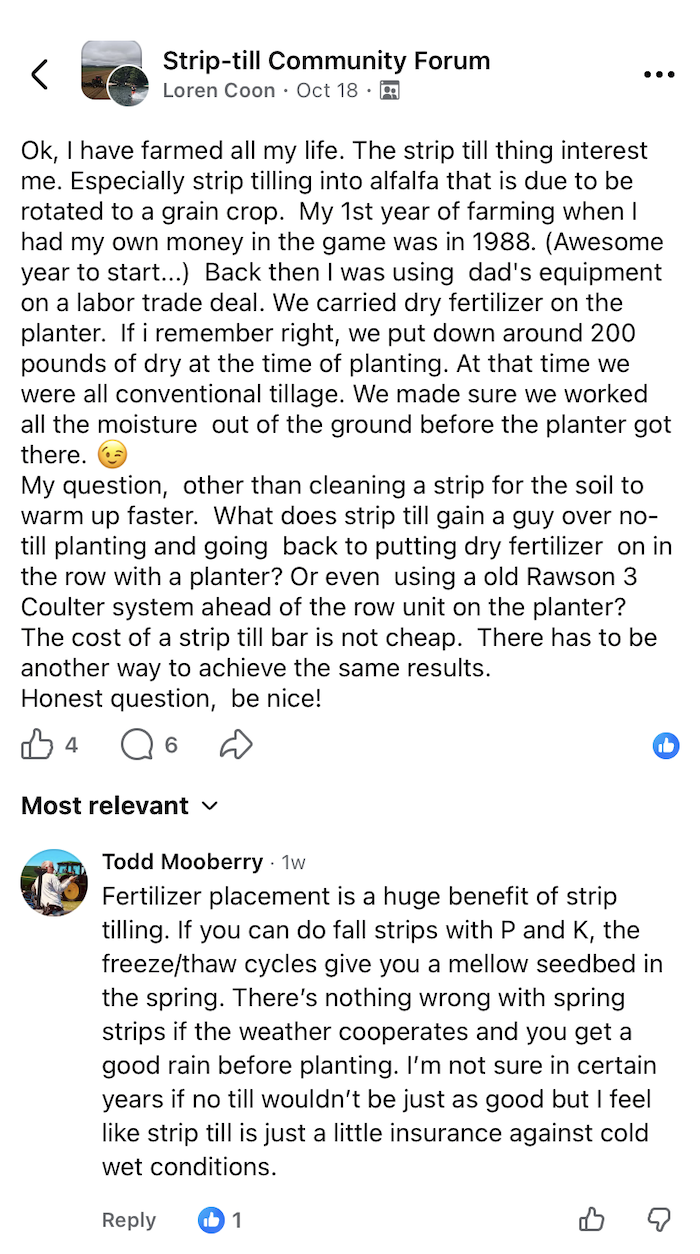
Here’s a good discussion we came across last week in the Strip-Till Community Forum on Facebook. Loren has been farming since 1988 and wants to know how strip-till could potentially improve his operation. “Other than cleaning a strip for the soil to warm up faster, what does strip-till gain a guy over no-till planting and going back to putting dry fertilizer on in the row with a planter?” Todd Mooberry, the inventor of the strip freshener, shared his thoughts. “Fertilizer placement is a huge benefit of strip-till,” he says. “I’m not sure in certain years if no-till wouldn’t be just as good, but I feel like strip-till is just a little insurance against cold, wet conditions.”
Strip-Tillers Take Home Conservation Farm Family Award
Kellogg Farms just received the 2026 Conservation Farm Family Award from the Ohio Department of Agriculture. Bill and Shane Kellogg started experimenting with strip-till on their Hardin County, Ohio, farm back in 2020. “We’re applying about 40% less dry fertilizer in the strip than we would if we broadcast,” Shane says.

How Deep Should You Build Strips This Fall?
When you’re strip-tilling in the fall, going 6 inches or deeper is “usually a good idea,” according to this YouTube short from Ag PhD.
Fall Fertilizer Management Strategies
Join the FarmDoc Illinois Extension panel of agronomic and economic experts, alongside a real-world practitioner, for an in-depth discussion on fall and spring fertilizer management. As farmers face fluctuating input costs and changing weather patterns, making the right nutrient management decisions is more critical than ever. In this video, the panel breaks down the latest on-farm research and economic data to help you optimize your fertilizer strategy. They cover the logistics of fall anhydrous applications, the importance of the 50-degree soil temperature rule and how to maximize your Return on Investment (ROI) using Maximum Return to Nitrogen (MRTN) rates. The discussion also dives into practical strategies for managing Phosphorus (P) and Potassium (K) during times of high fertilizer prices and wraps up with best practices for winter wheat fertility.
Custom Applicators Share Cover Crop Strategies
In this video from Practical Farmers of Iowa, Ben De Boef of Heartland Custom Applications shares practical lessons from his experience using cover crops to reduce erosion, improve soil health and boost yields. De Boef touches on cost-share programs and how to choose the right cover crop species for your goals.
Is there something you want to share in "This Week"? Send us an email.