Greetings from Southeastern Wisconsin, where the Brewers have punched a ticket to the World Series for the first time since 1982 and it’s finally starting to feel like fall! Hope harvest is going well for all of you so far. I wanted to shine some light on how conservation practices like strip-till are making a difference in one of the top corn and soybean growing states in the U.S. … and later revisit a bold strip-till prediction that was made 3 years ago.
Checking All the Boxes
Now in its 10th year, the Minnesota Agricultural Water Quality Certification Program (MAWQCP) has annually kept 61,739 tons of sediment out of the state’s waters, retained 168,555 tons of soil, and prevented 1,259,535 pounds of nitrogen (N) from entering waterways. Strip-till has been one of the key practices driving the program’s success.
Faribault County strip-tiller Corey Ehlert is one of 1,900 farmers who are officially Minnesota Water Quality certified. He originally pursued certification because of the financial and technical assistance available through the program, but he also sees the value in protecting his soils for future generations.
“That’s the goal — to have good, healthy soil for a long time,” he says.
On top of the soil health benefits, strip-till has also improved Ehlert’s overall profitability, as he recently shared in a short MAWQCP video (watch below).
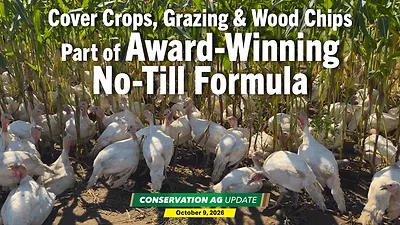
Ehlert strip-tilled his soybeans in 2026 and he was happy with the results after a smooth harvest earlier this month.
“I’ve been really happy with the yields,” he says. “We’re definitely not taking a yield hit (by strip-tilling soybeans), that’s for sure. With strip-till, we’re able to cut back a little bit on fertilizer, and with today’s expenses, there are positives for ROI.
“These soybeans were strip-tilled into standing cornstalks last fall,” he adds. “We plant into the strips in the spring, pick the beans in the fall, and then the next pass will be with the strip-till bar when we do it all over again for corn the next year. Our nitrogen program is all liquid 32 in the spring and the summer with the sidedress bar, and we apply other fertilizer with the strip-till rig in the fall. We build strips between the rows, moving over 15 inches every other year. It’s not as big of a deal in the bean fields, but it’s a big deal in the cornfields, so you’re not making a strip right on the stalk.”
Ehlert was pleasantly surprised by how dry it was during soybean harvest, which says a lot about the water infiltration benefits of strip-till.
“In early September, we were wondering when we were going to get in the field,” he says. “We got in later than we usually do, and I was surprised by how dry it is out there. It’s been dry for the last week, but before that, we were really wet. Pretty good water infiltration out here.”
Ehlert’s story is a small snapshot of how strip-till is impacting thousands of Minnesota Water Quality certified acres.
Revisiting a 2026 Prediction
Back in October 2023, our Frank Lessiter reported on a strip-till prediction made by Warren Formo, who sadly passed away this past August. The founding executive director of the Minnesota Agricultural Resources Center predicted back in 2023 that strip-till could become the predominant tillage system in Minnesota by 2026.
At the time, Formo said strip-till acreage was continuing to grow by more than 5% each year. Knowing that the USDA doesn’t collect strip-till acreage data, Lessiter asked Formo to elaborate on his prediction. Formo said he based his prediction on 4 factors:
1 The strip-tillage acreage in Minnesota increased by more than 30% from 2012 to 2017 in the Ag Census. (Update from the 2022 Ag Census wasn’t available until February 2024)
2 Equipment manufacturers are seeing steady growth and increased farmer interest in strip-till.
3 Formo said his conversations with farmers are changing in regard to strip-till. The same farmers who 10 years ago told him that strip-till would never work on their soils now talk proudly about their transition to strip-till.
4 Another big driver is that many of the earlier strip-till innovators seemed to be medium-acreage farmers.
“There seemed to be a perception that large-acreage farmers would not be able to make the switch because of concerns about getting the field work done on time and delivering fertilizer to the strip-till bars,” Formo said. “I now know of several Minnesota farms of 5,000-10,000 acres getting into strip-till, and there is even an operation of more than 20,000 acres moving to strip-till.”
Judging by the number of strip-till field days in the state this summer, the interest we saw from Minnesota farmers at the National Strip-Tillage Conference, and the stats reported earlier from the Minnesota Water Quality Program, Formo’s prediction appears to be coming to fruition 3 years later.
What kind of strip-till adoption trends are you seeing? Is strip-till on the rise in your area? Let me know at Nnewman@LessiterMedia.com. Thanks for reading and have a great harvest!