With fall strip-tillers are hopefully taking advantage of a mild autumn in many areas to get berms built before winter permanently arrives, they are also assessing options to maximize biological value of corn residue.
A scarcity of subsidies for conservation tillage methods, and the fact that most corn grown in Europe is for silage, are limiting factors to widespread adoption of strip-till. However, there could be potential for increased adoption in the near future — albeit not necessarily for the same reasons North American farmers utilize strip-till.
As successful strip-tillers know, the benefits of the practice come from being able to evolve and adapt the system to suit their operation. In other words, it takes patience to see the payoff.
It’s no secret that farmers are continuing to be more conservative with their new equipment purchases until the tide turns on the commodities market. This approach also extends to precision technology, although strip-tillers may be more willing to flex the budget depending on the return-on-investment potential.
At the 2015 National Strip-Tillage Conference Mike Petersen, the lead agronomist at Moline, Ill.-based ANP, Inc. offered five tips to help strip-tillers maximize the potential of their fertilizer application.
Drought isn’t a word farmers want to hear during any growing season, especially as some states wrestle with growing demand and decreasing supply of water. In particularly arid parts of the country, strip-till has proven to be an asset in not only to maximize water usage, but also increase yields.
Cover crops are becoming an increasingly attractive addition for many strip-tillers, primarily as a way to carry over nitrogen and increase water infiltration.
Throughout the growing season, strip-tillers have kept a close eye on their corn crop to assess if and when any late-season nitrogen (N) applications are warranted. Whatever the situation, strip-tillers don’t want to see N go to waste.
During our 2nd Annual National Strip-Tillage Conference in Iowa, I was able to touch base with speakers and attendees alike over the future challenges within the strip-till industry and how we as a community can strive towards success.
These days, farmers are certainly being more judicious with where they spend their money. While there are certainly unavoidable expenses, farmers can also use a little creativity to produce an economical result.
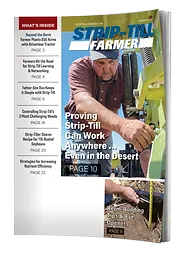
Strip-Till Farmer delivers a mix of features on strip-till farmers, strip-till management topics and trending practices in strip-till. This FREE quarterly print newsletter is available to qualified subscribers in the U.S. and Canada.
On this episode of Conservation Ag Update, brought to you by Yetter Farm Equipment, we get the scoop on the benefits of planting green with Jackson, Wis., no-tiller Ross Bishop.
TarasPort Trailers is a North American trailer manufacturer specializing in custom over-the-road trailer solutions for fleets, owner operators, and military use. Our company designs precision-built equipment transport trailers, freight trailer solutions, and mobile power trailer solutions...
Founded in 1954, Sullivan Hardware is a local hardware store in Indianapolis, IN. We provide the best in class products, including artificial Christmas trees, grills, and patio furniture. Spanning nearly seven decades and two generations, our family-owned business also conducts unique grilling...
Aero Energy provides professional fuel delivery services in Pennsylvania and Maryland. We offer residential fuel delivery and commercial fuel delivery backed by more than 95 years of service. Homeowners rely on Aero Energy for trusted residential HVAC services with heating, air conditioning, and...
 RSS
RSS