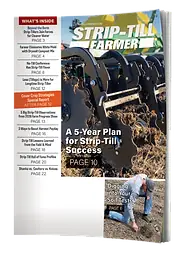
Below are some key strip-till takeaways from several of the features found in the Summer 2025 issue of Strip-Till Farmer.
Patience Pays for Strip-Till Rookies
- Strip-till success doesn't always happen overnight. Sometimes it takes 2-3 years before seeing ROI in the form of higher yields and fertilizer savings.
- It also might take some time to clear the mental hurdles that come with switching from conventional tillage to strip-till, as your fields will look different with more residue build-up.
Fall/Spring NPK, Custom Starter Mix, Cover Crops & In-Season Fertility Boost Strip-Till Yields
- With strip-till, lowering phosphorus (P) and potassium (K) by 30% can pay off in certain situations, but exercise caution when lowering nitrogen (N) rates. Using 0.8 pounds of N per bushel should get the job done.
- Starter fertilizer sets the crop up for success. Iowa strip-tiller Andrew Focht tweaks his blend every year. In 2024, he laced it with a liquid chicken manure product from Mutiny Crop Performance.
- Leverage technology to increase in-season nutrient use efficiency. Focht uses an online program called Adapt-N to determine in-season nutrient application rates. The program integrates 13 different models, including weather, soil and crop models, to provide variable rate recommendations.
Residue Management, Pattern Tile, Split N Applications Key Pieces to 400-Bushel Strip-Till Puzzle
- The journey to high yields begins in the fall with residue management. Strip-Till Non-Irrigated Yield Champion Galt Porter (Mercer, Mo.) uses a fall application of Holganix Bio 800+, a product that helps break down crop residue and charge the soil with over 900 species of soil microbes, nitrogen (N) and microbe food. He also pattern tiles his high-yield plot in the fall to ensure it will be dry enough for the strip-till rig in early spring.
- Adding more N after the initial NPK strip-till pass can pay off big time. Porter followed his strip-till pass (200 pounds N, 100 pounds P, 100 pounds K) up with a weed and feed herbicide pass about a week later. It contained 25 pounds of liquid N.
Every Strip-Till Operation is Different, Think Outside the Box
- Planning on strip-tilling in October, but the weather isn't cooperating? Don't be afraid to call an audible if Mother Nature throws a wrench in your strip-till plans.
- Spacing out nitrogen (N) applications throughout the season ensures the crop has what it needs to make it to the finish line.
- Precision technology— like RAIN 360 and subsurface drip irrigation — can drastically increase your water and nutrient use efficiency.
- Proper weight distribution on the tractor will help the planter stay on the strips.
Strip-Till, Dairy Farming Make a Winning Combo
- With frigid temperatures and short fall windows, strip-till helps put time back on the clock for busy dairy operations.
- Not 100% sold on strip-till? See if there are any lease-to-own programs in your area for strip-till toolbars.
- Crop rotations build resilience. After 2 years of corn silage, Wisconsin dairy farmer Mike Fischer plants oats in the fall ahead of alfalfa. During the 2nd year of alfalfa, he interseeds meadow fescue grass in July. Fischer says the interseeding has helped eliminate leaf spot pressure that was cutting his alfalfa yields in half, and the grass is making his fields more resistant to erosion.
Balancing Micronutrients Can Boost Strip-Till Yields
- In some situations, low soybean yields can increase significantly with cobalt applications.
- In normal soils, there typically isn't enough iron in a plant available form, so soil organic matter is needed to break it down into a usable form.
- Boron toxicity can be a concern in sandy soils, but clay soils have enough buffering capacity in most cases to prevent that problem.
Strip-Till Can Solve Erosion Issues & Revive 'Dead' Soils
- Strip-till and cover crops can reduce erosion and improve water infiltration, even in heavy clay soils with granite ledge rock underneath.
- Adding small grains to your corn-soybean rotation can improve yields significantly.
Strip-Till a Good Option on Your Most Challenging No-Till Acres
- No-tilling corn on some ground — due to erosion and abuse — proved to be a challenge for South Dakota farmer Ryan Larson. He borrowed a neighbor's strip-till rig and started banding fertilizer in the corn in poorer fields while no-tilling the rest. Larson is now strip-tilling two-thirds of his corn and no-tilling a third of it. He's liking the results so far.
Start Thinking Like a Corn Rootworm to Beat it
- "The more you know about what is making rootworms successful, the more you might be able to make their life more complicated," says Ann Marie Journey, an independent soil, wetland and stream health evaluator and founder of EntoVentures.
- Healthy soils with plenty of life are a rootworm's worse nightmare because they're easy targets to be eaten by viruses, bacteria, protists, fungi, nematodes, worms and more. Conventional tillage damages pore structure in the soil, making it harder for the rootworm's enemies to survive and thrive.
Thinking About Strip-Tilling Corn-on-Corn? Start Small, Make Mistakes and Learn
- With strip-till, you need to put a system together that fits what you want to accomplish, says Cade Bushnell. The Stillman Valley, Ill., strip-tiller says the way you implement strip-till must work for your soils, your equipment and what you can tolerate.
- Setting a planter up for both no-till and strip-till corn-on-corn will help handle situations where the strip is missed.