Tanner Schoff’s dad, James, started no-tilling corn and soybeans almost 30 years ago in Walnut, Ill., to keep the soil in place on their highly erodible land. Not too long after that, they started strip-tilling their corn.
“We mainly started no-tilling and strip-tilling for erosion control, but after a few years we saw even more benefits,” Tanner Schoff says. “Our compaction issues improved over the years. We can dig into the soil now and see a ton of earthworms. It’s amazing what the switch has done for our soil biology. Also, banding fertilizer in zones has greatly increased yields and reduced our overall fertilizer use.”
Today, the Schoffs implement a corn-corn-soybean rotation. They strip-till all their corn acres and no-till their soybeans. Although the switch to conservation practices delivered significant payoffs, it also came with a big challenge.
Tools of Choice for Strip-Till
The Schoffs have 2 identical John Deere 12-row strip-till bars with shanks, one for applying anhydrous and the other for applying dry fertilizer.
“Every field is different on our farm,” Schoff says. “Fields that are corn following corn, we apply anhydrous. On corn following soybeans, we’re using 2-year prescriptions and running a single product, either DAP or potash. We’ve experimented with doing a little blending on some fields, but we’re mainly variable-rate applying one product.”
They make most of their strips in the fall but sometimes pivot to spring strip-till if Mother Nature dictates it.
The Schoffs typically apply about 100 pounds of nitrogen (N) in the fall, and another 80-100 pounds of N with their sidedress bar in the spring. They’ve backed off on starter fertilizer with their John Deere 24-row planter because they haven’t seen a huge ROI from it in recent years.
“Residue management was a huge problem for us, especially in the strip-till corn-on-corn environment,” Schoff says. “When you’re not doing full tillage, you’re left with plenty of residue. We’ve always fought the old corn stalks, which are even more vigorous today and harder to break down. The gauge wheels on the planter would ride over those stalks and create less seed-to-soil contact.”
Dawn of the Rezidue Reaper
Schoff, who graduated from Illinois State Univ. with an ag business degree, tapped into his passion for building things and started working on a solution that would solve their residue Rubik’s Cube.
“I had a vision one day while running the combine — I’m already lined up with the rows, I could be managing these stalks with the corn head,” Schoff says. “That’s how the Rezidue Reaper was born.”
“This is just a simple, mechanical way to break up that residue and get that decomposition going to release the nutrients…”
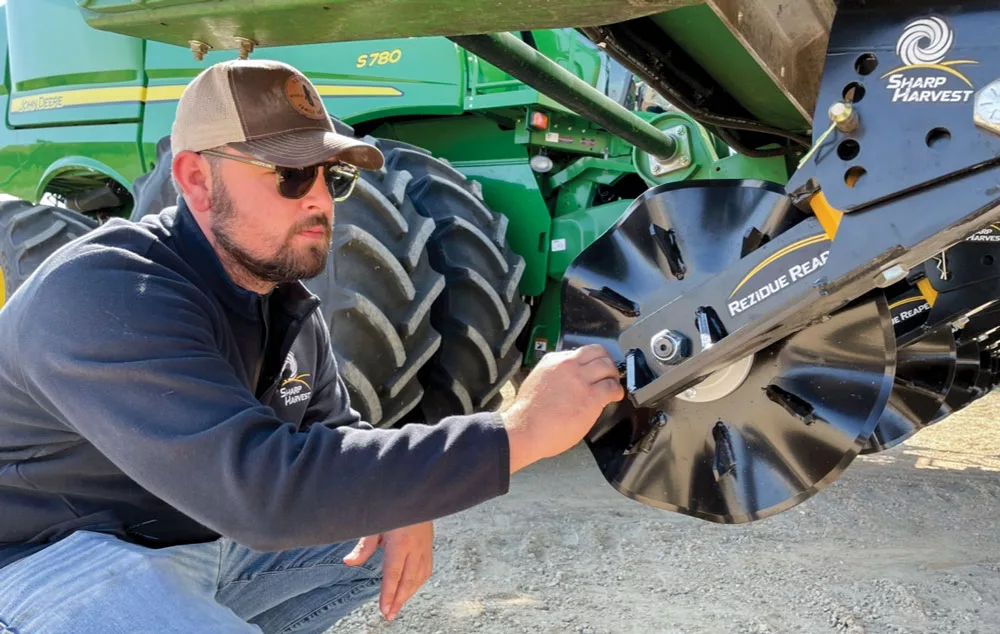
Schoff launched the company Sharp Harvest out of his farm shop and designed the Rezidue Reaper as a tillage attachment tool for the combine. Its blade — 15 inches in diameter — aligns precisely with the corn rows to shred stalks while harvesting.
“Its footprint is 4.5 inches wide, which means if you’re not quite centered to the stalk while harvesting, there’s still a wide enough footprint to consistently cut up root balls and stalks,” Schoff says. “The fins on the sides of the wavy coulter act as a gauge wheel as well, giving you a consistent depth of about 2.5-3 inches.
“It’s also spring loaded, so the blade can travel up and down about 5 inches if you hit a rock or go through uneven terrain. The whole unit is bolted to the frame of the corn head.”
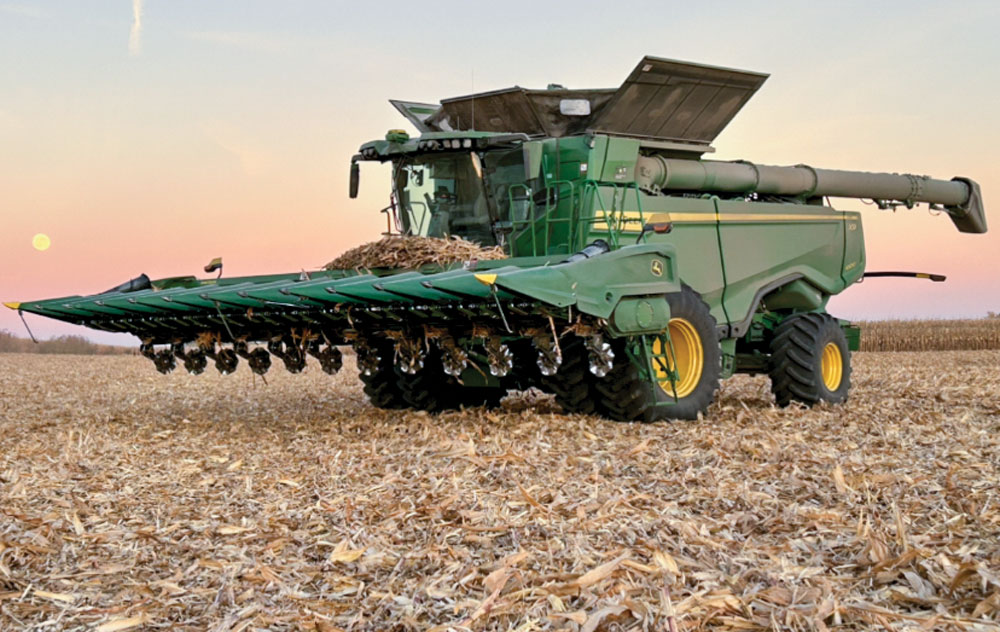
HEAVY RESIDUE. The Schoffs struggled to manage heavy residue after switching to a strip-till corn-on-corn system. The Rezidue Reaper combine attachment has accelerated residue breakdown on their fields, allowing them to make fall strips and plant earlier in the spring. Tanner Schoff
The invention has proven to be a game-changer for Schoff’s system. He’s noticing the heavy residue is breaking down much faster.
“Last spring, I was able to start strip-tilling and planting earlier than ever before,” Schoff says. “The field was ready, and strip-tilling through those stalks was much easier, allowing me to make better strips.
“We all know there’s a lot of nutrients tied up in those stalks,” he adds. “This is just a simple, mechanical way to break up that residue and get that decomposition going to release the nutrients. We’re doing side-by-side trials this fall to check for yield differences, and I’ll be able to share that data soon.”
One Pass Wonder
Whether it’s with the combine or strip-till bar, maximizing a trip across the field is always the No. 1 goal for Schoff. He’s now planting cover crops, applying nutrients and making strips in the same pass.
Schoff custom-built a cover crop seeder for his John Deere 12-row strip-till bar so he can broadcast seed while making strips in the fall.
“As a young farmer, I don’t have a choice other than getting extreme with my farming practices…”
“We’ve mainly been using cereal rye with our seeder on the strip-till bar,” he says. “Since we started broadcasting cereal rye, we’ve seen an increase in soil organic matter, improved soil structure, and better soil tilth for more ideal planting conditions.”
By tilling in 4.5-inch bands with the Rezidue Reaper at harvest, Schoff feels confident he can now strip-till into the same zone every year — not 15 inches off the old row like he currently does — which opens even more cover crop possibilities.
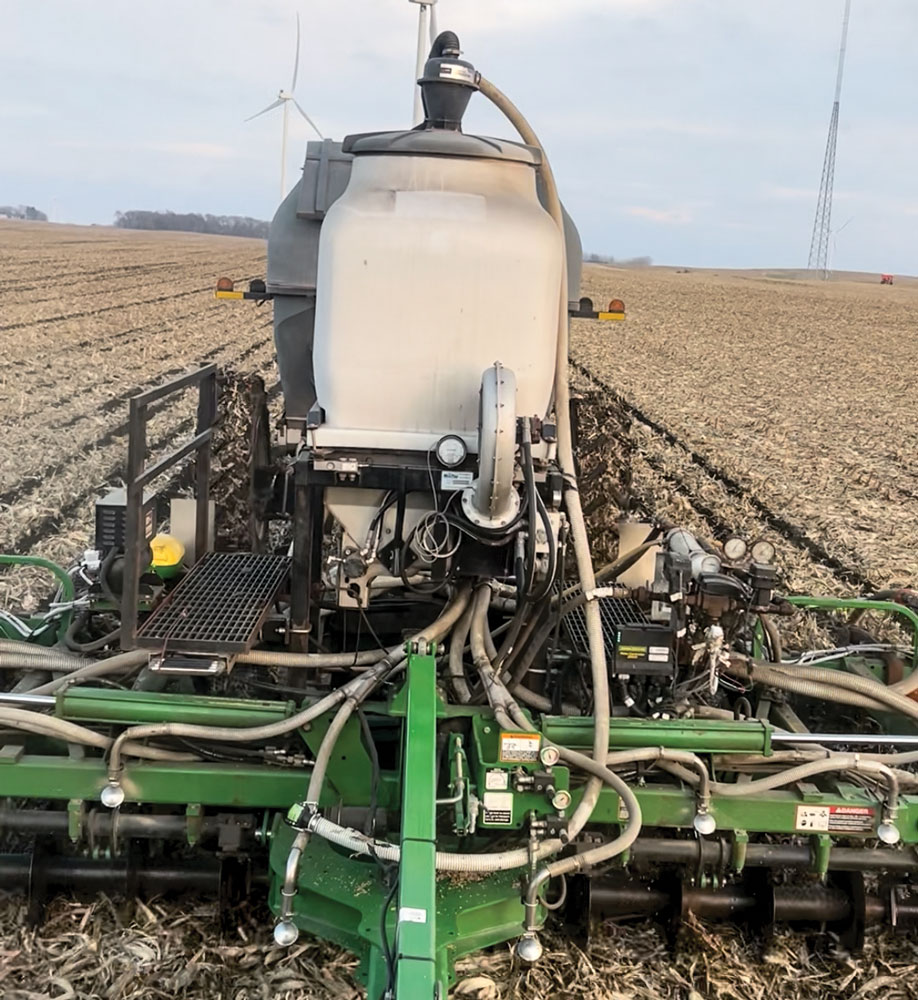
ONE PASS. Schoff looks to maximize every trip across the field. He built a cover crop seeder for his John Deere strip-till bar, which allows him to broadcast cover crops while making strips in the fall. Tanner Schoff
“By establishing crop zones, I can then plant a permanent legume cover crop in between those crop rows,” Schoff says. “My plan is to have 25-inch bands of a clover/alfalfa mix, and we’ll try to keep them growing all year outside of the strips. If I’m able to strip-till in the same zone year after year and establish permanent covers, that would be a game changer for nutrient management and weed control.”
Schoff is trying to eliminate the use of herbicides in his system by crowding the 25 inches between his strips with the clover/alfalfa mix. He’s also banking on seeing an uptick in nutrients in the soil.
“Legume nodulation should release natural nitrogen into the soil,” Schoff says. “Also, by mowing the legumes, we can create biomass that will release NPK. I’m planning on building a cutting implement to mow the cover crops during the growing season.”
Custom-Built Solution for Heavy Residue
Click here to watch Tanner Schoff demonstrate how he’s using his custom-built combine attachment to manage heavy residue in his no-till and strip-till system.
Schoff hopes the strategy will boost his soil health, reduce the number of inputs he’s applying and ultimately lower his overall cost of production.
“In today’s environment, you have to shoot for that because we’re not saving money anywhere else,” Schoff says. “As a young farmer, I don’t have a choice other than getting extreme with my farming practices. The cost of production is not sustainable for farmers of my generation. The only thing I can control is lowering my cost of production to ensure I am net positive at the end of the year.
“Not only will zone farming cut my production costs, but I see it being beneficial for soil health, decreasing wind and water erosion, and decreasing the use of synthetic fertilizers and herbicides that are poisoning the earth and are toxic to personal health. I’m not saying a practice like this is for every farmer or every acre, but it does excite me to try new things to get more sustainable and profitable.”