TAKEAWAYS
- Strip-till can help reduce fertilizer use by 2 times, and arguably 5 times on a “grams per square inch” level.
- Through increased nutrient use efficiency, strip-till can help grow healthier and heavier plants, resulting in increased yield.
- No-till converts can benefit from reduced compaction, improved water infiltration and reduced erosion.
Of all the advantages strip-till offers, one in particular grabs the attention of both conventional farmers and no-tillers alike — especially when fertilizer prices remain stubbornly high.
“As an agronomist and custom applicator, I’m always looking for ways to improve a customer’s bottom line,” says Travis Messer, general manager of Plains Grain & Agronomy in Mott, N.D. “Fertilizer efficiency is a big topic right now because fertilizer prices are high and commodities are low. For us, strip-till has been the one thing that actually increases nutrient utilization because we’re placing the nutrition directly under the row. More farmers are understanding that, which is why strip-till has really started evolving in North Dakota.”
Plains Grain & Agronomy is a 5-location co-op specializing in custom spraying and strip-till. The company has been strip-tilling since 2008 and currently manages over 20,000 acres across its statewide customer base.
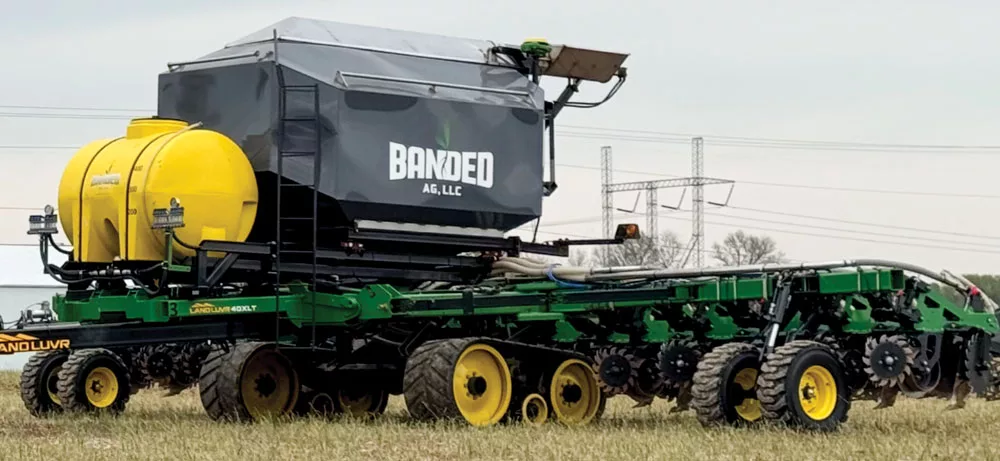
Over in Indiana, 2024 Strip-Till Innovator Chris Perkins is also seeing increased demand for both his custom strip-still services and the equipment he sells. Perkins began experimenting with strip-till in 2017. Impressed with the results, he launched his company, Banded Ag in Otwell, Ind., in 2019. Banded Ag is an ag retailer, custom strip-till business, and dealer for Land Luvr strip-till equipment.
“I’ve never been that blown away by a technology like variable-rate fertilizer,” Perkins says. “I understand the purpose of variable-rate, which is to get all areas on a soil map to be the same from a fertility standpoint. The problem is that the yield map never seems to match up. There’s more that goes into growing a plant than just winging fertilizer out the back of a spreader truck. Maybe we should just focus on feeding the plant instead of the soil. Then we can focus on coming up with different fertilizer blends to help feed the plant a balanced diet. This is why strip-till makes so much sense.”
Messer says strip-till has impacted yields significantly across North Dakota, particularly the western half of the state where no-till is more common. Most of his no-till customers raise a lot of 100- to 140-bushel corn. Those farmers will often see another 25 bushels after switching to strip-till.
“Those no-till guys are now making an extra pass across the field with a strip-till bar, but they have no problem seeing how that kind of increase in yield makes it more than worth it,” Messer says.
Improved nutrient use efficiency can be an even bigger game-changer with crops like canola, which Messer says is becoming more popular in western North Dakota. Canola is a taproot that doesn’t use fertilizer very efficiently.
“Strip-till gives you a shot at growing a high-yielding crop without having to dump so much money into expensive fertilizer,” Messer says.
Input Down, Output Up
How much can a farmer save on fertilizer inputs when switching to strip-till? Perkins says a long-used rule of thumb is 50% compared to broadcast spreading. But that doesn’t tell the whole story, according to Perkins.
“When you look at the surface area of an acre, you’re only using a third of it for growing corn,” Perkins says. “When you look at what the root touches, it’s even less than a third. We have been able to conclusively determine that fertilizer reduction is more like a 5x factor, not just 2x. It’s pure mathematics.”
How does that math work out? Say a farmer has been broadcasting 200 pounds of potash. Strip-till reduces that to 100 pounds right off the bat. “But since those 100 pounds are banded directly under the plant, as opposed to just spread all over the field, it’s really like using only 40 pounds on a grams-per-square-inch level,” Perkins says.
This is where the conversations around reduced fertilizer use and increased yield begin to intersect.
“You have to look at yield in the right way, for starters,” Perkins says. “Take corn, for instance. Under the right conditions, the grower will likely end up with a heavier kernel when fertilizer is banded right below the plant. That heavier weight is because that kernel is more protein than starch, and protein weighs more than starch on a molecular level.
“A bushel is simply a mathematical conversion, dividing by 56 or 60 pounds in a corn or soybean situation,” Perkins adds. “So, we farmers are really combining pounds per acre. The more pounds you have, the higher number you’ll have from a bushel standpoint. To really increase yield, you have to find a way to increase the weight of the individual kernels on every ear of corn. For me, strip-till has been a big part of the solution.”
Strip-Till Benefits
Messer says there’s much more to consider than just nutrient use efficiency when it comes to strip-till benefits. Strip-till creates the conditions that help farmers grow healthier, heavier crops in less time and for less money, he says.
For farmers practicing conventional tillage, strip-till opens the door to reduced labor, equipment and fuel costs by streamlining tillage implement needs and reducing the number of field passes needed over the course of a year.
“They’ll still be creating that nice, black zone to plant their crop in,” Messer says. “Additionally, strips tend to be 10-15 degrees warmer at planting, which is key in a place like North Dakota where springs can be a bit colder.”
“Strip-till gives you a shot at growing a high-yielding crop without having to dump so much money into expensive fertilizer…”
When a conventional farmer starts strip-tilling, Messer says they’ll sometimes want to go a bit deeper in the soil than normal because that’s what they’re used to. That’s not necessarily a bad thing because deeper tillage can improve water infiltration, he says.
“When we’re in a wet cycle, the farmer will see less ponding in their fields,” Messer says. “And because the fertility is banded right beneath the row, they’ll see less nitrogen loss and other fertility issues.”
Sometimes a good strip-till prospect has already begun experimenting with alternative forms of tillage. Take Jarret Orr, for instance, a sixth-generation waxy corn grower in Rowley, Iowa. He was vertical-tilling for 4 years before switching to strip-till 3 years ago.
“We’d been doing vertical-till in the fall, incorporating cereal rye with our plow-down fertilizer,” Orr says. “When we went to plant into that rye in the spring, we could see how good the spreader application was that we got from the co-op. We could see gaps or spots that were doubled up. Rye always tells the truth.”
Orr says he was also motivated by rapidly climbing fertilizer prices.
“We decided that it made more sense to put the fertilizer right where we needed it,” Orr says. “We farm 4,000 acres and only 300 are owned by us. On all those cash-rent fields, we decided we wouldn’t neglect them, but we also weren’t going out of our way to feed them. We just want to feed the plant we’re growing, and it became clear that strip-till would be the best way to do that.”
Orr says his fertilizer use immediately dropped by 40% and his yields steadily improved each of the past 3 years.
“My grandpa had record crops in back-to-back years,” Orr says. “Now we’re looking to scale back our fertilizer use even more. We’ll be soil testing to make sure.”
From No-Till to Strip-Till
No-till converts are poised to see several benefits from strip-till too.
“No-till is fine in my book, but there are some major problems that can lie ahead of it,” Perkins says. “Stratification is a big one. On the other hand, one potential problem with something like a field cultivator is the breaking up of organic matter. The nice thing about strip-till is that it gives the no-till farmer the best of both worlds.”
Compaction can also be an issue on no-tilled fields, according to Messer. Strip-till helps alleviate compaction while also enhancing water infiltration.
“It also helps increase corn root development,” Messer says. “A larger root system can handle stress better while also accessing water and nutrients better.”
Strip-till also addresses erosion issues. In dry, hilly western North Dakota, Messer says strip-tilling into stubble has proved to be an effective approach. For instance, the row cleaners Messer adds to his custom-built strip-till rigs can manage through 2.5- to 3-foot-tall wheat stubble. On the other hand, some farmers will be working through something that’s not nearly as thick, such as small-grain residue like spring wheat or barley. They could likely get by with a less aggressive row cleaner.
Seedbed creation can be part of the erosion discussion. Pounding spring rains in hilly, generally dry environments can cause zones to wash out. This will influence which strip-till units the farmer should have on their toolbar. For creating fluffy, 3.5- to 4.5-inch fall berms in wetter environments, a concave basket makes sense. But for flattening and firming to guard against spring washout in drier environments, Messer likes to use a flat paddle basket.
“When a no-tiller is converting to strip-till, those strips are the only loose ground in the field for that first year or two,” Messer says. “If the strips are too loose, you run the risk of water wanting to congregate there. Understanding the environment and helping the grower choose the right strip-till units is really important.”
Orr give a lot of credit to his dealer, Youngblut Ag in Dysart, Iowa, for helping him understand the advantages of strip-till.
“Strip-till is exactly what our operation needed,” Orr says. “It does take more of a skilled operator because strip-till makes tillage as important, or maybe even more important, than planting. There are more variables when strip-tilling. You need to focus on the strips and making a good seedbed, and at the same time you’re worried about your fertilizer system maintaining a consistent rate and not plugging up. The operator really has to be paying attention.”