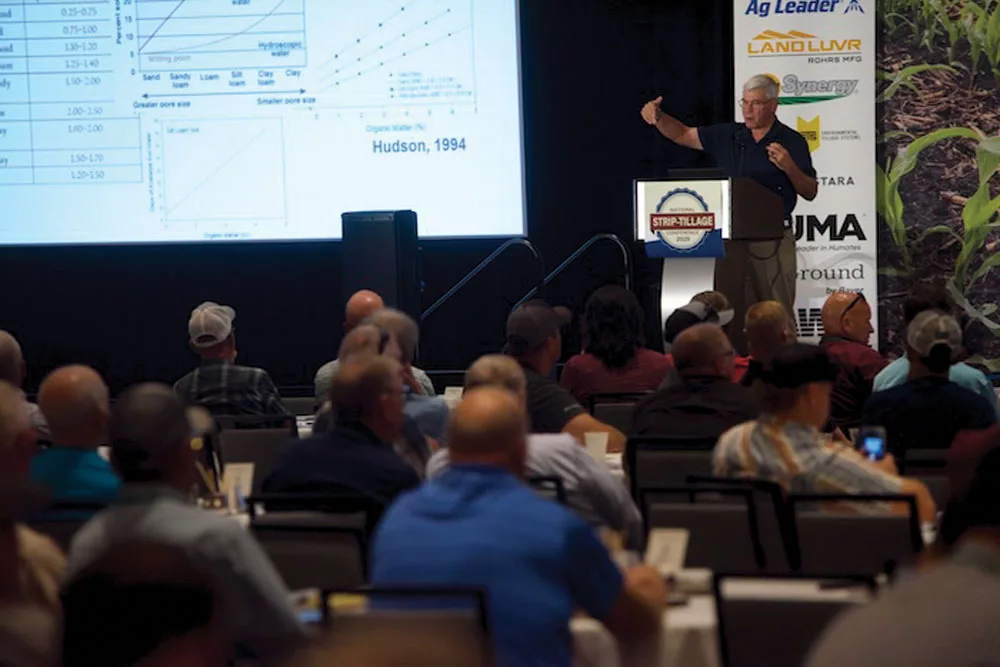
More than 300 farmers, agronomists, researchers, dealers and manufacturers from across the U.S., Canada and overseas gathered in Iowa City for the 12th annual National Strip-Tillage Conference.
The 2-day event featured general sessions, classrooms and interactive roundtable discussions, as well as hours of networking in the hallways.
Attendees exchanged ideas on everything from nutrient management and equipment to cover crops and biologicals. Here are 4 highlights from a few of the sessions.
1. Carbon is Currency
Soil health legend Jerry Hatfield hit leadoff with a keynote presentation on strip-till’s place in the soil health puzzle. The former director of the USDA Laboratory for Agriculture and the Environment discussed how strip-till checks the soil health boxes.
“Strip-till becomes a critical piece to the soil health puzzle because we see all the functions that we want for microbial activity,” Hatfield says. “With strip-till, we’re keeping the water where we want it. We keep the air infiltration where we want it. We reduce the loss of carbon compared to full-width tillage and we promote an environment where water and nutrient use efficiency are optimized.”
Biological activity is key to maintaining healthy soils, Hatfield explains, and keeping soil temperatures in check is important. Cover crops and residue provide the armor that shields the soil from scorching heat in the summer.
“We got curious about this a few years ago, so we looked at temperatures between rows in a conventional system vs. a strip-till system,” Hatfield says. “The strip-till system had no hours above 104 degrees F.
“In the conventional system, we’d see soil temperatures as high as 150-160 in Lubbock, Texas, and as high as 130 in central Iowa. If we don’t protect the soil surface, we’ll cook the life out of our soil.”
In another eye-opening study, Hatfield found that 1,000 pounds of carbon was being lost per year in a conventional system, while 300 pounds of carbon was gained in the first year of a strip-till system with cover crops.
“Carbon is the energy that drives the entire process,” he says. “It’s not nitrogen. It’s not phosphorus. It’s not potassium. Those are nutrients. Carbon is the energy piece to this puzzle. It’s the currency for changing soils.”
2. Nitrogen Not No. 1 with Strip-Till
The room was packed for Mick Goedeken’s deep dive into strip-till fertility. Among his many suggestions, the longtime agronomist from Polk, Neb., hammers home the importance of using a starter fertilizer mix.
“10-34-0 is not a starter fertilizer,” he says. “You’ve got to do better. A starter fertilizer needs to be a complete blend with N, P, possibly K, sulfur, zinc, other micronutrients and some sort of growth enhancer in it to do what we want it to do.”
Goedeken also details how strip-tillers can increase their nitrogen (N) efficiency by not applying as much with the strip-till rig. He says 25-30 pounds of N, 6-8 inches deep should be enough for the strip-till pass.
Considering the great loss potential of N between November and June, Goedeken recommends applying N throughout the growing season — either sidedressing, topdressing or fertigating — and including sulfur with every application.
“Sulfur needs to go with N, we put it on every year,” Goedeken says. “We don’t get that free sulfur from the atmosphere anymore. I moved to a 5-1 ratio, applying 1 pound of sulfur for every 5 pounds of N. But then I started doing some studies in the western Corn Belt, and the ratio there is closer to 2-1.”
What’s the right sulfur rate? Goedeken says it’s regional, but like N, later applications are more efficient.
3. Early Soybeans Pay
Ryan Nell shared his playbook for early-planted soybeans in Beaver Dam, Wis. Nell makes fall strips for soybeans after harvest, and applies phosphorus (P), potassium (K), sulfur, calcium, zinc and boron. He pushes his planting depth to 2.25 inches when planting in early spring.
“I need to keep that rapid change in temperature away from the soybeans,” Nell says. “When we plant earlier, we go deeper. I don’t want the beans to get out of the ground too quickly.”
A cereal rye cover crop is a key part of Nell’s formula. He plants 35-50 pounds per acre with an air seeder after harvest. Nell delays termination in the spring, allowing the cereal rye and soybeans to grow together if Mother Nature allows it.
“The last couple of years, when it was dry in May, we terminated immediately,” Nell says. “This past year, I had intentions of terminating around May 15, and then we got 2.5 inches of rain. I terminated some on May 18 and the rest on May 26. It was a little later than I wanted, but from what I can tell, it didn’t result in any issues with the stand.”
The benefits of the cereal rye include significant weed reduction, water infiltration, white mold suppression, residue breakdown and carbon payments, Nell tells his fellow strip-tillers.
Nell achieved his top soybean yield in 2021 with an average of 77 bushels per acre across 839 acres. The soybeans were planted on April 20, which was the earliest he planted since switching to strip-till in 2015.
“The average would’ve been over 80 bushels,” he recalls, “but I had to replant 70 acres that year because my best fields got hit with a frost on Mother’s Day and Memorial Day.”
4. Plants Determine Soil Life
Gary Zimmer, co-owner of Otter Creek Organic farm in south central Wisconsin, kicked off day 2 with a thought-provoking presentation on his approach to “biological farming.” Zimmer shares some words of advice about cover crops.
“The plants determine the soil life. Whatever you add to the soil doesn’t determine the soil life,” Zimmer says. “Oats and buckwheat take up a lot of phosphorus. Our grandparents grew oats because they would grow on low-fertility ground.
“Certain plants take up more potassium than other plants. The purpose of having a diversity of plants is not only to have a diversity of biology, but also to extract more minerals that are already tied up in your soil. Corn and beans aren’t going to do that for you and that’s why you must have some kind of cover crop.”
Zimmer also explains why farmers should manage the digestibility of their cover crops.
“Manage cover crops like you’re feeding them to a cow,” he says. “If you’re going to soybeans, you can let the rye get bigger. You don’t need to have nutrients. But on corn, it’s like feeding a cow you’re giving 100 pounds of milk to. You better give it high-soluble nutrients, and something that breaks down.”
At the end of the day, it’s the farmer’s job to balance soil minerals, maximize photosynthesis, feed and improve soil biology, manage air and water in the soil and manage crop residue decomposition, Zimmer says.
“Live like you are going to die tomorrow, but farm like you are going to live forever,” he concludes.
These 4 highlights from the National Strip-Tillage Conference are just the tip of the iceberg. Strip-Till Farmer will publish more insights from over 20 presentations in the coming months on StripTillFarmer.com.