Takeaways
- Look deeper than N, P and K and micros for better ROI on inputs.
- Treat the soil as a living system and not merely an anchor for plants.
- Invest in integrated “complete” soil analysis with labs capable of timely, precision testing.
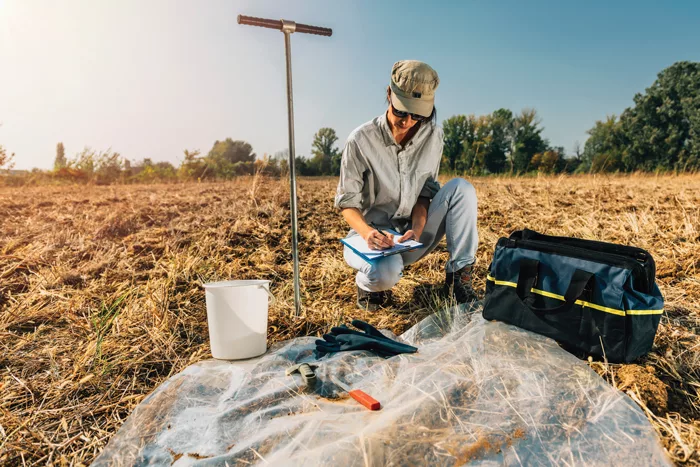
Big changes are under way in the soil testing industry as digital technology demonstrates the importance of viewing farm fields as a living system — requiring more than a yearly grocery list of plant nutrients.
Strip-tillers and no-tillers take soil biology seriously and many of them are looking beyond traditional soil tests to boost soil health while reducing input expenses. Typically, that leads to investing in data-driven soil analysis, which includes an integrated look at chemical, biological and physical properties of soil — not just plant nutrient availability.
While still important, the days of traditional soil sampling for nitrogen (N), phosphorus (P), potassium (K) sulfur (S) and micronutrients as a single agronomic best management practice are rapidly fading, experts say. What’s taking its place, however, promises far better precision nutrient management and timely, actionable in-season decision-making information.
Testing for Function
Colorado State Univ. soil health researcher Lexi Firth is well acquainted with the new face of soil testing in her work with soil carbon and water relationships. She coins a kitchen metaphor to explain the difference in traditional soil testing and what she calls “testing for function.”
“Traditional soil tests are like checking your pantry for how many pounds of flour you may have, but not whether the oven is on or who’s going to make the dinner tonight,” Firth observes. “Testing for function goes beyond producing an inventory of ingredients and seeks to answer how those ingredients will be blended, by whom and how long cooking will take. It can also give you clues of what to expect.
“The tests we’ve used for years tell us how much phosphorus, potassium or nitrogen was in the soil when the sample was pulled. But they don’t answer the question of, ‘Is the system actually working?’ That would involve determining: Is the soil cycling nutrients efficiently? Is it holding water? Is biology alive and actively working to break down organic matter?
“Testing for function by examining chemical, biological and physical soil properties provides an integrated look at soil as a system and how well it’s performing,” she adds.
Learning to Ask the Right Questions
In visiting with Mike Evans, Lexi Firth, Clint Frese and Kris Kinnaird, No-Till Farmer compiled the following list of curated questions and answers for growers to ask if they are interested in taking the next step into predictive agronomy or “testing for function.”
- What problems am I seeking to solve? Problems ranging from compaction, water holding capacity/infiltration, yield barriers, input costs, disease and pest control all have likely roots in soil health relationships. Seek advice from others using high-tech sampling for suggested resources.
- What does it cost? Buying in to high-tech integrated soil testing likely carries a higher cost than traditional soil tests, which mainly identify nutrient content. And, like other investments the cost-benefit ratio and timely ROI figures will be specific to individual operations. For a large grower who can save $20-$30 per acre on fertilizer, the ROI for advanced testing could be easily amortized. Frese says his Illinois operation was spending $1.40 per acre overall for traditional soil testing, but with the integrated approach he’s spending just over $2.
- What lab do I use? Firth recommends laboratories certified by the Soil Science Society of America’s North American Proficiency Testing (NAPT) program.
When testing for function, Firth looks at soil chemistry (available through traditional soil sampling) to know what raw materials are available. She also looks at biological indicators, which in terms of function, will tell her how well the soil is cycling nutrients.
“A measure of microbial respiration shows how active your biology is, and a strong burst of respiration indicates how busy your microbes are breaking down nutrients,” she explains.
She also looks for physical indicators (soil structure), which tell how well the soil is handling oxygen and water movement through pore spaces to gauge water infiltration, moisture retention and aggregate stability.
“This information shows whether soil pores are open, and water and oxygen can circulate,” Firth explains. “A soil that seals over quickly and doesn’t hold structure well is going to struggle to support root growth. It’s also going to struggle to support an active biological community, which again is connected to nutrient cycling.
“All these things combined give me clues about management decisions down the line and what might be helpful to optimize crop development,” she adds, noting the integrated soil sampling/analysis approach is part of a growing move to “predictive agronomy.”
Predictive Agronomy
Firth says traditional soil testing provides a “still snapshot” of plant nutrients in the soil, whereas predictive agronomy can provide a “time-lapse video” of likely in-season growing conditions.
It does this using digital data from many real-time soil and weather sensors, historic chemical samples, soil inventory maps, yield maps, satellite imagery, cropping history and historic rainfall and temperature data — all examined with the help of artificial intelligence (AI).
“AI is useful as a tool to find patterns in huge piles of data and then using those patterns to make predictions,” Firth explains.
As an example, an AI model for predictive agronomy would be created by feeding millions of data points from the above-mentioned sources into the system so it can learn which combinations of variables leads to high nutrient availability and which leads to deficiencies.
“Once we train an AI model it can use the data and make a prediction about what’s likely to happen next,” she says.
“For no-tillers this can be a very powerful tool. In a conventional tillage system nutrients are incorporated and mixed and the results are quite predictable,” she explains.” In no-till systems, nutrients tend to be more stratified, and their release depends heavily on residue breakdown or soil moisture microbial activity.
“By knowing rainfall patterns and soil moisture conditions, predictive agronomy can help a no-tiller anticipate nutrient flushes or shortages rather than waiting to see visible signs of crop stress.”
Click here to read the full story from our sister publication, No-Till Farmer.