I just got back from Phoenix, Ariz., where I spent a couple days visiting with 2026 Strip-Till Innovator Robert Boyle and the precision team at one of his dealerships, Stotz Equipment.
This was my first time stepping foot in the Grand Canyon State, and what a fun experience it was for this Ohioan. Luckily, it was only in the upper 90s, which is relatively cool for late May.
Farming out there is a completely different ballgame as you can imagine. Look no further than the photo below of Boyle standing in one of his strip-tilled fields with a dust devil on a conventionally tilled field in the distance.
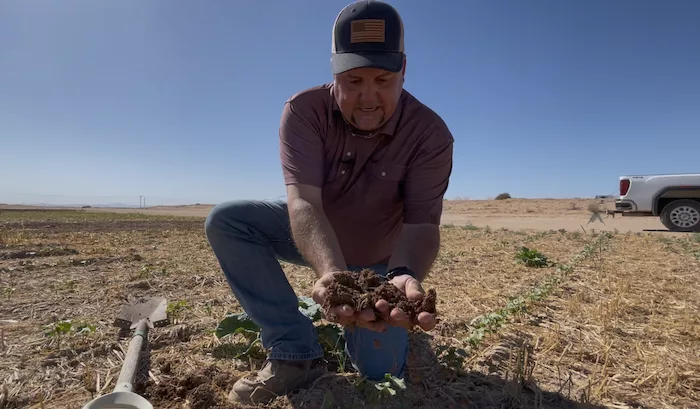
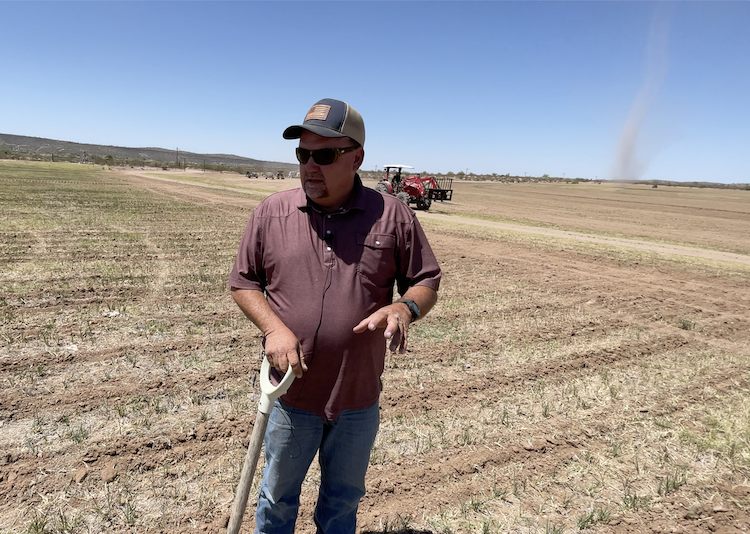 I didn’t see any dust devils on Boyle’s strip-tilled, cover-cropped fields. But I did see an earthworm, which never would’ve happened 15 years ago before Boyle made the switch to strip-till and cover crops.
“For the first shovel out of the ground to find an earthworm, that’s just unheard of in Arizona,” Boyle says.
The conservation practices have clearly transformed his soils — and added life to them — but it took some time to happen after years of conventional tillage. Boyle calls it an “ongoing 10-year process.”
“Any time you change the path of how you’re doing things, you have to give it at least 3 years to come around,” he says. “This field was in a cover crop last year, then fallow and back into a cover crop. Then we strip-tilled it, and ‘dry planted’ the cotton right into it. Most guys ‘wet plant,’ but the ground looked so beautiful, I was just tickled pink with it, and I went ahead and ‘dry planted’ it.”
The economic benefits of strip-till and cover crops are just as impactful as the soil health benefits, Boyle says. He typically plants about 80 pounds of cover crop seed per acre, enough to produce as much as 100 units of residual nitrogen (N), saving him an estimated $71 per acre on inputs.
“And some of these things are hard to put a number on, but we’ve definitely seen an improvement in soil health since we started using cover crops,” Boyle says. “We also see a deeper-colored green in the corn and it’s 2-feet taller.”
Driving around Boyle’s farm, it’s amazing to see how he tracks so many different pieces of equipment and manages dozens of fields, each of which have completely different rotations and cropping practices.
For example, one field we stopped by had twin-row corn growing on it, which was strip-tilled into a cover crop mix of triticale, oats, peas, vetch, clover and kale. A 360 RAIN unit was autonomously irrigating and applying nutrients on the field.
Boyle uses three different strip-till units, one from Environmental Tillage Systems (ETS), one from Orthman and another from Zimmerman (ZML). He also recently tested the new Case IH strip-till unit with some of the engineers who helped build it.
Just spending a day with Boyle, it’s easy to see why he was named Conservation Farmer of the Year by the Arizona soil and water conservation districts, and 2026 Strip-Till Innovator by our panel of judges.
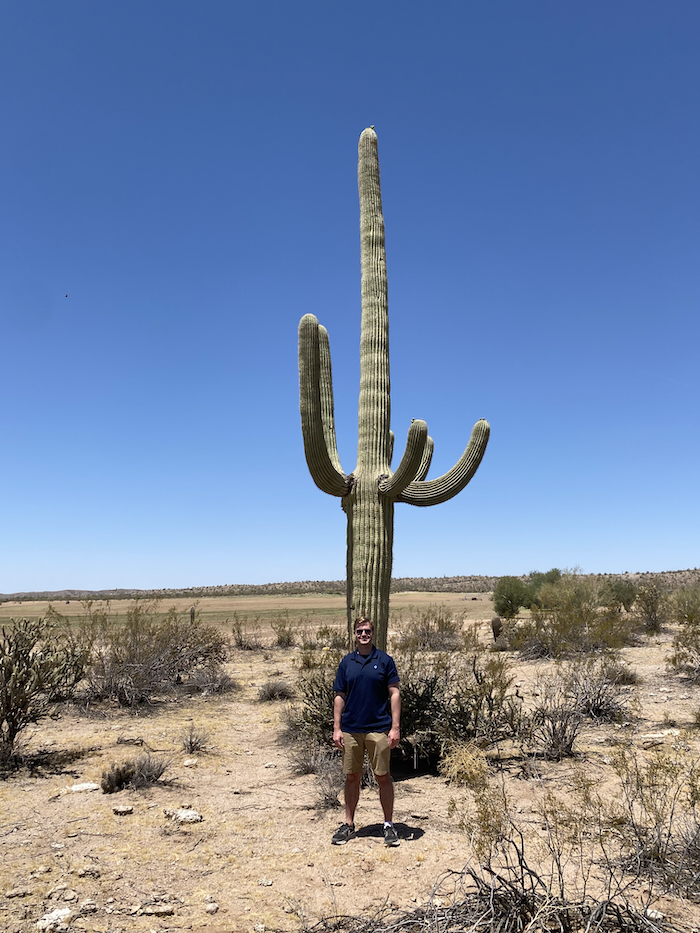
At the upcoming National Strip-Tillage Conference, Aug. 6-7 in Springfield, Ill., Boyle will reveal his top lessons learned from strip-tilling in dry conditions. And before then, I’ll share more stories from our visit in a feature article in the Strip-Till Farmer summer edition. In the meantime, here’s a photo of me standing next to a giant cactus (saguaro) by one of Boyle's fields.