Most farmers who’ve been no-tilling have likely already seen the benefits to their farm’s bottom line in terms of reduced fuel, labor and equipment costs.
But some growers may still be utilizing some type of tillage practice for a variety of reasons, such as managing residue, optimizing field conditions ahead of planting, incorporating cover crops, and killing stubborn weeds among them. The growth of strip-till and high-speed, low-disturbance vertical tillage implements has also created more options.
But when are extra tillage passes worth the time and expense, and how do conservation practices compare? University of Illinois ag economist Gary Schnitkey and Laura Gentry, water quality specialist with the Illinois Corn Growers Assn., shared the results of a data-driven study that dove into the economics of tillage practices over the last decade.
The study used data from the ICGA’s Precision Conservation Management program. They analyzed no-till, strip-till and multi-pass systems, machinery and input costs, commodity prices, soil productivity ratings, and soil loss and greenhouse gas (GHG) emissions. Here’s what they found.
Breaking it Down
PCM collects data from farmers participating in the program for every field pass for on tillage, fertilizer and chemical application, harvesting and planting. A cost is assigned to each category based on cost estimates from various sources to calculate a cost per acre for each pass.
No doubt, the operational costs of tillage, planting and combining corn and soybeans has increased over the last several years. For example, the costs of running a chisel plow has increased from $12.70 in 2019 to $19.50 this year — a 65% increase.
Cost increases for vertical tillage and disc rippers over the same timeframe were similar, and slight smaller for planting (59%). Costs for combining corn (69%) and soybeans (67%) have also increased markedly from 2019 to 2025. Schnitkey notes that with deeper tillage such as a ripper or plow, bigger tractors needed for the horsepower simply increases the costs.
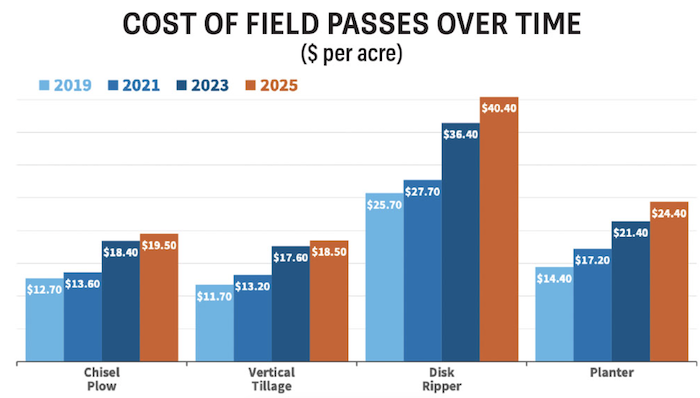 SLOW YOUR ROLL. The costs of various tillage operations and planter passes over the last several years have only gone up, Univ. of Illinois data shows. Univ. of Illinois
One of the variables affecting the economics of these field operations is the cost of equipment. Machinery-related costs for corn — including depreciation, fuel and oil, repairs and labor have gone up 78% since 2021.
Schnitkey also called out USDA estimates of the tractor price index. The score of 123 seen in 2021 was 23% higher than a decade earlier, and the index shot up from 112 in 2021 to 138 in 2025.
“Obviously that translates then into higher costs on farms. At the same time those machinery costs went up and all the machine or the repairs also went up,” Schnitkey said. “One can go to equipment dealer and buy used parts or try and get labor done and realize that all that has gone up.”
One of the largest areas is the cost of a combine. The cost per acre over 2,200 acres totals out at $62, but a smaller farm of only 600 acres will log $201 an acre.
A similar story emerges with planters: Before 2021, Schnitkey says many farmers had purchased two planters to run corn and soybeans at the same time. “That strategy has become more much more expensive,” he says.
The Best Move?
The point of the PCM program, Gentry says, is to help farmers understand what conservation practices like reduced tillage could mean for them financially. The current environment in agriculture since 2021 shows reducing tillage and machinery costs is a good financial move.
“This is one of the worst financial ag economies we’ve seen since about 2010 and farmers need to be thinking about how to be a low-cost producer,” Gentry says.
Gentry and Schnitkey shared research that examined the profitability of fields with both high and low soil productivity ratings (SPR), examining how different tillage practices affected the bottom line and what a field is likely to produce. A rating of 135 or greater is a “high SPR” field and less than 135 is a low-SPR field.
Tillage and Corn
For this study, researchers broke down data from 2015 through 2024 to identify the top 25% most profitable fields and what percentage of tillage systems were associated with them.
They established several tillage system definitions: no-till is no tillage being done at all; strip-till meant just a strip tilled in across a field 8 to 18 inches wide for planting; one-pass light means a full-width tillage pass with a light or a low-disturbance equipment such as vertical tillage or a high-speed disc.
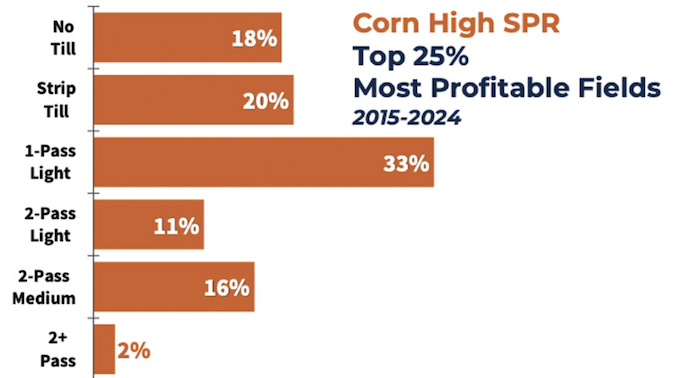 MANY OPTIONS. For fields with a high soil productivity rating (SPR) in the Univ. of Illinois’ study, fields with a 1-pass light tillage system, such as vertical tillage, were used in 33% of fields, but no-till and strip-till also had a respectable share of cropping systems. Univ. of Illinois
The two-pass light means two passes with a lighter piece of tillage equipment, and two-pass medium means one heavier piece of tillage equipment, usually a chisel plow, followed up by a lighter piece of equipment like a vertical tillage. Two-pass “plus” or heavy tillage means more aggressive tillage treatments, such as a plow.
The Lowdown on Corn
Regardless of the SPR, a 1-pass system with light tillage was used for corn in about 34% of the fields. No-till was represented in 18% of the high-SPR fields and 23% of the low-SPR fields, while strip-till clocked in at 20% and 14%, respectively.
Breaking out the top 25% of the most profitable high-SPR fields, 1-pass light tillage again won with 33%, while strip-till (20%) and no-till (18%) also fared well.
The researchers also zoomed in on the year 2022 to examine data for all 1,158 high-SPR corn fields. About 22% of all the fields in that year were no-tilled, 32% were strip-tilled, 26% were 1-pass light, while the rest were other heavier tillage treatments.
When looking at the top 25% most profitable corn fields, no-till shined with 35% of the fields, strip-till came in at 25% 1-pass light clocked in at 23%. “Anytime we see that a certain tillage class like no-till is higher in the top 25% than it is in as a proportion of the whole fields, we know that it outperformed its expectations,” Gentry notes.
“Another way to look at it is of those 259 fields that were no-tilled that year for corn production on high-SPR fields, 105 of them ended up in the most profitable fields category. That’s a strong indication that no-till performed very well in 2022 for Illinois.”
For the entire data set from 2015 to 2024 — for the top 25% most profitable fields with corn — all tillage passes produced higher yields than no-till: strip-till and one-pass light produced a 3-bushel advantage.
But when direct costs (e.g., seed, fertilizer, herbicide), non-land costs, power costs, field work and other categories were examined, the pressure on the bottom line is more apparent. Total power costs for no-till was $113 an acre, with 2-pass heavy tillage showing $153.
When looking at operator and land return, no-till easily beat out 2-pass heavy tillage at $347 an acre vs. $315 per acre.
With low-SPR corn fields that were among the top 25% most profitable, no-till (23%), strip-till (14%) and 1-pass light (34%) dominated the practices. But with yields for light tillage eclipsing no-till by 18 bushels an acre, the operator and land returns were not as favorable for no-till in this soil type.
Click here to read the rest of the article in our sister publication No-Till Farmer.