Want to make an extra $50 — or more — per acre?
When James Hepp runs the numbers, it’s clear that profitability goes hand in hand with reduced tillage, especially with today’s tight margins. “While strip-till and no-till are great conservation practices, that’s not why I started using them nearly 7 years ago,” admits this first-generation Iowa farmer.
Armed with his calculator, Hepp questioned every management decision when he started farming. He had a 290-horsepower, 2003 Caterpillar tractor, a 25-foot field cultivator and a smaller, traditional ripper. The tractor needed new rubber tracks, along with some other repairs, plus it wasn’t the most efficient tractor for tillage.
“I figured I’d need to spend about $100,000-$150,000 for a bigger tractor,” says Hepp, 36, who farms 1,400 acres of corn, soybeans, rye and oats near Rockwell City, an area with flat land defined by heavy, clay soils. “Then I’d need bigger tillage equipment, which could easily add another $50,000.”
He also figured in Iowa State Univ. Extension’s custom rates for tillage passes and fertilizer application, such as anhydrous. “Then add in your time, fuel and other costs, and you’re spending $50-$75 per acre per year on tillage. I started asking, ‘Do we really need to do all this tillage?’”
Conservation Connection
In 2019, Hepp started no-tilling all his corn acres going into soybeans the next spring. He strip-tilled the soybean acres that would be planted to corn.
“While I want to produce as many bushels per acre as I can, my main focus is ROI,” Hepp says. “Knowing your numbers is huge. That’s why a calculator is one of the most important tools on your farm.”
This self-proclaimed underdog in the farming world has gone “all in” on strip-till and no-till, with limited experience, modest machinery and a strong grasp on his financials.
Along the way, Hepp has developed a new appreciation for the value of soil health and the cost of soil erosion. “Every speck of black soil that blows or washes away carries nutrients with it, which contributes to pollution,” Hepp says.
This hits close to home for Hepp, who farms in Calhoun County, one of three northwest Iowa counties the Des Moines Water Works sued in 2015. The lawsuit targeted county boards of supervisors that manage ag drainage districts with high concentrations of nitrates.
Hepp favors conservation practices like strip-till to protect drinking water supplies, promote soil health and boost his farm’s profitability.
“If we do conservation right and soil health right, it benefits everybody.”
Hepp proves it’s possible to build a profitable strip-till, no-till system without deep pockets with these 10 tips:
1. Learn All You Can
There are many resources available, from YouTube videos to field days, to learn about a variety of conservation practices, Hepp says. Since 2023, he has hosted a field day at his farm each summer to help others learn about making conservation pay.
“Don’t be afraid to ask strip-tillers in your area for advice,” Hepp says. “Instead of jumping in with your own strip-till equipment, give it a try first. See if a local strip-tiller would do a portion of one of your fields.”
2. Leave Stalks Alone
Park the ripper in the fall. Residue management starts with the combine, Hepp says.
“Putting a Calmer corn head kit on my old Case corn head was a game changer,” Hepp says. “It chops residue into pieces like confetti, which break down much faster.” Knife rolls will replace a disc pass, Hepp notes. “Don’t think of it as, ‘Boy, that was $16,000 for an 8-row head.’ Think, ‘I don’t need to pay for a $20 vertical tillage pass to make more compaction and stalks that will blow.”
3. Upgrade Planter
A strong start at planting is essential. “If you do an 80% job in the spring, it’s really hard to gain that 20% back,” Hepp says.
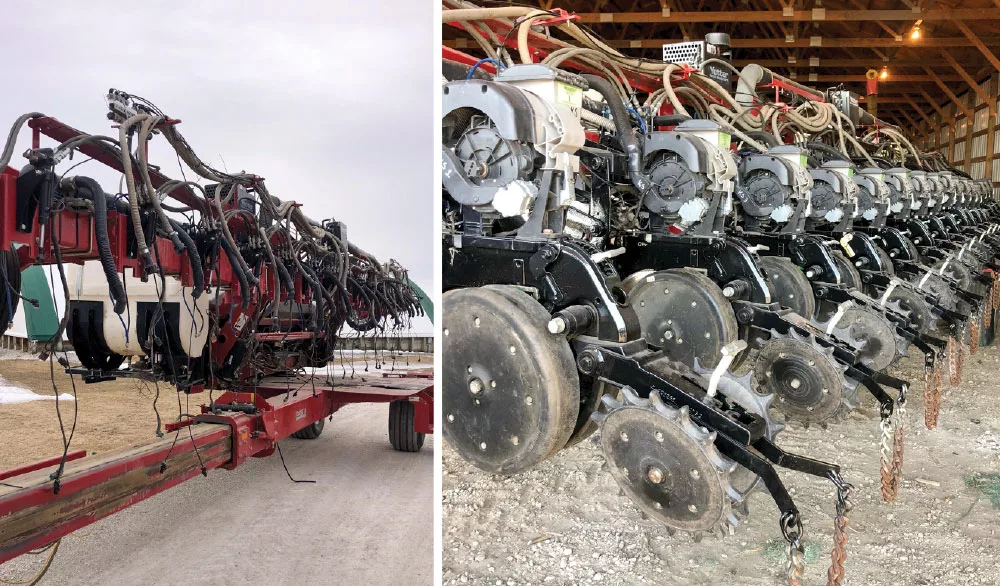
He started with a 2004 Case IH 1200 series 16-row planter with row units that were worn out. Hepp couldn’t afford to buy a new planter, but he connected with a North Dakota farmer who was reconfiguring his 1631 John Deere planter. That farmer had 16 MaxEmerge 5 row units for sale.
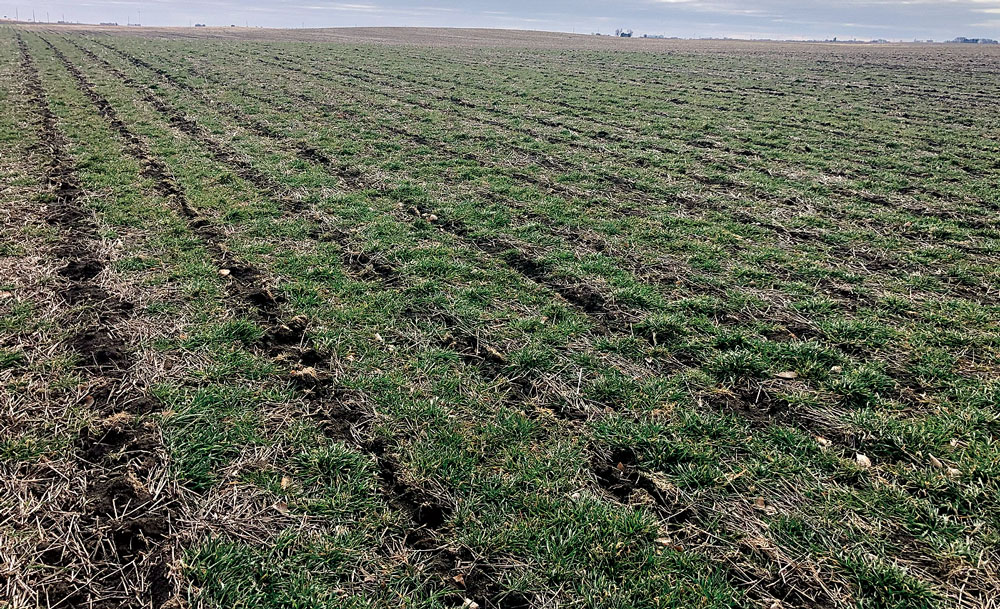
FALL STRIPS. Hepp used his 16-row Blu-Jet to make fall strips through this field where cereal rye was aerially applied. “That field produced some of the best corn we’ve had in the last 7 years. The strips stayed blacked into the spring. I was going to terminate early and try to plant corn into the rye, but there were hardly any weeds.” James Hepp
“I could buy all those row units cheaper than rebuilding the original Case IH row units,” Hepp says. For about $18,000, he was able to upgrade to a 2021 performance-level John Deere planter. “If you already have a good planter, look into getting the downforce, row cleaners and meters. You can do it in steps.”
Proper downforce pays for itself, since good seed-to-soil contact leads to uniform emergence, which contributes to higher yield potential. “Packing on yield on every acre pays back really fast,” Hepp says.
4. Maximize Row Cleaners
Hepp has Yetter row cleaners and can adjust the air pressure from the cab. “Proper pressure is a big deal for getting trash out of the way for better stand improvement,” Hepp says. “If you have to physically adjust the trash whippers, you probably won’t get out and adjust them as much as you should.”
5. Add Some Chains
Good closing wheels are important, especially in the high-magnesium soils that Hepp farms, and so are chains. At first Hepp thought there was no way something that simple and cheap would make a difference.
“But every time I get out, there’s always a handful of dirt just dragging along,” he says. “That’s your absolute last chance to do things right. Good closing wheels and chains cover up those clumps.”
6. Put Cover Crops to Work
Hepp plants cover crops on every acre to improve soil health and provide other agronomic benefits. He started with cereal rye and continues to experiment with more complex cover crop mixes, including triticale and camelina. Planting green is the way to go, Hepp adds. “Ideally, it’s nice to plant into knee-high rye. Then let it grow a little bit and terminate it, because I’m after the weed suppression.”
7. Write Down Your Goals
Anytime you plan to change any of your management practices, define your goals, and write all of them down on paper, Hepp says. Track the results and use the data to guide future decisions.
Some of Hepp’s top goals are controlling weeds and reducing herbicide passes.
“On good years when I have a good rye stand, I’ll just have a burndown of Roundup,” he says. “If I need to clean up a few weeds with Enlist, I will. But I’ve had years when I didn’t do anything but just 24 or 28 ounces of Roundup for the whole year on soybeans.”
All this contributes to another one of Hepp’s big goals — improved profitability.
“When you start putting $30, $40 or $50 back in your pocket, that cover crop’s working for you pretty good,” he says. “It’s also pulling up nutrients and making them more available to the crop.”
8. Prevent Problems Before They Start
Hepp uses grid soil sampling every 4-5 years, plus he has been sap testing for a few years now. Corn sap testing is like a real-time “blood test” for plants to optimize fertilizer use and improve yield potential.
About every 10 days during the growing season, Hepp heads out to various spots in his cornfields. He pulls the lowest leaf he can find, along with the highest mature leaf, from a selection of corn plants. He sends these samples to a lab in Michigan, where sap analysis reveals the plants’ nutrient levels. This data helps Hepp detect nutrient deficiencies before visual symptoms appear. Then he can make in-season adjustments to meet his crop’s fertility needs at various growth stages. “Sap testing is a big deal if you’re willing to go to the next level,” he says.
9. Reallocate Resources
While Hepp figures he invested $4,000-$5,000 in sap testing last year, it saved him at least $35,000. “Sap testing was one of the highest-paying jobs on the farm. I reduced nitrogen by 40-50 pounds per acre, reduced the dry fertilizer budget and did more foliar applications.”
Hepp includes micronutrients in every post-emerge pass, which helps boost nitrogen (N) assimilation. Testing has shown that Hepp is pushing 92-94% on N assimilation.
“That means I can get away with 100 or 120 pounds of N per acre and grow 240-bushel corn, while my neighbor is putting on 180-200 pounds of N in the fall, and he’s growing the same yield.”
10. Take the Long View
The right mindset is critical to profitable farming without deep pockets, Hepp says. Be willing to try new things, ignore the naysayers and keep pushing yourself to do better.
“There’s no $10 silver bullet for success,” Hepp says. “It takes ten $10 solutions to make these systems work.”
Being more profitable is vital to help the next generation succeed in farming, adds Hepp, who is grateful that he and his wife, Paige, are raising their young children on the farm.
“That’s why I strip-till. That’s why I no-till. That’s why I use cover crops. The future is everything, and these kids are the future.”