By Scott Huso, as interviewed by Martha Mintz
I grew up working alongside my dad on our relative’s farm and for others in Aneta, N.D. before heading to North Dakota State Univ., where I earned a master’s degree in ag economics and eventually worked for an ag advertising agency in Calgary. My heart was always in farming, but I never thought I would be able to participate directly myself.
You never know when opportunity will strike. While visiting home for the holidays I struck up a conversation with a farmer from the area.
Tim Brakke farmed with his brother, Brad. They farmed a lot of acres, used nice machinery, had a bunch of employees and their fields always looked good. It was a surprise when I got a call from Tim a few days later asking me to visit him. When my brother asked what I thought he wanted, I supposed he wanted me to play the trumpet at his wedding. My brother said, “No. I think he probably wants you to farm.”
My brother was right. It was quite a shock. I hadn’t really entertained the notion I could be in production agriculture since I was a junior in high school. I’d also become accustomed to a different way of living. Could I make the move from a city of 1.5 million people to a tiny community of 210 people?
I could and did make the move. My partnership with Tim gave me an amazing opportunity and resulted in me now running my own farm. Throughout the years I’ve learned a great deal about managing land and people. Experiences both good and bad have driven home that my top priorities are taking the best care possible of the people I work with and the land I farm.
Focus on Results
Tim started no-tilling in the early 2000s. We no-tilled wheat into soybean stubble, soybeans into corn stalks and soybeans into canola stubble with little issue. Today, I strip-till in the fall ahead of corn, pinto beans and sometimes soybeans. I’m able to place fertilizer exactly where it’s needed and use less fertilizer overall with strip-till.
I was nervous about strip-tilling at first, but corn planting went seamlessly. Harvest really clinched the deal. I saw a 20-bushel yield advantage that I credit almost entirely to the placement of the fertilizer. That was a real aha moment for me.
Since that success, a typical rotation for the farm is to strip-till ahead of corn, no-till soybeans, no-till spring wheat, strip-till pinto beans or canola, no-till spring wheat, then back to corn.
There are great benefits to be had with strip-till, especially in our conditions. With strip-till, there is only a strip 2 inches wide where the soil is disturbed 6- to 8-inches deep. That’s 2 inches per 30 inches of row. The rest of the 8- to 10-inch strip is worked only about 2-inches deep.
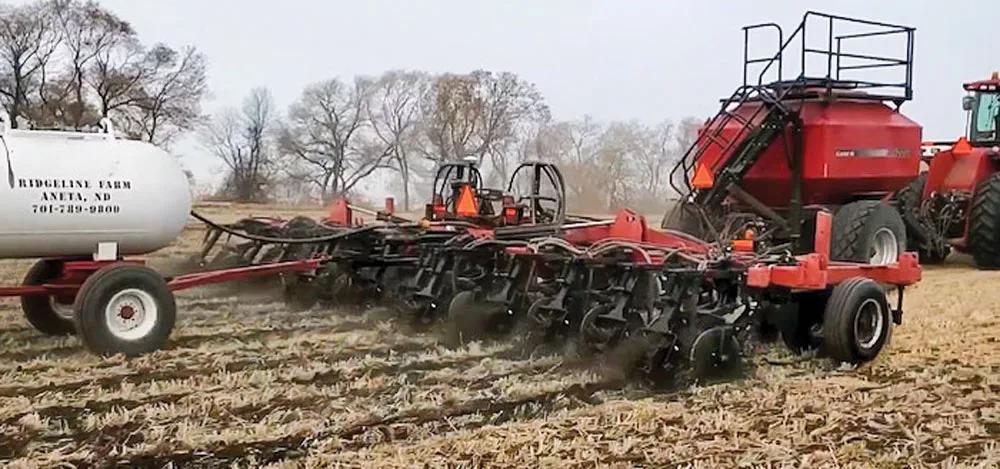
We use a 16-row Case IH ADX2230 air cart ahead of a Case IH Nutri-Tiller 5310 pulling an anhydrous tank. Nitrogen (N) is applied as anhydrous ammonia and any other nutrients we apply in a dry blend through the air cart.
The Nutri-Tiller has a large disc in front of the row unit that cuts residue and trash whippers to move residue aside. The shank applies both the dry blend and the anhydrous ahead of closing discs and a rolling basket that leave a bit of a mound on the strip.
Moving the residue and fluffing up those top few inches create a warm, dry seedbed to plant into. Our area tends to stay wet and cold in the spring. We’re able to warm the ground faster and get corn seeded sooner with strip-till. We’re also getting fertilizer exactly where roots need it so we can get more benefit from our investment without applying more fertilizer.
For the rest of my crops, I prefer to seed directly into the residue from the previous crop with our John Deere 1890 drill with a 1910 air cart. I have a backup plan for when things aren’t going well, as wet, cool conditions plague us too often.
When it gets too wet or the ground isn’t drying out quickly enough and the ideal seeding window is passing us by, I will make a light pass with a Salford vertical tillage tool to dry out the top inch or so of soil so we can get the crop seeded.
None of these actions have negatively impacted my soil structure. In fact, the quality of my soil is a selling point for my landlords. When I dig in my fields, I have earthworms and other life and the soil crumbles. I use a soil penetrometer to test resistance. It’s a great way to demonstrate the soil health to visitors.
Being able to easily push the soil penetrometer into the ground shows that crop roots can more easily move through the soil profile, reaching deeper to access fertility and water. It makes an impact on our crops and all the people who get to see the results firsthand.
Metering Out Fertilizer
Beyond strip-tilling, we’ve also made changes to how we apply fertilizer to our other crops. We used to apply a lot of fertilizer in fall, sometimes the total amount of fertilizer we thought we’d need for the following crop. Eventually we decided the risk of loss was too great.
We started applying fertilizer in spring ahead of planting but that became problematic because there wasn’t enough time to get all the fertility down prior to seeding.
Instead, we’ve switched largely to topdressing some of our crops. In spring, we seed barley, spring wheat, canola and some soybeans with whatever specific starter we’re using for that crop. Then we topdress the crop with the fertilizer it requires. For wheat, barley and canola, they get N in the form of urea. Soybeans get an 11-52-0 phosphate blend.
“I saw a 20-bushel yield advantage that I credit almost entirely to the placement of the fertilizer…”
When topdressing, rain is needed to push the fertility into the soil. If a urea pellet is sitting on the ground and gets just a little rain, very little N will move into the ground, but it can escape into the atmosphere. To offset that risk we use Nitrain 2.0 to reduce the urea volatility.
The topdressing strategy has helped distribute our workload and limit the amount of risk in our investment as compared to applying fertilizer in the fall. Spring work is time consuming. We can wait to topdress wheat until it has 3-4 leaves. At that point we’re mostly done seeding and spraying.
The later timing means we can also assess the climate. If it looks like we’re going to have a really great year, I’ll put down the full recommended fertilizer rate. If it’s really dry, I might cut the rate back. I always have the option of making a secondary application if the weather improves. It gives me the opportunity to not have to make all those decisions at once and put all my eggs in one basket at the beginning of the season.
Doing it Right
Equipment performance certainly has an impact on the success of the crop and profitability. We’ve invested in several technologies and practices we feel help us be more effective and efficient.
For planting we use a Case IH 1250 with a 20/20 Precision Planting monitor to control population, singulation and ground contact. We also added a vSet metering system for better accuracy. We have individual row control and can be more exact in our seeding. This is a technology that I feel pays off over time. Section control on the drill and sprayer also add to those efficiencies.
We use Case Aim Command sprayer technology that lets us drive at variable speeds and have the pressure automatically adjust on the booms to compensate, while also eliminating overlap. This is a big advantage for us and the environment.
The sprayer is also equipped with double nozzles. This is critical to our herbicide program. I use InVigor Hybrid canola with the LibertyLink trait. Liberty is a contact herbicide so we want to apply it with a lot of water — 20 gallons per acre. People skimping on water for these types of applications has likely contributed to the increase in herbicide resistant weeds.
Putting on that much water can slow down spray operations. With two ranks of nozzles we’re able to spray the full 20 gallons without sacrificing speed. There’s also great control with the pressure so we can get smaller droplets when applying fungicide or larger droplets for a systemic herbicide like glyphosate where you don’t need to drench the entire plant.
Updating our sprayer with Aim Command keeps the rate consistent on our 120-foot booms on turns, too. The end of the boom is moving much faster than the center during a turn. The Aim Command automatically adjusts the pressure and rate to compensate. It ensures we’re not under-applying at the end of the boom and overapplying at the center.
Quality vs. Quantity
Profitability is No. 1 for me. Yield is a draw, but top yield doesn’t always mean top profits. This varies by crop. For corn you’re just looking for bushels. Soybeans are also mostly just a commodity unless you’re growing food grade. For small grains, canola and pintos, however, quality is far more important to me than yield.
In wheat, yield usually takes a hit as the traits that improve quality of the grain usually negatively impact yield. They’re almost always at opposite ends of the spectrum. I choose short wheat varieties that don’t lodge, have disease tolerance, have good baking characteristics and relatively high yields.
During my time on the North Dakota Wheat Commission board, I was able to tour mills and see things most farmers don’t. Millers and bakers want certain characteristics and we can open more markets if we grow more wheat in North Dakota that offer those characteristics.
We get paid on protein. The higher the protein, the higher the premium. The quality goes beyond protein, though. Bakers are looking at things like absorption and dough strength. Farmers in the Pacific Northwest have capitalized on this knowledge and I think we need to, too. We already raise specialty barley for Anheuser Busch, so we’re familiar with how to keep higher value crops separate for contracts. I think we could do the same thing with wheat.
While that market develops, specialty markets for barley, canola and pinto beans are one of many drivers for why I grow so many crops. Management can be a headache. But there are more markets, I’m able to rotate herbicides, and it’s good for the soil. It’s worth the effort.