TAKEAWAYS
- There are more solutions available with today’s technology to more easily integrate livestock into your operation.
- Watch for new cover crop varieties coming onto the market that are more suited to specific environments.
- Residue management is key to successful planting season.
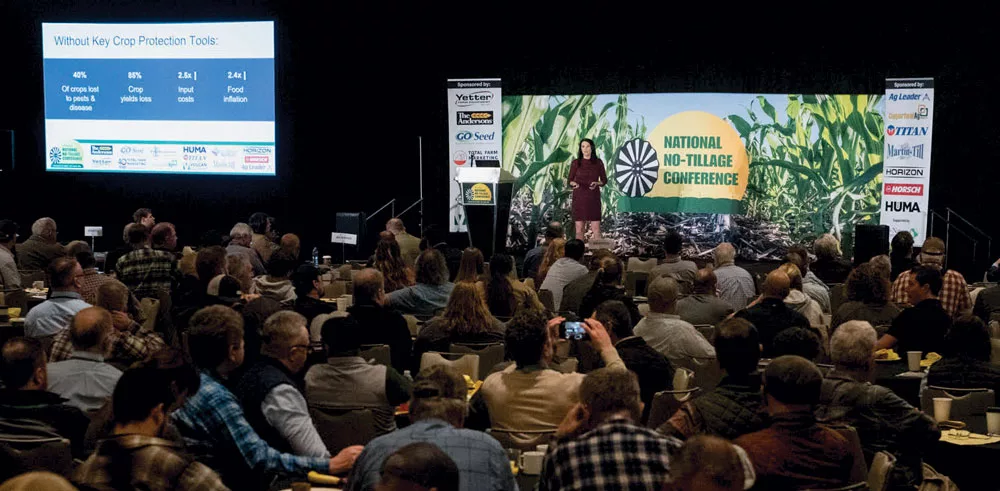
The 34th annual National No-Tillage Conference (NNTC), held January 6-9 at the Hyatt Regency St. Louis at The Arch, brought together a large and engaged audience of farmers and ag professionals from across the world for 4 days of education, idea-sharing and collaboration.
New and engaging session formats added energy to the program, including a Shark Tank–style session where presenters from agricultural companies pitched innovative ideas and solutions, as well as TED Talk–style presentations offering concise, thought-provoking perspectives on no-till practices and the future of conservation agriculture.
Here are some top takeaways from various sessions during this year’s event.
Improved Varieties
Cover crop researchers and breeders at the Univ. of Missouri’s Center for Regenerative Agriculture are working hard through the Cover Crop Variety Project to improve varieties and match seed traits to specific climates, says Rob Myers.
Researchers have found a new experimental line of hairy vetch with higher levels of biomass that is moving toward release. A lot of crimson clover is sold as “Variety Not Stated” and is not always consistent with germination depending on where it’s purchased, Myers notes.
But a couple of new varieties being developed are showing more consistency in Missouri, Indiana and the Mid-Atlantic, and a new German variety out of the Northeast is coming to the market soon.
“There are regional differences and we need to get to the point where you can say, ‘This is the right variety for my area,’” Myers said. “Look for improved varieties and don’t just rely on VNS.”
Biologicals Boost
Jeff Martin, who’s been strip-tilling and no-tilling for decades in Mt. Pulaski, Ill., shared some of the unique things he’s been doing recently with biological applications.
Martin uses compost that is locally produced and is run through an extractor, which turns the microbes, the fungi and the bacteria into a liquid form. He sprays the liquid in the fall as a digester and applies it in furrow with the planter onto corn and soybeans.
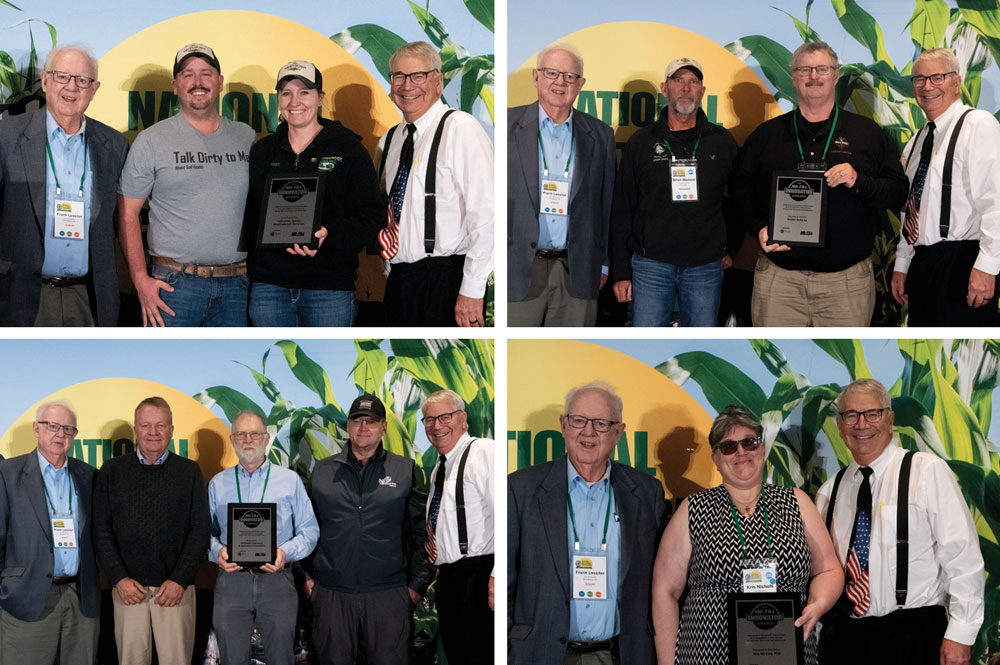
INNOVATOR WINNERS. The winners of the No-Till Innovator Awards for 2025 were (clockwise from upper left) Meadowbrook Dairy, Saddle Butte Ag, Northeast Iowa Dairy and Agriculture Foundation and Kris Nichols — all flanked by No-Till Farmer Editor Frank Lessiter and Marion Calmer, owner of Calmer Corn Heads. The award program is sponsored by Calmer Corn Heads and No-Till Farmer.
30th Class of No-Till Innovators Honored
The latest class of No-Till Innovators was honored at the 34th annual National No-Tillage Conference in January.
The No-Till Innovator Award program, sponsored by Calmer Corn Heads and No-Till Farmer, strives to honor farmers, researchers, businesses and service providers, and organizations for their contributions to the growth and success of no-till practices. We enlisted No-Till Farmer’s Advisory Board to evaluate nominees on their experience with no-till, advocacy and outreach efforts, innovations, community involvement and more.
After narrowing down the pool of nominees to a select group of finalists in each category, the judges determined the 2025 honorees are the Udermann Family, Meadowbrook Dairy (crop production); Northeast Iowa Dairy & Agriculture Foundation (research and education); Saddle Butte Ag (Business & Service) and Kris Nichols (Research & Education).
“We also put food sources in with it,” Martin says. “We use ground-up crab and oyster shells, which have nutrients in them. We also use ocean water that we buy from a company. Ocean water has every mineral known to man in it, and it’s run through a process so the salt doesn’t hurt anything. We’ve had great success with it.”
Residue Management
To Phil Needham, residue management is the difference between a good farmer and a bad farmer. The long-time consulting agronomist says spreading crop residue at least half or two-thirds of the width of the combine header is necessary or windrows will be left in the field.
“I see many new combines costing from $800,000 to $1 million-plus and people are putting 50-foot headers or wider on them, but the residue spread behind them may be only 35 feet or 40 feet at the most,” Needham told a packed classroom gallery at the conference.
“The following spring there will be obvious streaks of residue and it doesn’t matter if you use a planter, drill or air seeder. You can’t set it properly when the volume of residue changes — especially if there’s high-moisture soil beneath the residue.”
Needham recommends farmers pay special attention to adjustments to chaff spreaders for a more even distribution of residue, and matching harvest-head widths to the combine’s physical ability to produce a uniform residue pattern.
Geo-Fencing
Missouri crop and livestock producer Dan Bonacker says using satellite based virtual fencing saves him at least 6 hours per week of labor as he makes frequent paddock changes in his adaptive grazing management for his Charolais cow herd.
Virtual-fencing uses GPS tracking of receiver-collar-equipped livestock and remotely-programmed “fencelines” designed to trigger collars with audible tones and mild electric stimulation, much like the so-called invisible fence marketed to dog owners who opt out of building permanent fencing.
“A big challenge for adaptive grazers is pulling poly-wire reels across the area to contain the livestock on fresh forage. A single paddock can take up to an hour,” he says. “We’ve been using virtual fencing since October 2025 and it saves me valuable time.”
He says a phone app allows him to make changes to paddock sizes instantly and provide fresh forage to his herd with a thumb-tap.