The soil microbiome is an incredible asset to farmers. A healthy, diverse one will improve soil structure, increase water retention, help fend off pathogens and parasites, and buffer against abiotic stress. It also aids in nutrient uptake and cycling, which can have a significant impact on a farmer’s operation, given that generally less than half of fertilizer applied makes it into the crop.
David Stark, molecular biologist and president of agriculture at Holganix, says the nutrient use efficiency of nitrogen (N) ranges from 40-65%, phosphorus (P) 15-25% and potassium (K) 30-50%.
“The USDA in 2021 said 36% of the operating cost of growing a corn crop is fertilizer,” Stark says. “And to think that over half of our money is going to waste. How do we make these things more efficient?”
One way many farmers are trying to do that is with biologicals. Stark reviewed some of the options farmers have in using these products to get more nutrients into their crops, from tapping into what’s available in the atmosphere and the soil, to capturing and recycling applied fertilizer.
Creating Nitrogen
One option farmers have is applying biologicals that contain certain bacteria capable of converting N in the atmosphere into ammonia. While that may sound like an easy process, gaseous N is made of two N atoms that are triple bonded, while most chemical bonds — like ammonia — contain a single N atom bonded with three hydrogen atoms. It takes a lot of energy to break that N molecule apart into two atoms.
“Lightning can do it,” Stark says. “So, a thunderstorm is good, you get a little free ammonia and nitrate.”
“There’s more science that says roots are far more important than the stuff we leave on top of the ground for building soil structure and organic matter…”
The process used to create synthetic N fertilizer from N gas is to heat it up 700-900 degrees F under 150-250 atmospheres of pressure. While there are species of bacteria that can break the bonds, Stark is concerned they still face the challenge of not having enough energy to do it.
“I hope these products work — I think they’re clever,” he says. “But the energy requirement is a massive hurdle.”
Unlocking Fertility
Another option is to use biologicals to create a more biologically active soil, which will help protect the fertilizer strip-tillers are applying.
A summary of 230 peer-reviewed scientific studies that looked at N use efficiency in corn, rice and small grains, found that when a soil is biologically inactive, some of the N goes into the crop but the rest is wasted.
“If we have a biologically active soil, they found that most of the crop’s N needs pass through a microbe first,” Stark says. “It’s a good thing because microbes eat the fertilizer. They live within half an inch of a living root. They immobilize it so we have a lot less loss. As long as we have active biology, we can cycle it back. Bottom line, you get more bang for your buck.”
Finding a Balance
A question David Stark is often asked about biologicals is: Do I need to do this every year?
His answer: Probably.
The molecular biologist says that too often there are factors impacting the soil microbiome that farmers have no control over, like flooding and freezing.
“With flooding, after 48 hours, oxygen levels drop. Protozoa, amoeba, fungi, nematodes, all absolutely have to have oxygen,” he says. “So, we lose the predators of the bacteria. Some bacteria can grow. Freezing will also kill a lot of the microbes, but not evenly. So we lose balance.”
To make things even more complicated, Stark says scientists are finding that 6-10% of microbes are not only specific to different species of plants, like corn vs. soybeans, but they can also be specific to certain hybrids. One corn hybrid may attract and repel 6-10% of different microbes over another corn hybrid.
“There may be a day where you buy genetics and they will give you the host of microbes that work best with those,” Stark says. “That could be credible. It’s not credible today. Every soil scientist I speak with says just go with diversity.”
Stark explains that in a healthy situation, plants will secrete food for the microbes. But if there’s too much fertilizer in the soil, particularly N and P, then it’s just biochemical feedback.
“The plant senses it has excess nutrients. It won’t waste energy attracting and feeding microbes,” Stark says.
The same applies to P and K. In fact, there’s often P and K in topsoil that is inaccessible to plants because they’re bound to the soil. But microbes can unlock those nutrients and make them plant-available.
While there are biological products that can unlock bound P and K, Stark warns against the idea that growers can skip a P and K application because the microbes will unlock all they need.
“That may be true,” he says. “But what I haven’t seen is how quickly they unlock it. When you plant a seed, you need P right away to help with germination and establishment. So, can the microbes unlock it fast enough? I don’t know.”
Instead, he advises farmers to use microbes as a tool to steadily back off on fertilizer closer to removal rates and find their operation’s “sweet spot,” rather than eliminate P and K altogether.
More Robust Roots
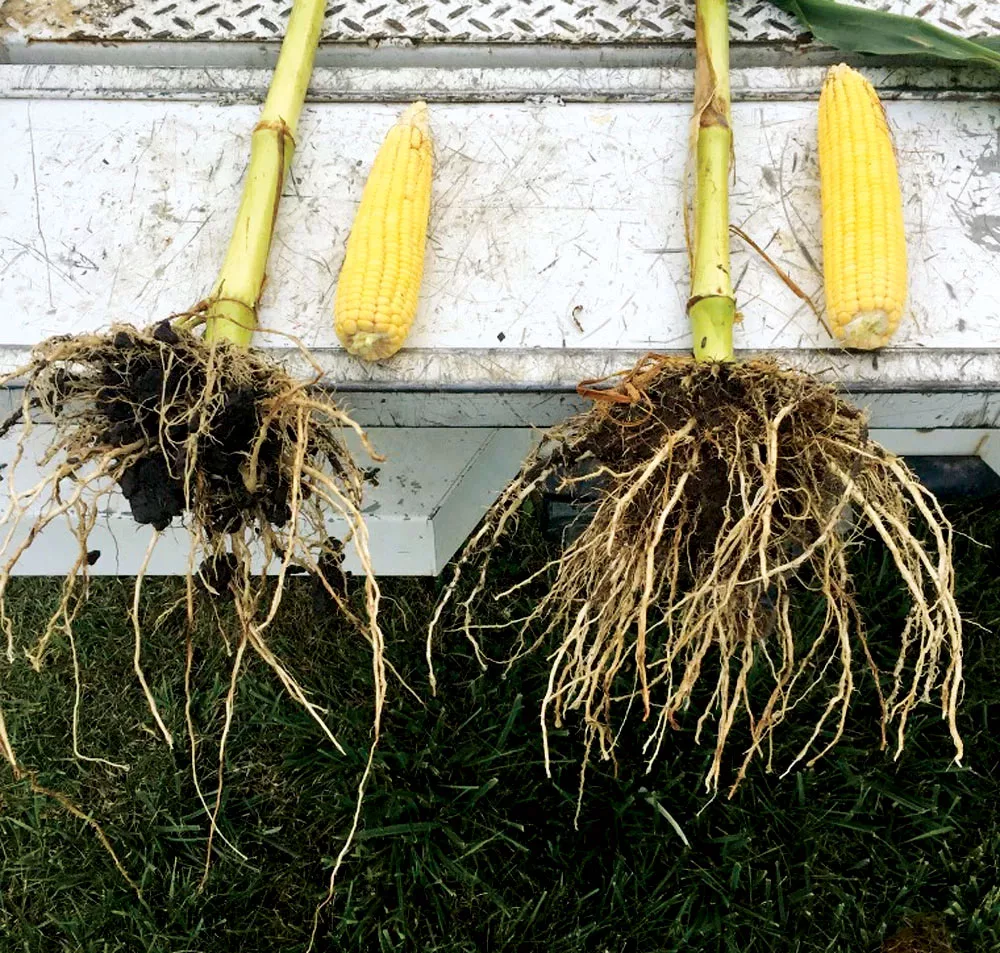
Strip-tillers can also use biologicals to improve root growth.
“Having more roots matter because the roots only explore about 1% of available soil,” Stark says. “The more roots you have, the more root hairs you have, the more soil that’s explored, the better the nutrient use efficiency.”
He adds that some microbes secrete hormones to induce rooting. Some go into the root tip and travel up to the bud of the root hair, where they’ll secrete another hormone and induce root hair formation. They shed a lot of nutrients when they do that, which the plant can then access.
“The plant senses it has excess nutrients. It won’t waste energy attracting and feeding microbes…”
In addition to the nutrient benefits, roots are also key in creating channels for air and water, and according to Stark, “everything you want living in your soil needs oxygen.” Then when the roots die, they become stable organic matter.
“There’s more science that says roots are far more important than the stuff we leave on top of the ground for building soil structure and soil organic matter,” Stark says. “If all you get are roots from a product, that’s not a bad thing.”
Breaking Down Residue
Finally, strip-tillers can also consider using biologicals to release nutrients from crop residue. Stark says that every 40 bushels of corn results in 1 ton of residue. Every ton of corn residue contains 17 pounds of N, 4 pounds of P and 34 pounds of K.
“This is all the money that you’ve spent on nutrients that’s on the ground,” he says. “Not an atom will ever be available if a microbe doesn’t break it down. We have to have microbial activity.”
But it takes more than microbes to break down residue. If the ground is frozen and is going to stay frozen, “don’t waste your money,” Stark says. Same if the ground is bone dry. The two things the microbes need to break residue down is the right temperature and moisture. For those reasons, Stark recommends applying a residue breakdown product as close to harvest as possible.
Farmers also need to be mindful of their residue’s carbon-to-N (C:N) ratio, especially if they have bacteria-dominant soils or are using products that only contain bacteria. For every N atom in bacteria, there are 5 carbon atoms.
“Bacteria, actinomycetes, are nitrogen hogs,” he says. “They tie it up. They’ll grab it, but they won’t let go of it.”
Since corn has a C:N ratio of around 55:1, a bacteria-dominant soil, or a product that only contains bacteria, is going to steal N from the soil to break down the residue.
Fungi, on the other hand, have a C:N ratio of 15:1. Stark says that fungi that are not unicellular like yeast but make long hyphae and mycelia, are the best degraders of organic matter, especially woody organic matter like corn stalks and wheat straw. Fungi are also great at unlocking P.
“They get between soil particles where even tiny root hairs can’t,” Stark says. “They really do a good job finding water and nutrients for the plant.”
When choosing a residue breakdown product, make sure it’s not just bacteria.
“They may be selling you a hammer when you need a screwdriver and a saw,” Stark says. “It’s the wrong tool.”