By Jake Isley, as interviewed by Martha Mintz
Everyone’s farm is a big puzzle. All farmers have access to mostly the same 20,000 or so pieces. The challenge is we each only have about a 300-piece puzzle, and we’re each responsible for picking the pieces that fit together to make our specific system work. There’s no one perfect picture that works for everyone.
My family and I are constantly working on our puzzle, and we’ll never be done. I farm in partnership with my parents, Jim and Laurie Isley in Palmyra, Mich. We firmly believe you should never be so married to a particular farm management puzzle piece that you can’t trade it out for a new one as the need arises.
This was the case when we made the transition from conventional tillage to strip-till and no-till in 2013. Our picture needed to change and so did a major piece in our puzzle — a corner piece, if you will.
Check The Specs...
NAME: Jake Isley
LOCATION: Palmyra, Michigan
ACRES: 1,100
YEARS STRIP-TILLING: 12
CROPS: Corn and soybeans
PRIMARY SOIL TYPE: Sandy loam
ANNUAL PRECIPITATION: 30-38 inches
The growing season of 2012 was a dry one. When working the ground in the fall, it was just nothing. No structure, no soil organic matter, it was just dirt because we were treating it like dirt. We realized we needed to start seeing it as soil and managing it as such.
When we started thinking in terms of “soil” we understood there are systems in place that have a bigger part than we thought in how a plant performs.
We had to start looking at the soil as not just a media to grow crops in, but as something that is as alive as the crop it supports. To harvest better crops, we needed to manage the soil system.
The Water Piece
Water conservation initially pushed our big tillage change. With most of our soils being sandy loam with a bed of gravel underneath, it’s not a question of if it’s going to turn dry, but when. At some point we’re almost guaranteed to go through a water-limiting event that will stress the plant.
After seeing the impact of drought in 2012 and the lifeless condition of our soil after that, it was time to act.
I was exposed to a variety of conservation strategies while earning my degree in crop and soil sciences at Michigan State Univ. I knew there were ways we could improve how we farm from a conservation standpoint, and how those methods could improve our water situation. A neighbor was also strip-tilling, so we had local proof of concept to observe for potential changes to our system.
The initial goal was to capture and retain more plant-available water. To do this we needed to increase soil structure to improve infiltration and build soil organic matter to hold water in the soil.
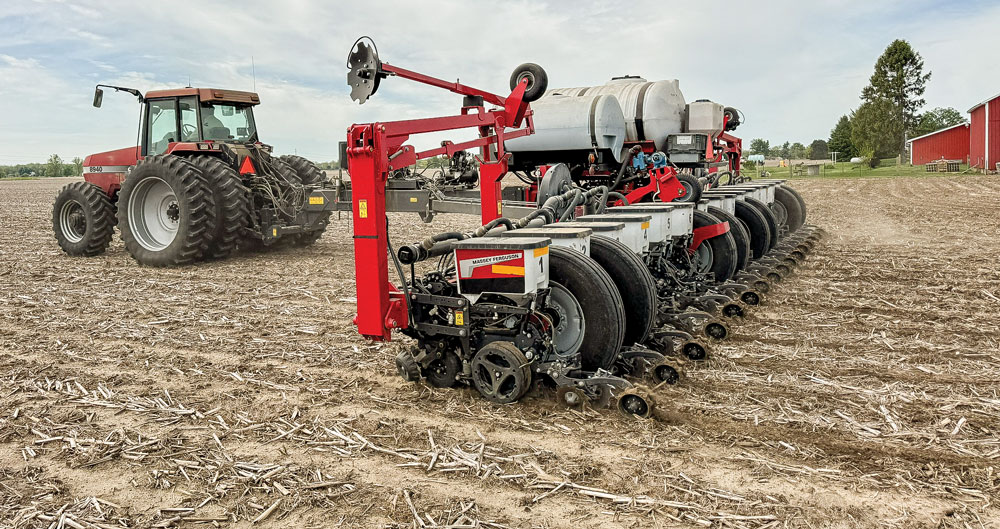
THINKING AHEAD. With strip-till, the path laid out in the fall directs how the planter traverses the field in the spring. Isley realizes that while strip-tilling eliminates multiple field passes, it must be done by a skilled operator who understands how to lay out a field for successful planting. Jake Isley
Reducing tillage not only would protect soil structure and allow it to continue to develop but leave more residue to protect the soil from rainfall events. We want raindrops to hit a leaf first before transitioning to the soil. Slowing the water down prevents it from breaking up surface soil structure and creating crusting that in turn reduces water infiltration.
Protecting the soil and capturing more water has become increasingly important as we’ve seen our weather patterns change in recent decades. Lately we’re just as likely to catch 2 inches of rain in 2 hours as we are to receive a half inch of rain, nice and slow over 24 hours.
We’re getting roughly the same amount of rain, but it’s coming less frequently and in more intense rainfall events. If our soils aren’t ready to capture rain during those heavy storms, we’re going to be more vulnerable to experiencing water stress sooner.
The Strip-Till Piece
Strip-till made a lot of sense to me. It not only reduced tillage but creates a flowerpot where all the phosphorus (P) and potassium (K) needed to grow the crop could be deposited and held right where it needed to be.
If I’m going to an all-you-can eat buffet, I want to sit right next to the buffet. It’s the same for our crops. If I can give them easy access to the buffet, they’re going to make much better use of it.
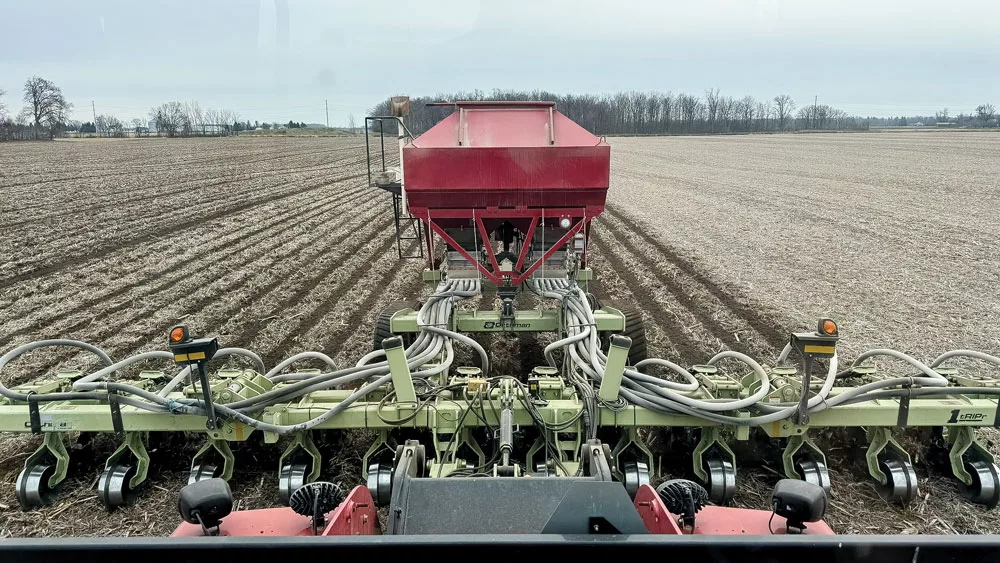
We purchased a 12-row Orthman 1tRIPr strip-till unit with a Valmar system and two boxes for dry fertilizer in 2013. We also had to get our technology up to speed, adding things like auto steer, a base station to facilitate RTK, and monitors to allow us to use the strip-till system.
With these changes there were immediate and long-term benefits. The technology opened possibilities that continue to ripple through our farming system.
“The long-term data revealed one year of high disease pressure made the investment in fungicide well worthwhile…”
The first benefit was combining what used to be three field passes into one operation. Prior to strip-till we ran a chisel plow in the fall, spread fertilizer, then ran some sort of finishing tillage tool in the spring. With strip-till, we combined all three of those tasks into one pass that happens in the fall. We gained tremendous efficiencies.
On the flip side, that fall pass became more complicated. Strip-till takes a higher level of operator skill than a chisel plow. Ideally the person running the strip-till unit is either experienced in planting or is the same person that will be planting corn in the spring. That person is putting strips where the corn planter needs to run.
They will make choices like: “Do I turn around and round this corner out or back in and square it up?” You’ve got to think ahead about how the crop will be planted and how it will be harvested. That said, when it’s done correctly, planting operations go a lot faster in spring.
The Timing Piece
Fall is our ideal timing for strip-till. Our logic is that we want to be in the fields planting as soon as possible in the spring. If conditions are fit to strip-till in the spring, usually they’re also fit for planting. We prefer to be planting.
We also like that it gives the dry P and K some time to interact with soil biology, get into soil solution and be more available for the crop. We do occasionally have to do some spring strip-tilling when weather keeps us from getting in the field in fall.
Strip-till in the fall has helped speed up planting. We had a very wet spring in 2019. If we had to work the ground ahead of planting I don’t think we would’ve gotten a crop planted at all. It gives us some extra planting days, especially when considering that we drive on unworked soil that’s more stable and therefore able to support equipment sooner than worked soil.
We seed corn with a 16-row White 9816 VE planter. It’s set up with Precision Planting’s DeltaForce, vSet, vDrive and FurrowForce. It has FlowSense to confirm consistent application of liquid fertilizer that’s applied with a Conceal system.
What’s interesting is that in a strip-till setting, the down pressure and closing systems tend to be picking up the row units more than applying down pressure. No matter the conditions, we’re getting excellent seed placement with this system.
To further give those seeds a good start, we apply a liquid insecticide in-furrow with our P starter to mitigate the risk from early season chewing pests. The Conceal applies sulfur and 28% nitrogen (N) in a 2-by-2-by-2 system, and the balance of N and sulfur is sidedressed at V3 or V4.
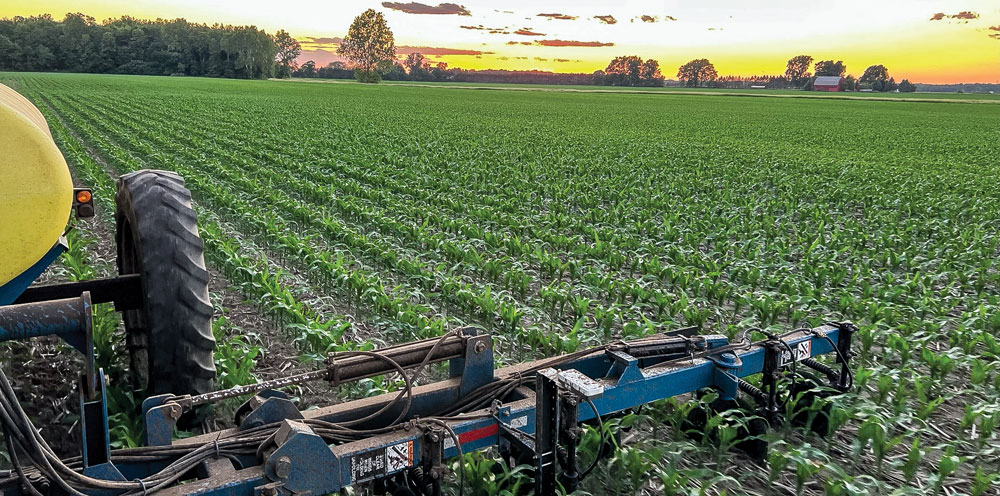
SIDEDRESSING STRATEGICALLY. Isley’s planter puts down 45 units of N in a 2-by-2-by-2 configuration. The balance of N and some sulfur is sideressed at V2-V4. Isley prefers to sidedress a bit early so he can get it done ahead of his post-emerge herbicide pass. Once the in-season herbicide pass has been made, he doesn’t want to disturb the soil. Jake Isley
After more than a decade of strip-till, we see a difference in how our soil system functions. Our crops and soils seem to be more resilient. We get better water infiltration, and it’s kept water more plant available to hold off drought stress in the crop.
Soil structure has been a big help, but the residue also serves its purpose. Bare soil gets hot. Where we’re able to leave residue between the strips our soils stay cooler and we keep more water. Residue is further preserved by no-tilling our soybeans.
Prior to strip-till and no-till we saw a fair amount of wind erosion and some water erosion on our sandy soils. These practices have developed soil structure and pretty much completely mitigated wind erosion. The crop stubble not only holds our soil but catches snow and soil coming from wind erosion from other farms.
We were using annual ryegrass cover crops for a while. It helped significantly with developing soil structure and protecting the soil. Unfortunately, we’re not set up to seed the cover crop ourselves. The cost of aerial application meant we had to set our cover crop program aside when margins got too tight. We hope to bring it back in the future. Still, we’re making progress.
With strip-till and no-till, ground that historically was very prone to drought stress seems to be doing a lot better now. Our crops don’t roll up as quickly and they don’t miss a beat. They’re healthier and more productive. We’ve seen yields continue to go up every year and continue to be amazed at what your soil can do when it’s managed well.
The Nutrient Piece
Strip-till not only allowed us to position nutrients where they’re needed but allowed us to refine our variable rate applications.
Prior to strip-till, we were doing some variable rate applications, but they were broadcast. We went from controlling a custom applied 60- to 80-foot pass to being able to control a 30-foot pass with our strip-till rig and banding those nutrients right where needed. I believe we’re getting better efficiency and improving accessibility to our nutrients.
We started gathering yield data 2 years prior to starting strip-till. There were always parts of the farm we knew were poorer or performed better than others, but the yield data made it very visual. To be able to see the map and see it spatially, we were able to start understanding how nutrients were being used. We could investigate what was impacting water availability and what made performance better in certain areas.
With this information, we went from managing at the whole farm level to the individual field level then down to the sub-field level. The sandy knob with poor moisture retention needs to be managed differently than the swale where too much moisture collects.
Initially we started with zone management. Soil samples were taken by the zone, but soon we wanted to get more precise. Using the data we had, we started sampling much smaller zones, almost like grid sampling, but by zone. We didn’t just go out in the middle of a grid. We wanted to look at specific areas to see how and why they were performing differently.
We don’t have individual row control, but we can vary rates across our 30-foot strip-till bar controlled by our Ag Leader monitor.
The Data Piece
With technology came the ability to accurately record and analyze data. To push our system, we must evaluate it and test new options. Hybrids are a constantly evolving piece for us. Each of our fields are planted to multiple corn hybrids every year.
Split planting is simple in my book. I have a 16-row planter, an 8-row corn head, and the guidance and monitors needed to capture the side-by-side data — I just must be very careful that I enter each hybrid correctly at planting.
On one side of the planter, I’ll always use the hybrid that’s performed best in the past. On the other side I test the latest hybrids and different maturity groups. Maybe only one or two of my planter fills this spring didn’t have two hybrids going in. I test around six new hybrids each year.
Hybrids are advancing faster than ever. If there’s a better hybrid for my farm, I want to find it as soon as possible and switch it into the high-volume slot. Then I’ll keep comparing until I find the next replacement. I want to find the next best hybrid as soon as possible to keep driving yields.
Using this system, I’m always about 50% in the unknown. With the pollination windows I haven’t had any issues comparing different maturities in the same field. Some of the hybrids won’t perform as well, but at least in this system I figured it out in 8 to 16 bags of seed instead of 100 acres. It allows me to look at things on a smaller scale and see if it fits the operation so I can scale it up faster or eliminate it faster.
“After more than a decade of strip-till, we see a difference in how our soil system functions…”
Data is gathered through my Ag Leader monitor. I then use SMS Software and FieldView to analyze the data on hybrids and other management strategies.
Crop inputs are also evaluated. The technology and the data it provided proved very helpful when we were going back and forth on the benefits of fungicide applications. Over the course of multiple years we’ve been able to leave untreated swaths and evaluate our fungicide applications. Repeating the test was critical to our understanding of the complete picture.
There were years we only broke even on a fungicide application at best. However, the long-term data revealed that one year of high disease pressure made the investment well worthwhile. We now apply a multiple mode-of-action fungicide to all our corn acres, mostly to protect against tar spot.
We apply at brown silk through true R1. This is a little on the late side. I don’t want to spray too early because I believe fungicides keep the plant healthier and greener longer, helping extend grain fill. We do scout regularly, though, and we will apply the fungicide earlier if there’s pressure.
Another interesting finding from our data was the value of sulfur in our crops, including soybeans. We had identified sulfur as a nutrient that helped unlock our corn’s ability to take up other nutrients. Sulfur is now added at multiple points in our production system. It’s applied at corn planting, is part of the sidedress application, and when we broadcast AMS ahead of soybeans.
To speed up our strip-till operation, we don’t apply all our K in that one strip-till pass. Instead, we broadcast the balance of what our soils need ahead of soybeans. Adding sulfur to that application resulted in a more than 7-bushel yield boost in soybeans in some cases. Without the data, we wouldn’t have attributed those gains to sulfur.
This is what makes farming exciting for me. I get to constantly assess the puzzle and swap out pieces to make a picture that keeps getting better and better. Each field is its own puzzle, too. I just have to find the right pieces to make that puzzle work.