The Feed in Focus program, a sustainability initiative launched 5 years ago by The Nature Conservancy (TNC) and the Innovation Center for U.S. Dairy, helps farmers adopt conservation practices to support environmental goals and economic viability. Participating farmers receive technical guidance and financial incentives for implementing various conservation practices.
The program, which offers a flexible menu of conservation practices that are customizable to specific needs and circumstances, has engaged 43 farmers in Idaho, Michigan, Ohio and Wisconsin, covering 50,000 acres and 43,000 cows so far.
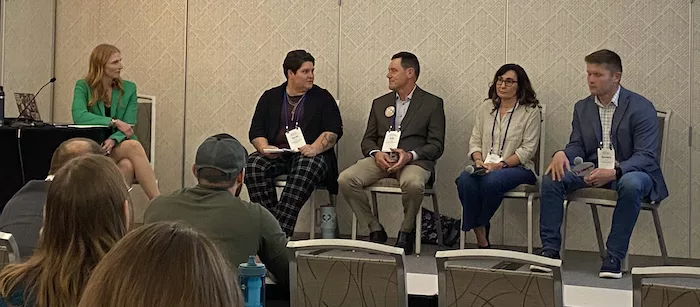
At the 2026 Dairy Sustainability Alliance Spring Meeting April 29 in Oak Brook, Ill., a panel of farmers and managers shared their top takeaways from participating in the program, including what worked and what didn’t over the last 5 years.
The panel featured St. John’s, Mich., dairy farmer Kris Wardin and Creston, Ohio dairy farmer Zachary Steiner. Other panelists included Sarah Michalek, farm sustainability manager for Michigan Milk Producers Association (MMPA) and Alisha Staggs, dairy program director for TNC.
Here are some highlights from the conversation.
Is cost the biggest barrier to adoption of any field practice?
Wardin: Yes. I put an asterisk on it though because weather is probably the biggest trump card, but we don’t control that either. I believe cover crops work because they’ve been used by a lot of people over the years, but if you’ve never planted them, it’s scary to spend extra money for something that doesn’t necessarily give you an immediate return. That’s where the cost-share element of Feed in Focus and other programs really pays off. It takes years to really prove to yourself that some of these practices work on your farm.
Steiner: We’re all at different places in our journey as farmers and one of the biggest barriers I had to overcome with my family was, “We’ve always done it this way, and it’s worked.” That’s a hurdle we always try to push through. There’s risk involved (with adopting new practices), but with Feed in Focus sharing some of that cost, some of that risk can be offset.
What practices did you implement through the program and what kind of technical assistance did you receive?
Wardin: Honestly, I don’t think I could rattle them all off because we tried to do as many as we could each year. Some of the bigger projects — we invested in underground manure piping both for water quality as well as efficiency of fertilizer and time. We also did some irrigation upgrades.
We pivoted on some things, but I don’t think we’ve had any total absolute failures. We managed to get some benefit out of most practices we tried.
As far as determining what worked, some of it was easy. It was like, “Yes, it worked, or no, it didn’t.” Cover crops are the hardest ones. I think there’s tremendous benefit, but they’re harder to measure and it takes years for that (the benefits) to accumulate. There has to be something to not only incentivize farmers to keep doing it, even if some years don’t look as good as others, but it’s not the easiest data to collect either. That’s where the technical assistance comes in. That was huge when it came to things that aren’t as easy to measure or see from a farmer’s point of view.
Steiner: We’ve only been in the program one year. We grow about 800 acres of corn. We used to apply liquid 28% to all 800 acres. Through this program, we were able to invest in some technology that allows us to variable rate apply nitrogen. And then we pair that with soil tests and yield maps so we can start to apply fertilizer only in areas that need it, which is more profitable to us. There are some areas where it’s not even worth it to apply fertilizer. Using this technology just gives us another tool to be more efficient.
We farm along several ditches and creeks, so another project we’re going to do this year is replanting buffer zones.
Now that you’ve done the program for 3 years, how has your perspective on conservation practices changed?
Wardin: It’s allowed us to get financial help to prove what might work or what doesn’t work. Several of the practices we’ve tried will be long lasting, but we were able to try them with less financial risk. That’s the number one overall benefit of the program, along with the depth of practices and the flexibility to maybe change mid-year. We went into certain years thinking, “This is what we’re going to do, and circumstances happen and we couldn’t do this, but how about we do this instead?” That happened almost every year we’ve been in the program.
Is the Feed in Focus program running exactly as you thought it would 5 years ago?
Staggs: The name of the game is flexibility, right? And being willing to pivot and not let perfect be the enemy of good. We were building the plane as we were flying it, as many people like to say. There were major modifications the first couple years. We’d take off, then we’d stop recruitment after the season and have a laundry list of things that could’ve been better. We’d take the summer to make those revisions before opening enrollment up again. Then last summer, we noticed our list of revisions was short. I think we’ve built something now that is a pretty well-oiled machine.
Has farmer interest been consistently high since the start of the program?
Michalek: We tried to eliminate a lot of the barriers for adoption (extensive paperwork, for example). And having the menu option of practices, it allowed farmers to do multiple things. It wasn’t like a one-hit wonder. They got to sign up for a variety of practices they wanted to try, and they could stack it year over year.
We didn’t have issues with recruitment for the program and really what helped us over time was word of mouth from farmers who signed up the first year. Then suddenly, their neighbor was signing up the following year.
Staggs: We have 5 years’ worth of data now; we can see how that growth has happened for farms over time. Typically, in the first year they are just testing the waters with us, right? “Are you guys for real? Is the check going to come?” All that. So, they might start out with 100 acres of cover crops or something they feel comfortable with and then after 2-3 years in the program, what we're seeing is, “OK, let's try more.” They’re stacking all these practices.
Was having supply chain involvement from companies like Nestle and Domino’s a key reason why you got involved in the program?
Steiner: I’m 27 and I’ve only been farming full time for 4 years. So, it’s neat to see the consumers drive what happens on the farm and what happens day to day. It’s neat to see the process every step of the way, from when the product leaves the farm to when it ends up on the shelf. We want sustainable practices to catch on because people my age or even my kids someday are going to be working in this environment. It’s just neat to see how everybody’s playing a part in the whole process.
Michalek: The partners in the supply chain have been great to work with and they’ve given us the freedom to do what’s necessary to adapt the program to the farmers who are participating. But it’s a hard sell at first because it’s kind of a first come, first serve program. The farmers who call us first, we talk through what they want to do. I have no idea when we’re trying to sell this program what those farmers want to do. So, I can’t guarantee a customer some sort of carbon reduction, which is what a lot of them are looking for, because I don’t know which farmers are going to participate, what practices they want to do, what scale of adoption they want, how large their farm is. Those are all things I can’t answer right away.
What are some of the deliverables to the partners like Sam’s Club and Domino’s? How much access do they have to the farmers’ data and information?
Staggs: All the data is secure and anonymized. We provide them with high level aggregated numbers, including number of acres, number of cows, number of farms, total GHGs reduced. We do have to show the companies a return on their investment, right? Most of them have been very happy with getting these high-level results that we’ve been sharing.
What’s your 10-year goal for the program?
Staggs: We’ve been in 4 states so far — Idaho, Michigan, Ohio and Wisconsin. There’s a lot of opportunity for growth. We need more people to step up. We need more partners. I can’t say enough about the difference that MMPA has made. We need more co-ops to step up and be willing do the work and we need more corporate partners to pay for it.
I need to find ways for us to work smarter, not harder. We need to train the trainers. We need to activate local organizations outside of TNC that can help us. We want to scale and we can’t do all this work ourselves. We’re a fairly small team, so these are all things I’m thinking about for the long-term.
If you were talking to a peer who’s interested in getting involved in a program like this, what would be your advice?
Steiner: There’s opportunity out there. We’re constantly trying to evolve our businesses but also keep doing what has gotten our business to this point. Any idea you hear that you think is a crazy one, I’d encourage you to not cast it aside that quickly. We’ve pushed into some of those ideas and they’ve led us to some good places.
Wardin: We’ve been talking about this for a long time now, but there are still farmers, believe it or not, who aren’t big fans of terms like sustainability and regenerative ag. Feed in Focus has made this more of an efficiency conversation for farmers. You don’t have to love where we’re at with sustainability as an industry or what people are asking of us, but we can all win if you become more efficient and this is a great tool to help do it.
Michalek: From the co-op’s perspective, do your best not to limit the scope. The biggest challenge I run into right now is making sure that I’m not limiting the menu option of practices to a specific milkshed because that’s something that a farmer can’t control. We as a co-op are controlling that, and so I don’t want that to be a limiting factor for who can participate in what programs.
The other thing, too, is just making sure the partners you have, you trust really well and they’re willing to adapt the program over time because we’ve found a lot of success in being able to pivot on some of these things that we’re looking at to make it a successful program.