As the summer growing season unfolds, cases of tar spot in corn have been confirmed in multiple states across the Corn Belt. Growers should be scouting and preparing to make important decisions about whether to treat fields, experts say.
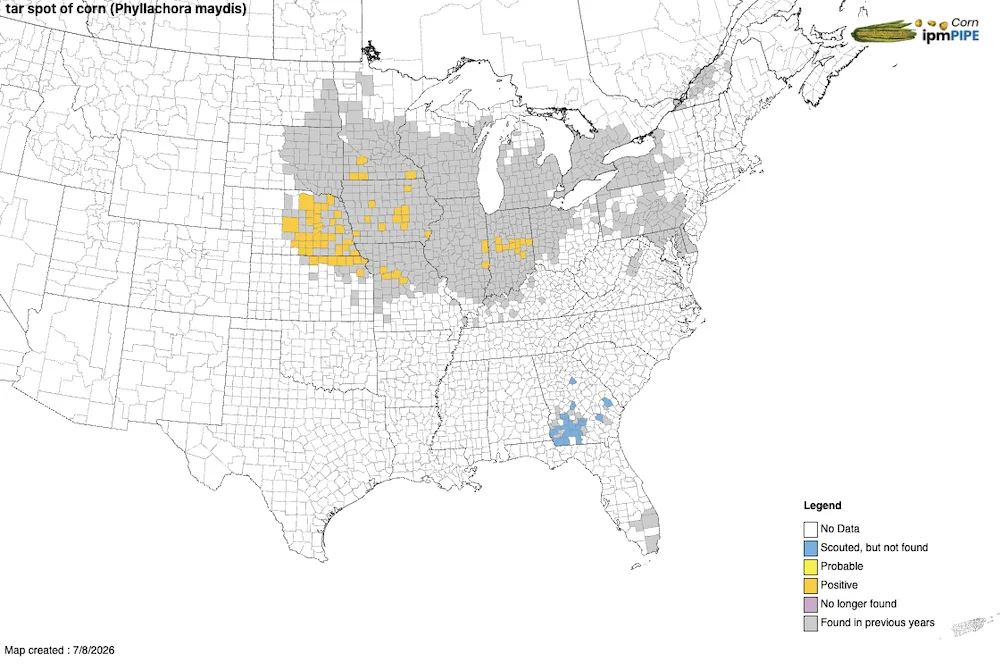
The tar spot monitoring map, IPM PIPE, has up-to-date information on where tar spot infections have been confirmed. As of Wednesday, the western Corn Belt is the focal point for the disease, especially eastern Nebraska.
Kim Tutor, technical marketing manager for BASF, says she is always going to recommend growers scout their corn crop early and often for this disease, but hold off on spraying until the right time rather than panicking. Spraying early could also commit growers to multiple applications, which is more costly.
“If you opt to spray really early in the vegetative stages there are a lot of leaves left in the whorl that haven’t come out yet that are not going to be protected,” says Tutor. “All of our data has shown the most important time to spray is when the plant is transitioning from the vegetative to reproductive phase because we really want to protect those upper leaves that ultimately drive ear development and grain fill period.
“So we want to protect the plant in that VT-R1 timeframe. I would say scout early, scout often, and we would much rather folks be proactive instead of reactive.”
Spray at the Right Time
If growers discover the disease is present, a fungicide application when the disease is active will likely necessary, and there are a bevy of crop protection options to choose from.
Tutor says BASF’s Veltyma fungicide has been highly rated as a treatment option for tar spot and other corn diseases.
With Veltyma, Tutor says there are three levels of recommendations on treatment, depending on how the disease is progressing, “because we must think about disease incidence as well as disease severity.
"I would encourage folks to hang on and not pull the trigger too early. Let’s see how this disease ramps up. If it starts to ramp up, then we need to start considering a fungicide application."
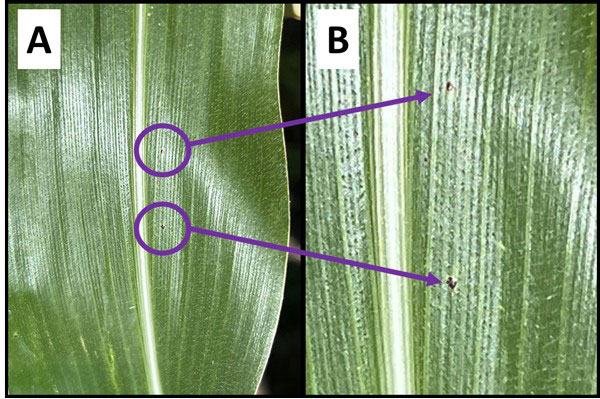
Figure 1. Example of tar spot of corn (A) and a close-up on the tar spot lesions (B). Photo courtesy of Rodrigo Onofre, K-State Extension
The first level of recommendation for BASF with Veltyma is 7 ounces an acre at Vt to R1 timing. If the environment is favorable for disease, or fields have a history of disease or it’s a corn-on-corn rotation, growers can go up to 10 ounces on the rate. That will provide some residual control and could be enough to protect plants through the rest of the season.
A 2-pass program may be needed if tar spot appears early and environmental conditions — moisture and leaf wetness — are conducive and expected to persist over time. The first application of Veltyma at 7 ounces may come at first tassel and a second pass, at the same application rate, would happen at R2 or R3.
Those are just guidelines, Tutor notes, and growers may want to reach out to their local representatives to discuss specifics in their local area.
Tar Spot Boosts it Reach
Tar spot in corn was first reported in 2015 in central Indiana, and the geographical reach of the disease has spread over that time. Disease severity can vary from year to year, depending on conditions.
For no-tillers and strip-tillers who leave more residue in their fields at harvest, it is possible for tar spot pathogens to overwinter in corn residue — but that’s not the only way the disease can spread, says Tutor. Field history and the behavior of the disease are important factors as well.
With this type of fungal pathogen, its spores will burst and release into the air, so plants can be infected from the bottom up or top down if tar spot spores are carried over in the wind.
“So even if you haven’t had a history of tar spot on your farm or on your operation, if you're hearing from your neighbors or you are seeing or hearing of other reports in your county, be aware because it can spread,” Tutor advises.
One of the challenges to controlling the disease is its long latency period of 14-20 days from infection to the point tar spot’s lesions are visible to the naked eye. That means the disease could be robbing the plant of water and nutrients and reducing its photosynthetic ability before scouting can detect it.
Tutor says she would not abandon no-till or strip-till due to tar spot concerns, because from a wholistic point of view, retaining soil moisture, reducing erosion and improving soil health is important, too.
“I would say that your crop rotation, environmental conditions, and the fact tar spot can spread from over wintering and infect from the bottom up or it can blow in from neighboring fields, adds complexity to the situation,” she says.