Strip-Till Hall of Famer Bill Preller of Congerville, Ill. believes that strip-till is the only soil management practice that optimizes agronomics, environmental concerns and economics in most soil types.
Preller cites a trial he collaborated on with a farmer to demonstrate strip-till advantages. In side-by-side plots, the farmer did vertical tillage in the spring in one test plot and strip-till in the fall in the other plot.
“The single biggest yield difference that I have seen this year was a side-by-side trial where there was a 50-bushel minimum difference between his vertical-till and strip-till,” Preller says. “Why? Because he literally has concrete. You're packing the daylights out of your soil 2 inches deep with a vertical tillage machine. There's a concrete layer out there. He has almost no roots below 2 inches deep.”
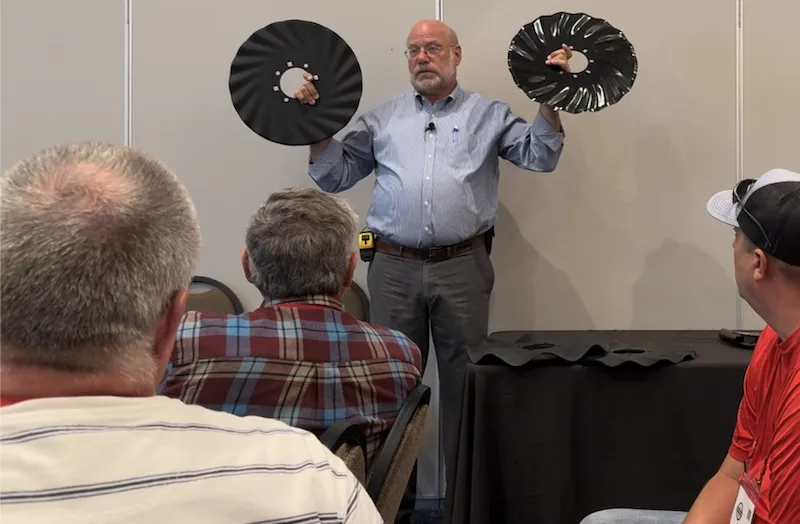
The AGuru Machinery founder and longtime independent crop consultant also believes that coulters, knives and shanks each fill different needs on strip-till bars.
Coulter Advantages
Coulters provide several advantages over knives and shanks, but each row unit has its pros and cons depending on the scenario, according to Preller. He says coulters are preferred in rocky soils because they do not pull rocks up to the surface. At shallower depths, coulters provide more fracture, especially with a 3 or 5 coulter system. Power efficiency is higher with coulters at depths up to 4 inches compared to knives or shanks; depending on the depth, coulters may only require 10-25 horsepower per row. Strip-till bars with coulters can generally run at 5-10 mph – comparatively faster than knives or shanks, Preller says.
Soil conditions also dictate which kind of coulter should be used, he adds. Straight style coulters need softer soil conditions and don’t go into the ground well when it’s dry, Preller says.
Coulter Limitations
Coulter power efficiency decreases beyond 4 inches, Preller explains. “The deeper we drive a blade, straight, curved, any of those, the less power efficient it becomes. If I'm pulling coulters at 3 inches deep, I have an extremely power-efficient system. If I'm trying to pull coulters 9 inches deep, I have an extremely power-inefficient system.”
Between turbo and vortex blades, Preller personally believes they perform similarly.
While coulters can run better in wet conditions than knives or shanks can, if the soil is too wet, they will also create clods, a poor seedbed and sidewall compaction.
Preller notes that if farmers are using strip-till as a method to mix nutrients into the soil, the nutrients are only incorporated in ⅓ to ½ the depth the coulter is set.
“If you're running a coulter unit 6 inches deep, you're putting all your fertilizer in the top 3,” Preller says. “It's probably better than the surface, but it's no better than your vertical-till, and it's no better than your field cultivator.”
Knife Advantages
Knives can fracture the soil deeper than coulters can, excelling in the 5-8 inch depth, and are excellent for applying dry, liquid and gas fertilizers, Preller says. Knives are also more power efficient at depths below 4 inches.
Preller says that achieving true fracture doesn’t take more power since the knife leaves a hole and then squeezes through. If conditions are fit, knives can be run in the spring. They can be used in lighter soils without many limitations. Preller recommends knives be run at 5-7-plus mph.
Knife Limitations
The mole and gopher knives commonly used on strip-till bars got their names from the corresponding mole- and gopher-sized holes they leave in the ground while fracturing the soil. This characteristic carried over from when they were designed for fertilizer applications, Preller says. Knives are great for fracturing the soil for fertilizer applications, but if roots are left surrounded by only air, they will die, Preller explains. He emphasizes the need for water to collapse the hole.
Using knives may leave a farmer with some unwanted variability in depth, Preller adds. Using knives on applicator style toolbars that don’t have row-to-row depth control leads to variance in fracture depth and fertilizer depth. While this has minimal effect in a perfectly flat field, Preller notes most people aren’t in such an environment.
As with coulters, using knives when it’s too wet creates clods and a smeared seedbed that essentially concretes around the germinating seed.
“Knives have a distinct V-shaped fracture. If you use them because you're putting down anhydrous ammonia, that same hole that helps you capture anhydrous is bad for root growth,” Preller says. “That's a limitation and that's the point design. If you're tempted to put wings on, go to a wider point instead. It's more power efficient and broader.”
Shank Advantages
Of coulters, knives and shanks, the shanks have the ability to provide the most fracture deepest in the soil, Preller says. Shanks are generally most power efficient below 7 inches and Preller says most strip-till machines max out at 12 inches, although it's possible to run deeper.
Different shank designs fit varying needs. Flatter point shanks create more lift, Preller says, and more triangularly-shaped shanks push sideways. Preller says a triangular-shaped shank isn’t bad, but be aware that it has more potential for sidewall pressure.
Shanks can be run in the spring, but only in light soils. Preller says on most poorly drained soils, shanks are a fall-only option.
Shank Limitations
Strip-tillers with rocky soils would do well to limit shank usage. “The more we run shanks, the more we bring up rocks,” Preller says.
Preller warns the deeper strip-tillers go with a shank, the chance of the shank breaking to one side increases, and may overload the row unit with the increased soil movement. As shanks wear down, they often pull to one side and the point on one side wears more than the other. Preller says a tell-tale sign of shanks running crooked is uneven paint wear. As a result, the sloppy shank can twist and create sidewall compaction.
Fertilizer Placement & Strip-Till Depth
Preller says to most efficiently utilize fertilizer, keep it away from the seed, air and water. Placing fertilizer deep in a wet year reduces its availability because there is no air in the soil.
When knifing in fertilizer, Preller's golden rule is to keep the fertilizer (preferably 3-4 inches) away from the seed.
“Purdue has research that says in many of the Corn Belt soils, the optimum amount of the soil profile to fertilize is 15-20%,” Preller says. He adds that many strip-till fields are right in that sweet spot if all the nutrients are mixed in the 7.5-inch wide zone.
In high shrink-swell clay soils, Preller says that strip-till offers a unique advantage in making potassium (K) more available to the plant. He says in dry periods, the clay collapses and traps K in the collapsed block. However, strip-till allows the farmer to place K in high concentration in the bands where the soil has been loosened up, allowing the plant to utilize the nutrient.
When determining how deep to strip-till, Preller says to go out in the field and dig. Past tillage largely dictates how deep to set strip-till equipment, but rather than using a penetrometer, Preller says to use a shovel.
“Go dig the hole, and while you're at it look at some roots. See where the roots are, but find the bottom of the pan. That's how deep you should run. Dig the hole, find where the layer is, go below it.”