“Man, this Strip-Till Section just keeps getting bigger and bigger every year.”
That was my first thought as I started flipping through the Farm Progress Show Official Program book while chugging coffee, shortly after arriving at the nation’s largest outdoor farm show in Boone, Iowa, early Tuesday morning.
There are a whopping 24 companies listed in the strip-till category of the program directory: AgSynergy, Apex, Davis Equipment, DigiFarm, Fast Ag Solutions, J. Assy, Kinze, Kuhn Krause, Lemken, Lynx, Martin, Montag, Prescription Tillage Technology, Remlinger, Salford, Schlagel, SMA, Environmental Tillage Systems, Summers, SurePoint, Unverferth, Vulcan, Yetter and Zimmerman.
Many of them were showcasing new toolbars and row units publicly for the first time.
I did my best to hit as many booths as I could during the rain-shortened event. Here are 5 big things I uncovered while racking up over 26,000 steps in 2 days with heat indexes soaring above 100.
1. Strip-Till Versatility
Many strip-tillers need the ability to adapt their practices for the fall or spring, especially if Mother Nature throws a wrench in their plans after harvest. Yetter aims to solve that conundrum with its new 9000 Rebel, designed to interchangeably operate with either a coulter attachment or a knife configuration.
“If adapting to weather and shifting management practices requires two machines or excess time, it’s a barrier for growers,” says Andy Thompson, Yetter strip-till product director. “The Rebel is designed with the flexibility to create new strips in the fall or spring and also freshen and maintain existing strips in either season.”
Meanwhile at the Montag booth, a new toolbar with Dawn Pluribus row units caught my attention. It turns out with this toolbar, strip-tillers can work with their dealers to add whatever type of row unit they’d like. Roger Murdock, director of sales/marketing for Montag, gives us the scoop in the video below.
“This new toolbar system gives you the ability to apply liquid or dry fertilizer, and on the toolbar, you can mount whatever you want,” Murdock says. “You want a certain brand of strip-till? You want a simple unit for banding your fertilizer? Whatever you want, you can add those.”
2. Leveling Up
Kuhn Krause’s new 24-row 1210 Gladiator XL was on display for the first time. Michael Berggren, Kuhn Krause product manager, says the new machine quenches a thirst for increased capacity.
“With this new machine, we’ve increased our fertilizer capacity from 9 tons to 16 tons,” Berggren says. “Designed for high acres and custom operators, this allows you to keep running with less downtime. We’ve almost doubled our fertilizer capacity, but you can see from our high flotation tires, that we’ve maintained a light footprint in the field. We’re all concerned about soil health, and avoiding compaction, and we’ve actually decreased the force we’re putting down on the soil.”
Another popular strip-till brand, the Environmental Tillage Systems (ETS) SoilWarrior, also got an upgrade. Dave Sender, ETS sales engineer, gave attendees the rundown on the new narrow-fold, 60-foot, 24-row SoilWarrior, which allows for transport at a width that’s about the same as the 12- and 16-row SoilWarriors.
“This also has our updated EdgeVantage row units,” Sender says. “There’s a J. Assy flow monitoring system for each individual row. This gives the operator peace of mind and real time data to know they’re applying the correct amount of fertilizer across the entire toolbar.”
3. Collaborating with Customers
If there’s a strip-till conference or demo day, chances are you’ll see AJ Adkins there. The Lynx national sales manager always has his antenna up when talking with strip-tillers about their challenges, ideas and goals.
“One thing we always hear from farmers is that they love strip-till and they’re doing a lot of corn on corn, but their issue is flowing residue through the row unit in the fall and constantly struggling with that,” Adkins says.
Adkins also says many strip-tillers are considering going from 30-inch rows to 20-inch rows.
“Or maybe they’re doing 20-inch soybeans, but 30-inch corn because of the strip-till aspect,” he says. “They’ve been struggling to find a machine that does a great job on 20-inch rows and managing residue.”
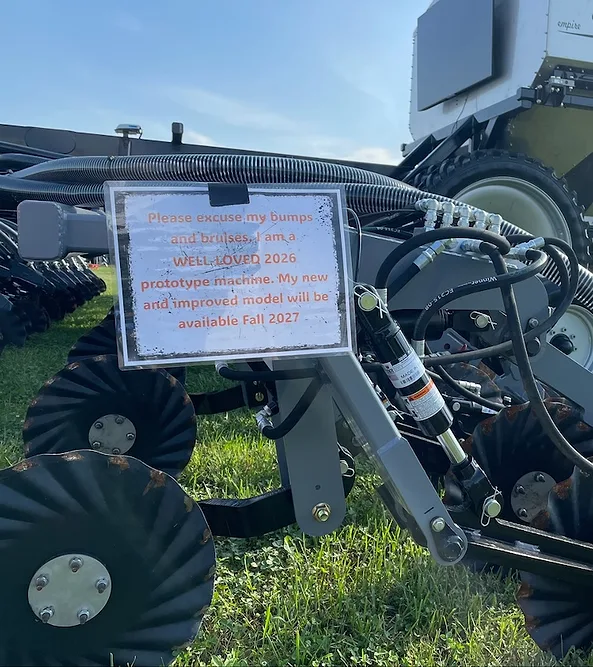
With those struggles in mind, Lynx designed the new Empire 24-row toolbar for high residue corn and 20-inch rows. The prototype made its debut at the Farm Progress Show, and Adkins details some of the key features in the video above.
4. Maximizing Inputs
No-Till Legend Marion Calmer started using an Unverferth Raptor strip-till unit to get more bang for his buck with fertilizer, specifically phosphorus (P) and potassium (K).
“We need to put the fertilizer back from where we took it,” Calmer says. “Over time, corn plants take those nutrients from the 5-8- and 9-12-inch levels and suck them out of there, but we’re not putting them back (when broadcasting with no-till). That’s what we’re doing with the strip-till bar. With the Raptor, I can change the depth of where I want to place the fertilizer.”
Some new fertilizer options took center stage in the Agronomy Zone, a cool new feature at the show this year. The 6-acre research plot gives crop input suppliers a space to showcase the benefits of their products in the field. I met up with Craig Dick from Phospholutions for an up-close at the RhizoSorb trials, which you can check out in the video below.
“Across nearly 200 corn trials, we averaged a 1.5% yield increase with 10% cost-per-acre savings,” Dick says. “Most growers can enjoy around a 20-dollar ROI by switching to RhizoSorb. With today’s phosphate prices, every little bit helps.”
5. Economical Options
Lenox, Iowa-based Dalton AG debuted a new strip-till machine, one that appears to give growers a more affordable entry point to the practice. The RTZ Strata Series toolbar is a more economically minded machine, says Andy Brammer, Dalton Ag sales manager.
“A concept of simpler strip-till — a very modular row unit where you can add row cleaners, baskets, change the sealers if you want,” Brammer says. “There are several configurations available, so you’re not married to one setup.”
RTZ Strata Series test units are running in fields this fall. Brammer says some should be commercially available this spring, with full production scheduled ahead of Fall 2027.
Stay tuned for more Strip-Till Farmer coverage from the Farm Progress Show in the coming days. And for some key agronomic, soil health and cover crop insights from across the show, check out the latest episode of Conservation Ag Update below!