
.webp?t=1781029343&width=1000)
Takeaways
- Growers are going into fall harvest with diesel fuel prices topping $6 per gallon.
- No-till leads to big fuel savings compared to intensive tillage systems.
- Reduced domestic oil inventories will lead to continued high diesel prices in 2027.
When paying for high-priced diesel for fall harvest, no-tillers are in the same boat as neighbors still using intensive tillage.
While nobody likes diesel prices that have soared to over $6 a gallon in recent weeks, no-tillers are definitely coming out ahead when you look at fuel needs for an entire cropping year.
Sure, they need a limited amount of fuel to seed cover crops this fall, but most no-tillers won’t be putting down anhydrous ammonia or doing tillage. And when spring rolls around, they’ll be saving fuel-consuming spring tillage trips being done by “tillage-hungry” cash crop producers.
Big No-Till Fuel Savings
Relying on data gathered over a number of years, the No-Till Farmer editors have compared fuel needs for conventional tillage, minimum tillage and no-tillage systems. Besides tillage and planting, our comparison also included harvest and two trips with a sprayer.
The data indicates conventional tillage requires 8.09 gallons per acre of diesel fuel compared to 5.6 gallons for minimum tillage and only 3.93 gallons for no-till.
Based on a 2,175-acre operation, we calculated fuel needs for three systems. Our calculations showed 8,548 gallons of diesel fuel for no-till, 12,180 gallons for minimum tillage and 17,596 gallons for growers still doing conventional tillage.
With an early September diesel price of $5.96 per gallon, this adds up to yearly fuel costs of $50,946 for no-tillers, $72,593 for growers using minimum tillage and an astounding $104,872 for growers doing conventional tillage.
The fuel savings between conventional tillage and no-tillage in a 2,175-acre operation favor no-till by $24.80 per acre less cost. With minimum tillage, no-till comes out ahead with a fuel savings of $9.95 per acre. This amounts to an extra $53,926 in higher yearly fuel bill for folks still doing extensive tillage rather than no-tilling.
Fuel-Hungry Harvesting Equipment
Skyrocketing diesel costs are threatening to squeeze farm profits even further this fall. With the average price of U.S. diesel reaching an all-time high of $5.94 a gallon in early September, this is a 64% increase from just one year earlier.
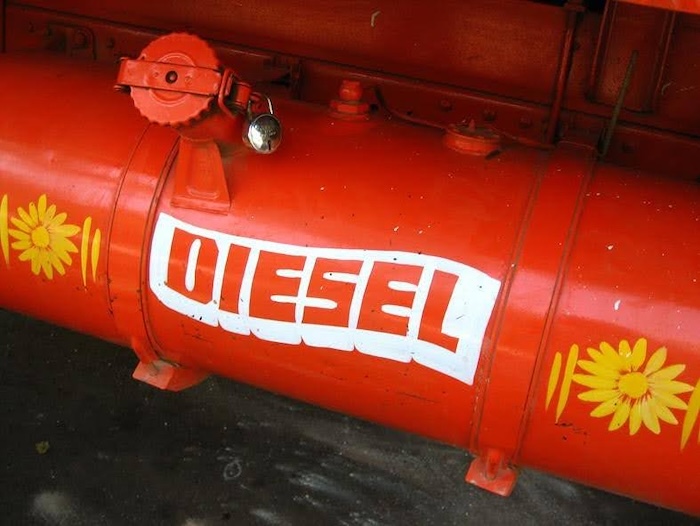
Maybe — just maybe — high diesel prices will convince more growers to shift to no-till in 2027. Source: Meena Kadri/Wikimedia Commons
Renewed Middle East military attacks between Iran and the U.S. and the resulting volatility in oil prices make it tough to use futures contracts to hedge against higher fuel costs. It’s extremely difficult with crude oil prices recently breaking the $107 per barrel barrier, wrote Ryan Hanrahan in a recent University of Illinois farmdoc report.
In this report, AgroLatam’s Emily Trask added that fuel is one of the most visible farm expenses. However, the actual economic impact extends much further.
“Diesel is embedded in fertilizer delivery, grain hauling, livestock transportation, custom harvesting, machinery services and nearly every stage of agricultural logistics,” she says.
“When diesel prices rise, farmers can pay twice: first through their own equipment and again through higher freight and supplier charges. That multiplier effect can raise total input costs even for operations that have already contracted or hedged part of their on-farm fuel requirements.”
“When diesel prices rise, farmers can end up paying twice…”
No Relief Coming in 2027
To make matters worse, the U.S. Energy Department in early September sharply raised its forecast for U.S. diesel prices next year as reduced global supplies keep domestic inventories unusually low.
Diesel fuel inventories are expected to dip below 100 million barrels for the first time since 2003, according to the recently released Energy Information Administration’s Short-Term Energy Outlook.
The Middle East conflict, thwarting oil and petroleum product supplies and Ukraine’s drone campaign targeting Russian refineries led to the recent rise and higher projection for 2027 diesel prices.
The latest Energy Information Administration outlook expects retail diesel to average $4.40 a gallon in 2027, up 33 cents, or 8.2%, from its previous forecast of $4.07 per gallon