Strip-Till Takeaways
- Herbicide prices are at historic lows, giving farmers the opportunity to increase herbicide rates and establish clean fields for the future.
- Consider spraying pre-emergent herbicides in the fall, rather than spring, if it works with your climate. This gives the herbicides enough moisture to work 100% by the spring.
- Use several effective modes of action and residual herbicides for the best weed control.
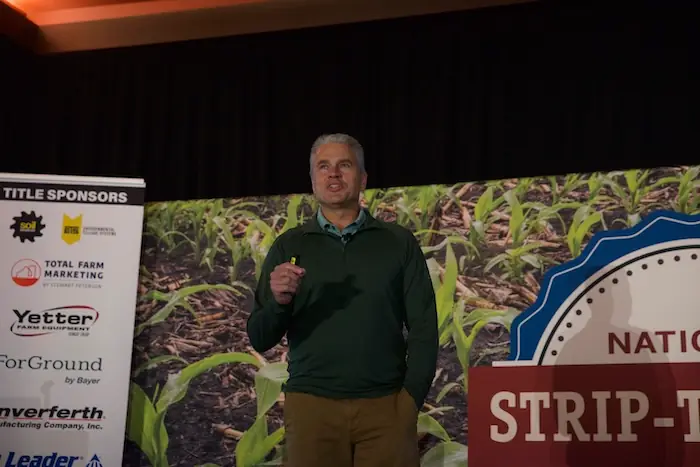
Brian Hefty, strip-tiller and longtime host of the AgPhD agronomy show, believes weed problems are worse now than they were nearly three decades ago when he started his agronomy show.
“As I drive through the country, I see a lot of weeds, which frustrates me,” Hefty says. “We’ve been doing our television show for more than 28 years now, and we have a segment called Weed of the Week. You would think by now we got all these stupid weeds under control, but I think it’s worse than 28 years ago.”
The good news is many herbicide prices are already at historic lows, according to Hefty, and others are decreasing in price. Hefty says BASF Zidua and generic pyroxasulfone, Zidua’s active ingredient, are likely to be half price or less in 2027. Bayer Harness, Corteva Surpass and other Group 15 herbicides could be down 30% or more in the coming year. BASF Liberty and generic glufosinate will continue coming down in price as well.
There’s also a new pre-emergent herbicide with a different mode of action available as of July 2026. Bayer received labeling for Convintro, a pre-emerge herbicide for waterhemp that can be used in corn and soybeans. Diflufenican, the active ingredient and a Group 12 mode of action, gives strip-tillers a different mode of action to control waterhemp, palm, and pigweed.
Hefty also believes dicamba will continue to be labeled in soybeans on Syngenta XtendFlex beans, providing another option for weed control. At the same time, BASF’s Status and Sharpen are going off patent in the next few months, clearing the path for generics. Hefty says he expects a decrease in price for both in 2027 and a much lower price in 2028.
“Now, because they’re coming way down in price, I don’t want you to just say, ‘Great, I saved a bunch of money,’” Hefty says. “What I want you to do is increase your rates and use more of these things, so we actually kill the weeds in the future.”
Multiple Modes of Action
Hefty farms 4,000 acres in Baltic, S.D., most of which are strip-tilled. When he switched some acres to strip-till and no-till from conventional tillage, the weeds changed. Marestail, dandelions and other winter annuals started appearing, which led to an adjustment in his herbicide applications.
“I spray most of the stuff that people talk about spraying in the spring — I just do it in the late fall,” Hefty says. “In South Dakota, the ground is frozen for 5 months out of the year. I spray within 2-4 weeks of the ground freezing, and it works amazingly well because I know I’m going to get snow and some rain before spring.”
His keys to success are using full rates of the herbicides and planting early. He also avoids atrazine because it could leach before the weeds use it up. Hefty says his fields are perfectly clean, while other farmers who applied the same herbicide program in the spring will still have weedy fields.
“Don’t listen to the people who tell you that you only need ½ inch of rain to activate the herbicide,” Hefty says. “That’s to activate it, not make it work 100%. You probably need 2-3 inches of rain to make it work 100%.”
Hefty will tell his crew to shut down the combines if the conditions are right to spray during harvest. He’ll use 1 quart of Banvel instead of the 1 pint in-crop rate to eliminate marestail, dandelions and winter annuals.
“What I’ve found is I don’t even need a spring burndown,” Hefty says. “It doesn’t fit in every geography because not every geography has winter like I do, but I spray everything right before freeze up, and then in the spring, I plant as the frost is coming out of the ground. We have clean fields, and I don’t spend any more money. It’s awesome, and I have the work done."
Controlling Kochia, Pigweed
Kochia is the most common weed in Hefty’s region. It’s difficult to control because it survives drought and saline soil.
Hefty’s strategies for controlling kochia and pigweed in any crop starts with using several effective modes of action and residual herbicides. In corn, Hefty recommends applying a full rate of Zidua pre-plant because that Group 15 lasts the longest. A full rate of Harness could be used instead in dry climates.
“Which one you’re going to pick depends on your geography, but those two are the best on pigweed and kochia,” Hefty says. “Plus, throw in 2-3 ounces of Sharpen. Those are the best products, and they’re all coming down in price.”
A tank mix is the best bet for controlling weeds in post-emergence corn, according to Hefty. He recommends 5 ounces of Status, 1.5-3 ounces of Callisto, 0.25-0.5 pounds of atrazine, 30 ounces of Roundup PowerMAX 3 and potentially a half rate of Harness or Zidua for additional residual control.
“Is it easier to kill pigweed and kochia in corn or soybeans?” Hefty asks. “Corn. So we have to have 100% control in corn. Not 90%, not 95%. We need perfect control in corn. Otherwise, it's going to be a nightmare when you go to soybeans.”
Adding plant growth hormones makes some of the herbicides safer. Hefty’s company makes MegaGro L, a patented safener for glyphosate that also safens dicamba. He will add 2 ounces of MegaGro to the post-emergence herbicide tank mix.
To control pigweed and kochia in soybeans, Hefty recommends using a yellow herbicide, which would be BASF’s Prowl for strip-tillers. Combine the yellow with metribuzin and FMC Authority/Spartan or Valent’s Valor. At early post-emergence, apply Zidua or Bayer Warrant, along with Syngenta Flexstar. If necessary, Enlist One, BASF Liberty or generic dicamba could be added at this time to burn down other weeds that Flexstar won’t control.
Make Liberty Work
Hefty says there are plenty of options for the second post-emergence pass, including Liberty, dicamba, Enlist One, and Roundup.
“Let me tell you how to make Liberty work great,” Hefty says. “I don’t care if it’s generic or name brand. It doesn’t make any difference. What does make a difference is no. 1, you need heat plus humidity. It would be great if it was a sunny day as well, but if I add up my temperature plus my humidity and it’s 150 points or more when I’m spraying, usually Liberty works fantastic.”
Liberty kills weeds by overloading the plant with ammonia. The ammonium sulfate helps with that and almost becomes an active ingredient, according to Hefty.
“What we find is if you take the ammonium sulfate out, it’s just like you cut the Liberty rate,” Hefty says. “Use ammonium sulfate. It’s the cheapest thing you could add in there.”
His recommended rate for ammonium sulfate is a minimum of 3 pounds per acre and a maximum of 5 pounds per acre as an adjuvant with Liberty.
As a contact herbicide, Liberty needs to be sprayed when the weeds are less than 4 inches tall and before the crop canopy is dense in order to get good coverage.
“When I have a pigweed or kochia plant that’s 4-6 inches tall, I have 20-30 growing points on there,” Hefty says. “I have to kill every single growing point or that weed’s not dead. If I don’t, it branches out and keeps right on growing."
Spraying smaller droplets with high pressure and 20 gallons or more of water per acre will help with coverage. So will slowing down — meaning 10 miles per hour or less — to kick up less dust.
“If some of those things are against you, you’re going to have to throw in something else with Liberty, like Enlist One, Cobra or Roundup,” Hefty says. “But in a lot of cases, I spray nothing but Liberty on my farm post-emerge and kill every single weed there is.”