While strip-till may be the ideal blend of a perfect seedbed and soil conservation practices, it also creates the right environment for weeds that plague both tilled and no-tilled fields.
For many strip-tillers, the most challenging weeds to manage within the strip are waterhemp, ragweed, grasses and other weeds that produce small seeds because the seeds rise to the surface and easily germinate within the tilled root zone. At the same time, marestail, horseweed, shepherd’s purse and dandelions thrive in undisturbed soil between the strips.
“Uncontrolled weeds are future expenses,” says Daniel H. Smith, nutrient and pest management program manager for the Univ. of Wisconsin-Madison. “Every time you see a waterhemp plant, that’s weed seeds that you’re going to have to manage for 5-6 years, regardless of your tillage system.”
Since 2018, Smith has been researching weed control at the university’s farms in Lancaster and Arlington, Wis., and working with growers in Wisconsin’s Rock, Walworth and Jefferson counties. After years of experiments using a variety of tillage types and weed control practices, Smith recommends taking a systems approach to weed control.
“It starts with a plan,” Smith says. “Whether you’re going to crush herbicide resistance with cover crops or a mix of herbicides, write down your plan and have some contingencies figured into your budget.”
“Uncontrolled weeds are future expenses…”
Based on Smith’s findings and other studies completed by his colleagues at UW-Madison, he offers the following advice for dealing with 3 challenging weed species in strip-till.
• Canada Thistle. Canada thistle is a perennial that spreads via seeds and roots. Smith says it thrives in strip-till systems because the weed is cut off with the tillage pass in the strip.
“When you cut it off, you make it angry,” Smith says. “Once it’s angry, it doesn’t control well. Glyphosate won’t kill it because it’s too resilient, and it has a lot of root reserves.”
To control thistle, Smith recommends applying a translocating herbicide, such as glyphosate or glufosinate, 2 or more months after the plant was disturbed. However, strip-tillers should expect to battle it for a few years before it’s completely controlled.
• Field Horsetail. Field horsetail, a perennial weed that spreads via rhizomes, looks like a small Christmas tree in its first year. In its reproductive phase, it looks like bamboo and may start to affect yield at this point. If it’s not controlled, the field horsetail will continue to spread through the field and take over like a grass. Smith says there are quite a few herbicide options for field horsetail, but they have to be applied at the right time to work. The lack of surface area on horsetail also makes it a challenge to control, so Smith says application technology is very important to eradicate it.
• Pigweeds. Palmer amaranth and waterhemp are two common pigweeds plaguing fields. Smith says a very healthy Palmer amaranth or waterhemp plant can produce 250,000 seeds, and the plant retains 99% of its seeds until it’s combined.
Species identification matters when it comes to controlling pigweed (see sidebar). The two pigweeds of greatest concern are Palmer amaranth and waterhemp because these species have herbicide resistance.
“If you didn’t think you had Palmer amaranth and see a plant with a mature seed head, this is going to be a major shift for you,” Smith says. “You’re going to have problems for a few years to really control it.”
Identifying Pigweeds
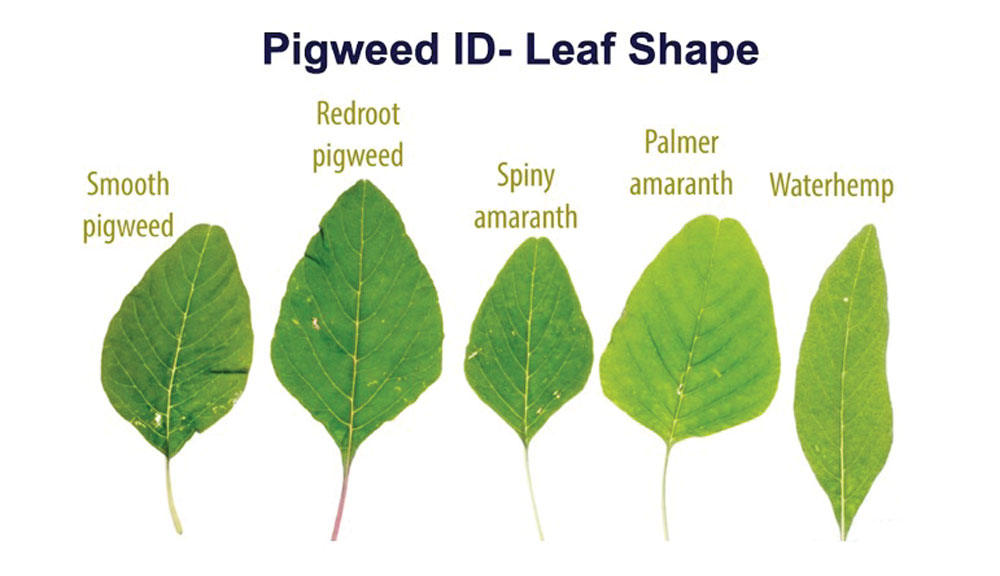
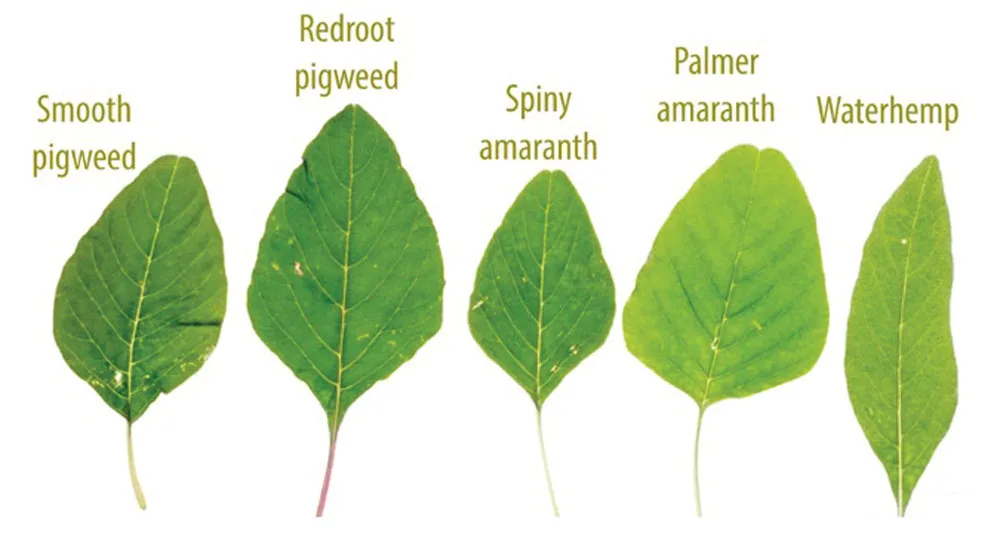
The best method to control pigweeds depends on the species. Smith says inspect the leaves, stems, seed heads and petioles — where the leaf connects to the stem of the plant — to identify the species.
Smooth pigweed isn’t as common as redroot pigweed in the upper Midwest. Spiny amaranth has thorns, while Palmer amaranth has more of a lobed leaf, which can lead to confusion with redroot pigweed. Waterhemp has a leaf shaped like a knife blade. Smooth pigweed and redroot pigweed have hair on the stems of the plant, making them easy to identify.
“These are pigweeds that we can manage pretty easily with many of the tools in our toolbox,” Smith says. “If the stem doesn’t have hair on it, it’s spiny amaranth, Palmer amaranth or waterhemp, with the latter being the two that we really want to identify because there are fewer options to manage them with all the herbicide resistance that we see in those.”
To identify these two problem weeds, fold the petiole over the leaf. If it’s longer than the leaf, it’s Palmer amaranth. If it has a short petiole and a blade-shaped leaf, it’s waterhemp.
Finally, measuring the seed head can also indicate the pigweed species. The seed head on Palmer amaranth is 1-2 feet long when fully mature, whereas waterhemp has a much smaller seed head.
If Palmer amaranth gets too big, it’s hard to get good coverage when spraying, and the plant can survive the herbicide pass. This leads to herbicide resistance, which isn’t solved with respraying.
“If you make a respray application, think about changing what you’re doing on that second pass,” Smith says. “The economics might be more complicated if the spray is free, but try not to spray the field with the same thing.”
Designing a Herbicide Program
Smith says using the same site of action groups every year creates challenges for herbicide resistance. The site of action is where the herbicide works, and it’s listed on the front of the herbicide label in a number format.
“If we’re buying a generic product one year and a brand-name product the next, check the active ingredient and site of action,” Smith says. “That way we’re designing a holistic herbicide program.”
“Cover crops help crush herbicide-resistant weeds…”
When designing a herbicide program, take into consideration the most prevalent early season and troublesome weeds as well as perennial and winter annual weeds. Smith says strip-tillers should start with a pre-emergence herbicide pass that targets small-seeded grasses and broadleaf weeds early in the season. He also recommends that farmers look at small-plot herbicide evaluation studies conducted by the universities in their state and pest control manuals that rate products’ level of control for troublesome weeds. All of the information is free.
“The entire goal of those programs is to say what percentage of control is achieved by what herbicide,” Smith says. “You can use it to make decisions at home when picking products.”
Controlling with Covers
Cover crops are another effective tool for fighting herbicide-resistant weeds. They add a layer of complexity, but Smith says they’re a key part of a systems-based approach to weed control.
“Our first purpose within the system is to find a goal for the cover crop,” Smith says. “If we’re going after weed suppression and erosion control, small grains do quite well. They help crush herbicide-resistant weeds with a nice biomass and mulch layer.”
Smith says winter cereal rye lends well to this goal due to its ability to overwinter and produce a large amount of biomass. It begins growing at 40 degrees F, giving it about 10 extra degrees of growth compared to corn. That equates to about a month of extra growth in most settings, according to Smith.
“Think about maximizing early spring biomass,” Smith says. “Planting dates are inherently important for yield, and you’re going to want to find that middle point of maximizing yield and weed control for the best results possible.”
Based on research from Rodrigo Werle, weed scientist at UW-Madison, Smith recommends aiming for 4,600 pounds of cereal rye biomass per acre on the field. Rye will typically be knee to waist high to produce this amount of biomass. He says 4,600 pounds will be hard to achieve with corn, but it works with soybeans.
Your Combine’s Role in Weed Control
Your combine may be preventing you from keeping your fields clean. Daniel H. Smith, nutrient and pest management program manager for the Univ. of Wisconsin-Madison, and his colleagues asked Wisconsin producers to send in samples from their combines to assess the combine’s impact on weed seed management.
“We grew those samples in the greenhouse, and what we found was most combines are going to contain weed seeds,” Smith says.
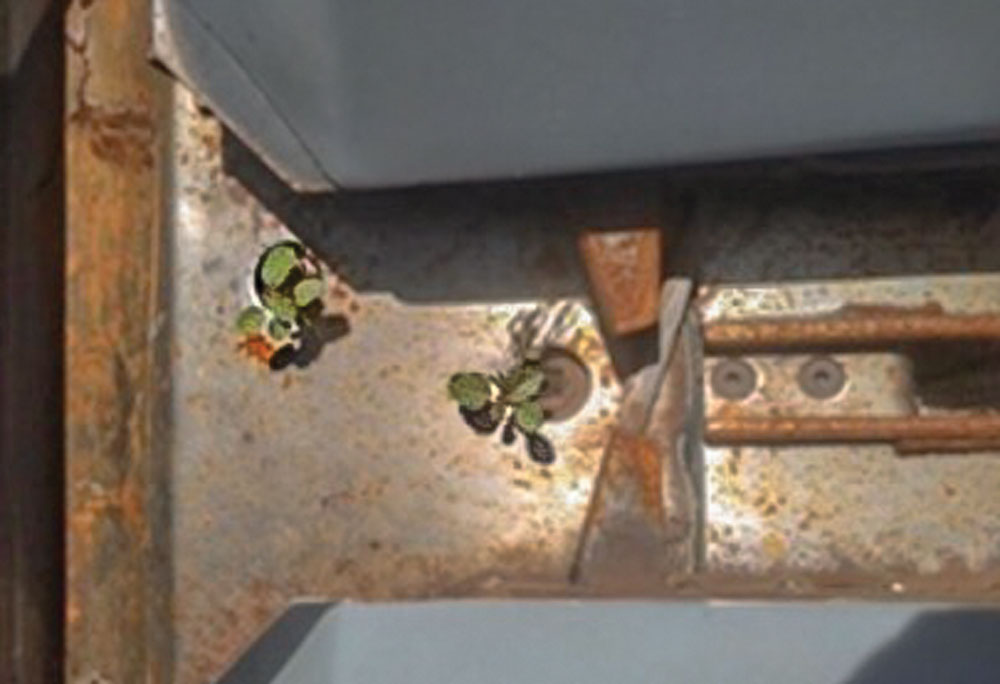
UNPLEASANT SURPRISE. Palmer amaranth grows out of a corn head that sat for a year. Combines can inadvertently spread weeds if not cleaned properly.
Since then, Smith has hosted 19 combine cleaning clinics, and of the 19, only 2 of the combines did not contain weed seeds.
“The only two were the brand-new ones,” Smith says. “Weed seeds are in every combine.”
The solution is simple but takes time away from harvest. Smith suggests keeping a battery-powered leaf blower or gas-powered air compressor in the cab and using it to blow off the stripper plates of the corn head or the sickle bar on the soybean head before moving to the next field. Next, clean out the feeder house and dump out the rock trap. Be sure to wear goggles and a respirator while cleaning.
“When we sampled combines, most of the weed seeds were hiding in the head and feeder house,” Smith says. “We don’t have to get every piece of biomass off that combine, but if we can shut down for about 30 minutes before we move to a custom field or from a weedy field to a clean field, it is going to pay off.”
“Spring termination is really important when we’re thinking about the system,” Smith says. “We could plant soybeans into the rye, let it grow a little longer and terminate it later. Maximizing the amount of biomass reduces the waterhemp population by 50% and controls most weeds in soybeans.”
Smith says termination timing is critical in a system that includes cover crops. Nighttime temperatures above 50 degrees F and daytime temperatures above 60 degrees F for 3 days before and after application are necessary for glyphosate to translocate, according to Smith.
While some farmers are concerned about covers impeding the pre-emergence herbicide pass, Smith says his research shows that the herbicide will still make it through the cover crop residue to the soil surface.
Crushing Herbicide-Resistant Weeds with Cover Crops
In his presentation from the National Strip-Tillage Conference, Daniel H. Smith, nutrient and pest management program manager for the Univ. of Wisconsin-Madison, shares data examining the impact of various tillage types and cover crop termination dates on weed suppression. Click here to see the data. The NSTC Replays are sponsored by HUMA.
“Where we had a pre, even with poor coverage, we only had 1-3 waterhemp plants in a 3-by-3-foot area, compared to 9 plants without the pre,” Smith says. “Even though we’re tying up a little of that herbicide initially, it’s eventually making it down to the soil surface through rainfall or naturally.”
Smith says his strip studies have shown that even half the rate of glyphosate will kill rye when it’s actively growing, regardless of the height of the rye.
“It’s very easy to terminate rye when it’s actively growing,” Smith says. “The take-home message is going to be a full burndown rate for cases where we’re pushing the boundaries with cover crops, but we still need to be scouting the fields for weeds that might have made it through. The 1-foot-tall ragweed is going to require a growth regulator and some extra stuff in the tank.”