By Rodman Lott, as interviewed by Martha Mintz
Our heavy clay soils are among our greatest farm management challenges. They’re also vaults holding exceptionally valuable production rewards. We’ve just got to cut the right key — or more accurately, keys — to gain entrance. I say cut because I’ve yet to find a practice that’s plug and play in farming.
Every farm is different. Our family knows this better than most as we’ve farmed in Pennsylvania, Florida and New York. Urban sprawl moved the farm from the Philadelphia area to Florida in 1970. The move didn’t suit, so my parents, Ralph and Shirley, headed back north in 1980 settling in Seneca, N.Y., where today we farm together with my parents and brother, Ben.
The first years in New York, Dad tried to work the ground as he had in Pennsylvania and Florida. Tillage in slightly wet conditions, which were no problem on his previous farms, formed what he described as softballs of clay that baked in the sun and wouldn’t break down all season.
His frustrations with the heavy clay soil texture led him to adopting the Rawson zone tillage system and starting our journey to no-till, bio strip-till, cover crops, intercropping, soil biology and building functional, sustainable farming systems.
Check The Specs...
NAME: Rodman Lott
FARM NAME: Rodman Lott and Son Farms
LOCATION: Seneca Falls, N.Y.
ACRES: 3,200
CROPS: Corn, soybeans, wheat and pumpkins
PRIMARY SOIL TYPE: Clay
ANNUAL PRECIPITATION: 40 inches
LIVESTOCK: Small beef herd
We’ve spent decades tinkering with equipment, adjusting management strategies and trialing products. The goal is to protect and build the soil to grow healthy plants that are better able to withstand disease and other threats. Our experience tells us a functioning system requires fewer synthetic inputs and expensive interventions, which keeps the farm a functioning and sustainable system, too.
No Vacancy
Living roots must constantly occupy our soils. At least that’s the goal. Looking back on our journey from full tillage to no-till and beyond, we now consider cover crops the most important management practice for our soils.
Throughout the years we’ve put a lot of effort into developing establishment methods to make this practice work in our short northern growing season.
Producers in our area often opt to plant short-season soybeans, allowing them to double-crop wheat or seed cover crops. We didn’t want to take the yield loss that would occur by switching from full-season to short-season soybean varieties. We did want to use cover crops, though, so we had to figure out how to get a cover crop growing in our standing crops.
First, we tried aerial broadcasting a wheat cover crop into standing soybeans. The effort was somewhat successful, but coverage was spotty. Next, we used a BBI fertilizer spreader to broadcast seed following soybean harvest. We liked the timing of the plane application and the coverage of the ground spreader. Our search to find the perfect combination of the two practices led us to European 3-point mounted spreaders with impressively wide spreading capability of more than 160 feet.
We purchased a Kuhn Axis 50.2 spreader — the biggest 3-point spreader made — and used it to broadcast cover crops into standing soybeans. As anticipated, it provided the timing of the aerial application and the coverage of the ground rig. The combined results were excellent. We used the system for 7 years to seed cover crops into soybeans, building the program to the point of cover cropping all soybean acres.
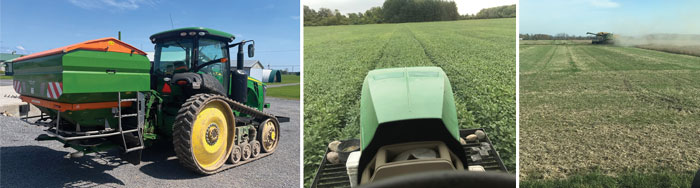
A 3-point spreader and tramlines allow the Lotts to seed wheat or cereal rye cover crops into standing soybean crops. They’ve found it’s ideal to plant when soybeans are still green to avoid shattering pods. At soybean harvest, the small grains are well established and provide a beautiful green, soil-securing cover. Some acres are seeded at higher rates, resulting in a grain crop that can be harvested. Image: Rodman Lott
Eventually we switched to an Amazone Profis ZA-TS 4200 3-point spreader, but both units provided excellent results. The Amazone has swath control, and it can change spinner speed to spread to different distances. You can also adjust the drop point to spread in different patterns. It’s amazing. We’re really thrilled with the coverage we get and think seeding cover crops into a growing soybean crop is one of the best things we can do for our soil structure and soil biology.
Once we determined that this seeding strategy worked, we invested in a tramline kit from Tram-Rite Tramlines. Tramlines served to control traffic, protecting our highly compaction-prone soils and limiting crop damage. We use the controller on our John Deere 1790 no-till soybean planter with 15-inch row spacing, allowing us to shut off row units as needed to create tramlines customized to our equipment. We’re able to run our sprayer and cover crop seeder on 100-foot swaths without trampling any crop. We also follow the tramlines as much as possible with harvest operations to further limit compaction.
Bonus Harvest
Wheat was our go-to cover crop in this system, though we have also grown cereal rye and mixes. But the wheat cover crop was standing so well that we decided we should try to harvest some of the cover crop for grain.
Seeded as a cover crop, we used as little as 60 pounds of wheat per acre. We upped that rate to 150 pounds per acre with the intent to harvest.
It worked well, and we’ve been able to achieve county average yields of 60-80 bushels per acre consistently. Last year, we experimented by seeding all wheat at 80-100 pounds per acre. It proved to be too light of a rate to produce a crop for harvest, so we bumped the rate back up to 150 pounds this year.
We seed around 400 acres of wheat for harvest into standing soybeans each year. It looks amazing at soybean harvest. We cut away the crop to reveal a carpet of green as good as any lawn. On a good year, it will be 2-6 inches high. We have clipped the top of taller wheat with the combine a bit, but it hasn’t caused any issues.
“Cover crops are the most important management practice for our soils…”
We’ve had success with a wide seeding window. Ideally, we prefer to seed the wheat in mid-September. The spreader is mounted on a tracked tractor with low clearance. When we get late seeding the wheat, the tractor bottom can shatter pods. At the start, we figured we had to wait until the soybean leaves turned yellow to seed, but we found that isn’t the case. The best wheat crop we’ve harvested in this system yielded 85-90 bushels per acre and was seeded into a completely green and growing soybean crop.
Slugs have been a challenge to wheat and soybeans at times. A dense soybean canopy creates a nice environment for slugs. When we have bare spots in the wheat, scouting reveals slugs have eaten the seed germ. Wet springs can also spell trouble for soybeans seeded into cover crop residue. Our crop was slug bait this year!
Moisture has also thrown a monkey wrench into our plans when we experimented with a cover crop of spring oats and radishes seeded into short-season soybeans. Rain delayed harvest, and the fast-growing oats were over 1 foot tall when we were finally able to get in the field. Ben said trying to run green oats through the combine was a horrible experience that he had no desire to repeat.
We use a John Deere S780 combine with a RD40F 40-foot draper flex head. It works great when we use winter grains, such as wheat or cereal rye, as cover crops because they’re slow growing and won’t get much taller than 6 inches. The spring oats were just a bad idea because they grow aggressively, which set us up for disaster on a year when we can’t harvest in a timely fashion. Over the years, we’ve mixed in different broadleaves like rapeseed, clovers and vetch with no problems.
Bio Strip-Till
The 400 acres of wheat we seed for harvest give us the opportunity to work with more cover crop options. A longer growing window allows us to take advantage of diverse mixes for maximum benefits. In this system, we’re experimenting with bio strip-till.
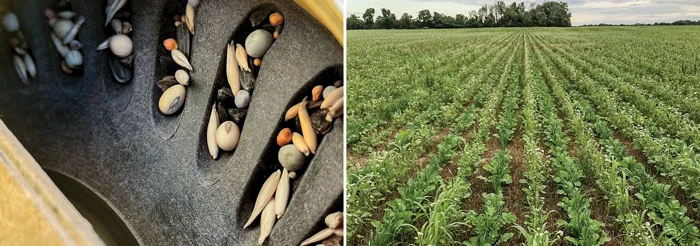
Essentially, we plant a mix of cover crop species that will winter kill in the row where corn will be planted. Row centers are seeded to crops that will overwinter and keep the green relay of living plants moving forward.
To make the strips, we purchased a special SeedRight vacuum seed plate for our corn planter. It has large seed cells to accommodate seed mixes that include large and small seeds.
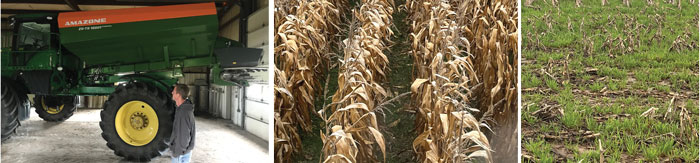
A borrowed spreader mounted on a high-clearance machine and a drought-stressed, short corn crop gave the Lotts the opportunity to experiment with seeding cereal rye into standing corn. The success of the experiment prompted them to purchase an even higher clearance Hagie chassis fitted with a Fennig air dry fertilizer applicator system to accurately broadcast covers between individual rows in tall, healthy corn. Image: Rodman Lott
The first year, I used the corn planter to plant a mix, then shifted 15 inches over using RTK guidance and made a second pass to seed the mix I wanted between the corn rows. In the row, I seed species like oats, buckwheat and radish. Between rows, I also add species like red, Balansa or crimson clover. I like to include a large plant like sunflowers or sorghum sudan to add residue between the rows. The idea is to seed a variety of brassicas, grasses, broadleafs and legumes so I can get one of each type that winter kills and one that overwinters for maximum soil benefit.
I don’t stick to set species, and I keep rates low to control cost. The most I want to spend on a cover crop mix is $30-35. Many of the species are only seeded at rates of 1 pound per acre each. Controlling cost has also driven us to explore other seeding methods.
2 passes with the planter worked great, but it added up. To cut costs the second year, I broadcasted the mix on wheat acres instead of doing the bio strip-till. The next year, I fitted a Valmar air seeder on a strip-till unit to blow seed between the rows. The in-row mix was added to the fertilizer in the main box, and the mid-row mix was surface applied. It didn’t work. The seed was too deep in the row and lacked adequate moisture to germinate between the row.
This year, I put the SeedRight plates on every other row of my Central Commodity System (CCS) John Deere soybean planter set up for 15-inch-wide rows. On the remaining rows, I used high-rate sorghum plates. I blocked flow from the CCS hopper holding the between-row mix to the tubes feeding the sorghum plates. I then hand-filled the 3-pound hoppers on those individual row units with buckwheat and radish. I could seed 10 acres per fill. It wasn’t ideal, but it was one way to get results without the wear and tear of having to run the corn planter twice.
Covering Corn
Clearance kept us from seeding cover crops in corn. We’ve tried seeding cereal rye after corn harvest, but nothing would grow until spring. The reduced benefit didn’t justify the cost or effort.
When 2022 served up dry weather and subsequently short corn, we saw an opportunity to do some experimenting seeding cover crops into a standing corn crop. We rented a high-clearance spreader from a neighbor — an Amazone spreader fixed on a sprayer chassis. We successfully seeded 100 acres of cereal rye into the corn. It’s only been 1 year, but it seems like it was easier to plant soybeans into the acres where the rye grew.
This year, we’re seeding cereal rye into all our corn. We plan to seed about 100 acres of cereal rye into soybeans to harvest for seed to use in corn. Our corn is better this year, so it might not work as well, but we’ll find out. Cereal rye is seeded into corn in mid-October. The extra month paid off last year in fall growth that should provide more benefit for our soils.
One reason we’re pushing hard to seed cover crops on all our acres, especially cover crops that provide a lot of surface residue, is we’re getting an increasing amount of herbicide-resistant weeds in our area, including marestail and waterhemp. If chemicals are failing, it’s increasingly crucial that we’re able to grow cover crops able to serve as a weed barrier.
“The goal is to grow healthy plants that are better able to withstand disease…”
Initial results are good. There seemed to be less waterhemp pressure in the soybean crop on acres where we were able to establish cereal rye in the preceding corn crop. We’re going to have to dial in a seeding rate for the best overall results. If the cover crop is too heavy, it doesn’t dry out well in the spring. But if it’s too thin, we’re not getting the weed control. The correct balance is in the middle somewhere.
We’re committed to making the practice work. This year, we invested in our own high-clearance system to seed cover crops into corn. We purchased a Hagie high-clearance machine with a Fennig dry applicator that will be used to seed cover crops in corn and soybeans.
Coverage should be better than the 3-point mounted systems. The spreaders worked great, but coverage was always a bit thin on field edges. The new system has drop tubes to accurately spread seed between rows, delivering uniform results throughout the field. The driving reason for the switch, however, is to get the clearance needed to seed in a tall, healthy corn crop.
The high-clearance machine has a 120-foot boom, which will have to be adapted to accommodate the tramlines this year. It’s a challenge because of how the air delivery system works, but I’m a mechanical engineer, so I enjoy this sort of puzzle. We will adjust the tramlines next year to accommodate the Hagie.
Healthy Plants
Regionally we’ve had issues with vomitoxin in wheat and corn. It’s been used as a reason to dock corn prices as a lot of grain corn is used to feed hogs. This led many producers to use fungicides to attempt control. We started running all our corn through a cleaner to bring numbers down so we could pass, but I think we might be able to reduce the toxin by increasing plant health. A healthy plant is more resilient to disease. I’m completely against using fungicide in this situation. We tried it on a few hundred acres with no benefit, and I’m sure it harmed our beneficial fungi.
Advancing Eco Agriculture (AEA) is working with us to do sap analysis on our corn. One potential problem these tests revealed was low levels of copper and manganese. Next year, we’re going to try applying these and other micronutrients to see if it makes a difference.
The past few years, we’ve also been using biological products. That seems to be the natural progression — no-till, cover crops, then biologicals. For our 2023 corn crop, we trialed a 7-23-5 popup and an in-furrow product. We also used AEA's nitrogen (N) stabilizer program for our sidedress N applications.
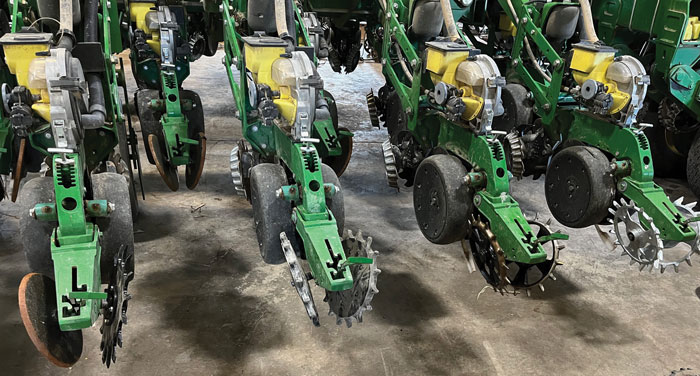
Over the years, the Lotts have gone from having every attachment possible on their planters to stripped-down setups. Here they’re trialing multiple closing units. They like the Schaffert Zipper closing system for closing slots when planting corn into heavy cover crop residue. Image: Rodman Lott
The AEA N stabilizer program is interesting to me because it’s supposed to work as a more natural N stabilizer that won’t harm soil life. I’ve used synthetic N stabilizers in the past, but I learned at the 2023 National No-Tillage Conference that may not be the best option for soil biology. I still want to stabilize my N, though, which is why I’m trying this program.
When corn is shoulder high, I use a self-designed split-tube streaming applicator on my John Deere 4730 self-propelled sprayer to sidedress. I like that the splitters put the N right at the base of the plant. Even when weather is dry, the corn plant will funnel dew to the base of the plant. The resulting moisture helps the N applied there get to the roots even without rain.
The sidedress application delivers 80 pounds of actual N with sulfur, boron, zinc, molybdenum, and HumaCarb to act as the stabilizer. I’ve tried the AEA N stabilizer program in wheat, too. I did a side-by-side trial using our normal chemical N stabilizer, Anvol, on half the field and AEA on the other half. Yields were equal. The AEA program was more expensive, so I cut back on the N rate on those acres. I think if I had been more aggressive with the N, I might have done better. We will continue to experiment, but I’m encouraged by the initial results with the biology-friendly option.
Tech Tactics
Our soils don’t drain well, even with pattern tiling. This has necessitated the use of grass waterways to put an end to the constant battle with washouts. Maintaining the grass waterways has recently become much easier thanks to improved sprayer technology.
Spray operations have been drastically slowed due to having to negotiate the substantial amount of grass waterways. Purchasing the John Deere 4730 with swath control helped, but we found the system never reacted quickly enough. To prevent damaging the waterways, we had to resort to spraying borders around them, again slowing field work.
That changed in 2020 when we purchased a John Deere R4030 sprayer with the ExactApply precision upgrade. It works great. The shutoff is right at each nozzle, so the system reacts nearly instantly and delivers accurate results. Now we can spray at full speed without having to avoid the waterways.
Our soils are still a challenge because they compact so easily. We’ve run a Blu-Jet LandRunner II in-line ripper at 14 inches deep to try to break compaction layers. The clay just collapses back down. Cover crops are helping — we just have to keep working at perfecting the system so they can hold our soils open and work with us.