TAKEAWAYS
- Strip-till can deliver big ROI on poorly drained soils. The biggest obstacle might be winning over your family members and peers who are skeptical of the practice.
- Try strip-tilling a few acres to see what works and what doesn’t before going all in on the practice.
- Enrolling in EQIP or CSP programs, or pooling your money together with a neighbor or family member for new equipment, will help make the entry point to strip-till more affordable.
Westin Arseneau was ready for a change after another frustratingly wet spring in Iroquois County, Ill., in 2019. Especially when he noticed his neighbors were the only farmers in the area planting corn in May that year. The common denominator? They were both strip-tillers.
“They were the only ones who could get in the field to plant in a timely fashion,” Arseneau recalls. “We were like, ‘What’s going on here?’ We were out there with a field cultivator, dragging it through the mud. We knew something had to change.”
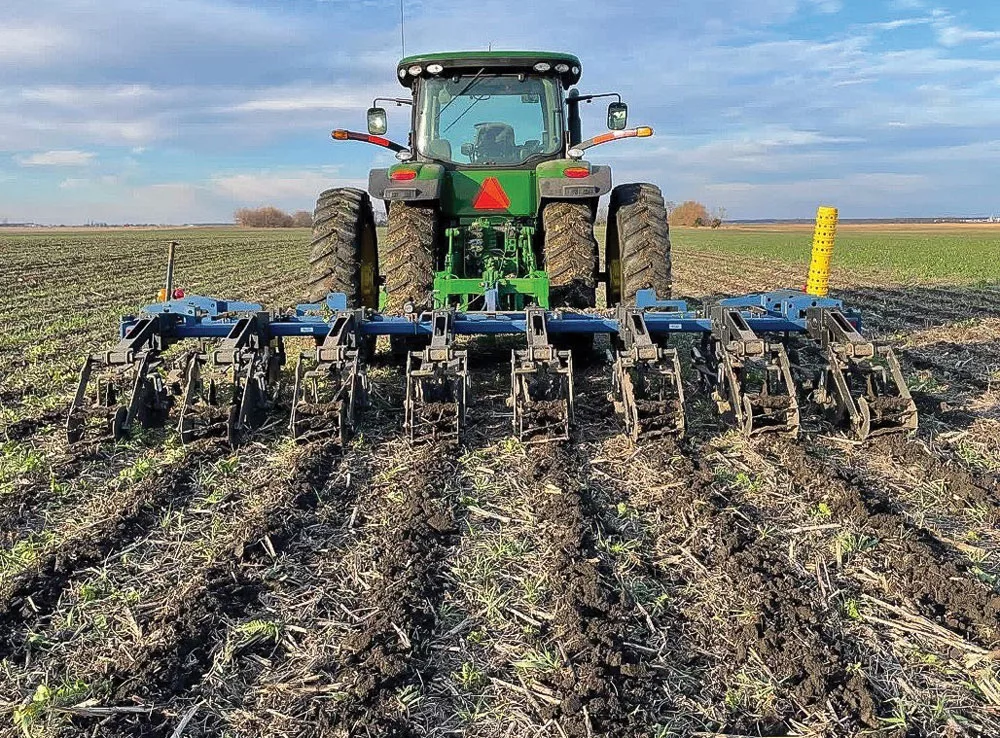
Inspired by his neighbors, Arseneau bought a Blu-Jet 8-row strip-till bar at a local auction and strip-tilled a few hundred acres the following year.
“The planting conditions were beautiful, we loved it,” he says. “We didn’t really have a goal in mind when we started strip-tilling, but we saw that it was working for our neighbors and wanted to give it a try.”
Change of Mindset
The biggest challenge for Arseneau was convincing his dad, Todd, and late grandfather, Bob, that strip-till was the way to go after years of conventional tillage.
“My mind was made up from the beginning,” Arseneau says. “I knew it was going to work, but it took a while for Grandpa to come around. Dad was also skeptical. Once we started doing it, and saw the benefits and yield increases, everyone got on board.”
Logistically, the transition was smooth, Arseneau recalls. The only difference was instead of running a chisel plow in the fall, they were running a strip-till bar. The biggest immediate payoff came on those poorly drained fields that were preventing the Arseneaus from planting early in the spring.
“I learned that you don’t have to have the perfect soils to make strip-till work…”
“We have sandy soils that are tougher to farm,” Arseneau says. “You can’t just throw stuff out there and get record yields. You have to work at it. A lot of our ground is poorly drained and located up against a main drainage ditch. The fields would often flood when it rained. With strip-till, the ground is firmer, and we’re able to plant 2-3 weeks earlier than we could before on some of that poorly drained ground.”
Strip-till also delivers big labor savings for the Arseneaus, who are essentially a 2-man show. Westin makes strips in the fall. When spring rolls around, Todd takes care of corn planting while Westin focuses on soybeans and running the sprayer.
Equipment Upgrade
Arseneau decided it was time to upgrade his strip-till equipment in 2024 after proving the practice worked consistently on his soils. He and his neighbor pooled their money together to buy a Kuhn Krause 16-row Gladiator with a Montag dry fertilizer box attached.
“Our neighbor likes to make his strips in the spring, and we make ours in the fall, so we don’t have to worry about sharing it in season,” Arseneau says. “We have some black sand, but if you go a mile north, it’s completely yellow and white. He doesn’t want to make his strips in the fall because he’s afraid everything will blow away.”
By applying fertilizer directly in the strips now, the Arseneaus can dial back their rates a bit, “which helps a lot, especially with how high fertilizer prices are right now,” Arseneau says.
He likes to make strips in mid-October, right after soybean harvest, but won’t hesitate to wait until December if conditions call for it. Arseneau runs a variable rate mix of potash and DAP with the Gladiator. He’s still tinkering with his nutrient management plan every year.
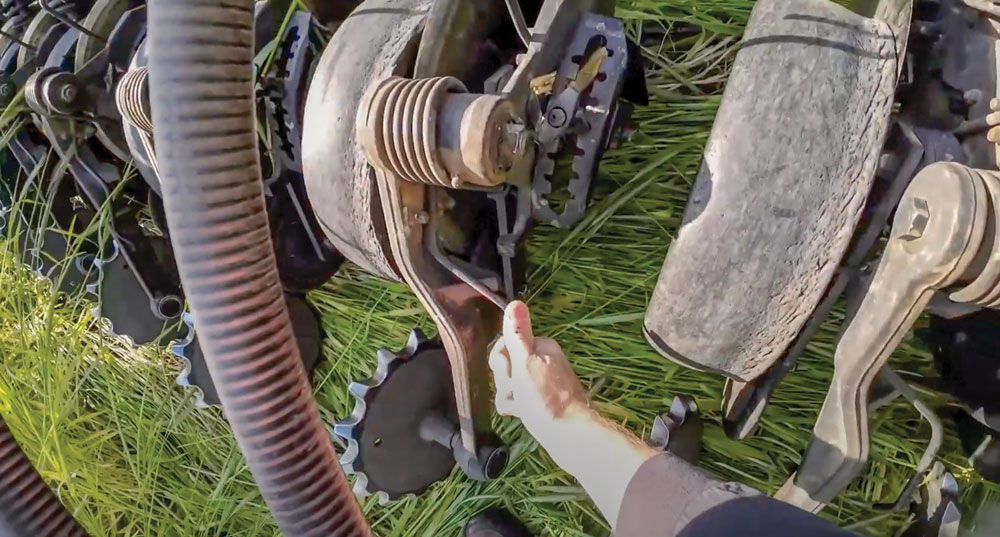
PLANTING GREEN. Arseneau increases the down pressure on his closing wheels to ensure the seed trenches are getting closed while planting soybeans in thick cereal rye. Westin Arseneau
“I usually look at the removal rate from soybeans for a good baseline,” he says. “I’m trying to figure out how I should go about it though because soil tests can vary. Having one tank is a challenge when it comes to figuring out a good system. I’m still working through it.”
Arseneau applies roughly 30 pounds of UAN28 in a 2-by-2-by-2 placement and a 10-34-0 starter fertilizer mix with his John Deere 16-row planter. He Y-drops the rest of his N with a RoGator around V5-V8 and uses yield maps to determine application rates for each field.
“If you treat every acre the same, you’re going to get an average crop,” Arseneau says. “But it pays dividends when you bump up those rates on better areas of the farm. We’re even experimenting with variable rate plant populations now. We’ve had 3 record crops in a row. Before strip-till, we were around 180 bushels per acre. Now we’re well above that.”
Corn-on-Corn & Covers
The Arseneaus run a corn-soybean rotation on most acres. Corn-on-corn has proven to be challenging for them with strip-till, but they haven’t given up on making it work on some fields.
“In the past, we chiseled the corn-on-corn acres because we couldn’t get the Blu-Jet to go through the stalks in the fall,” Arseneau says. “We didn’t have enough clearance. But this year we tried strip-tilling the corn-on-corn acres with the Gladiator in the spring, and that seemed to work much better.”
The Arseneaus have also found success with cover crops. They’ve improved the water infiltration on fields with cereal rye ahead of no-tilled soybeans.
“I have one field that I call my ‘test farm,’ and it’s been 100% no-till and cover crops for 8 years now,” Arseneau says. “If we get a big rain and it starts ponding, the next time you drive by the field, the water is completely gone. That’s a benefit we can visibly see.”
“We’ve had 3 record crops in a row. Before strip-till, we were around 180 bushels per acre. Now we’re well above that…”
Arseneau tried planting green for the first time in 2024, and it helped with weed suppression, even though he wasn’t confident it was going to work at first.
“We had a cold spring, so we just let the rye grow,” Arseneau says. “It was purely by accident that we ended up planting green on 200 acres. The rye was as tall as me. I was terrified until about July when I could see the soybeans poking through. They came up beautiful. We ended up planting green again this year, and it worked well.”
The Arseneaus enrolled in EQIP and CSP plans that will allow them to experiment with a new cover crop mix in 2025 ahead of strip-tilled corn. Arseneau plans on borrowing his neighbor’s vertical tillage tool with a cover crop seeder attached to plant a mix of cereal rye, winter barley, camelina and crimson clover on 80 acres in the fall.
Whether it’s with cover crops or strip-till, Arseneau encourages other farmers to not shy away from making changes, even if people are telling them it won’t work on their soils. If you’re interested in switching to strip-till but not sure it’s right for your operation, give it a try on a few acres and then decide, Arseneau says.
“I was conditioned to believe that you couldn’t no-till or strip-till unless you had good drainage,” he says. “Everyone told me that. I went along with it for a long time until I learned that you don’t have to have the perfect soils. You don’t have to farm in 300-bushel territory to make strip-till work. In our experiences, it seems like it works even better in the marginal stuff.”